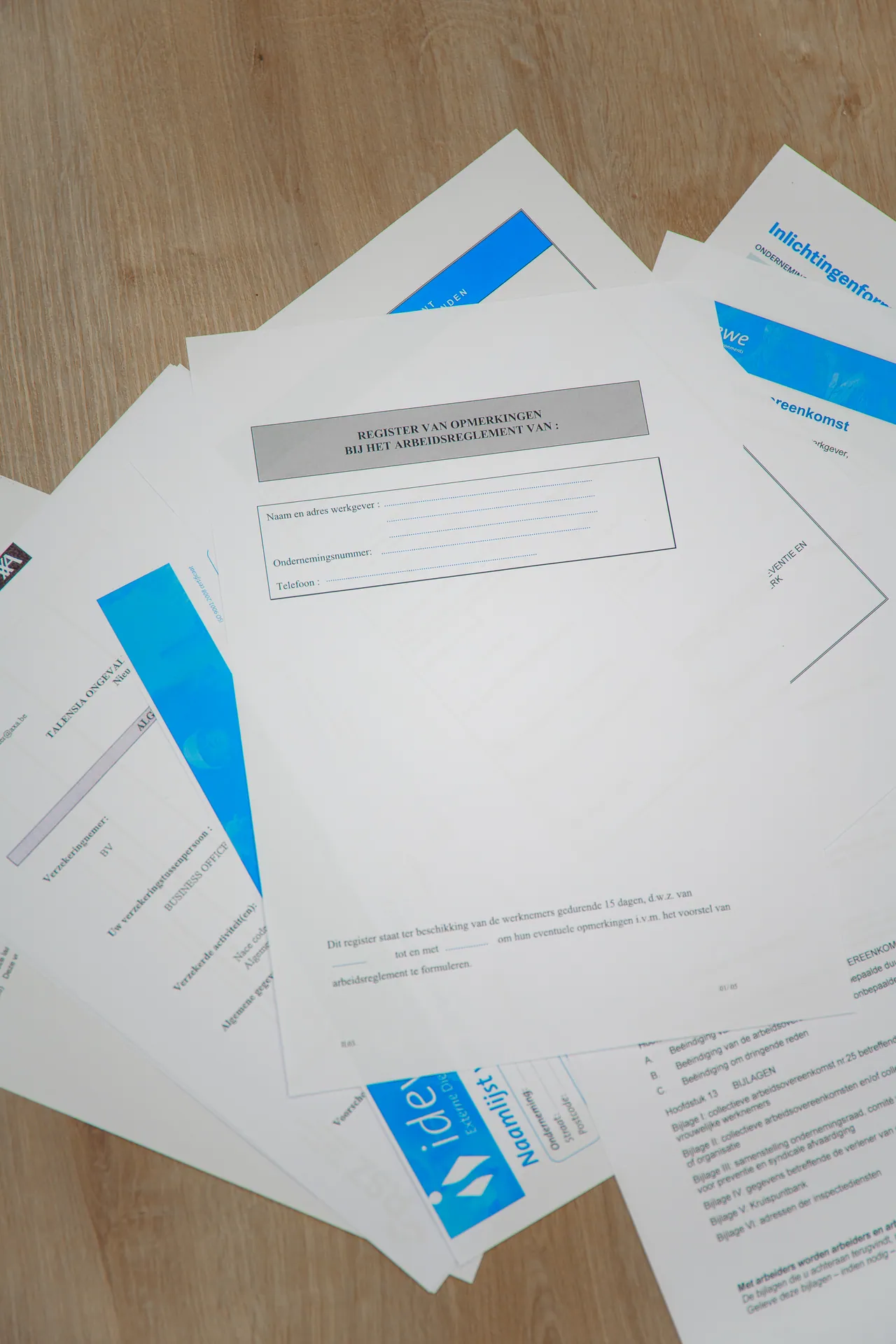
Why mistakes in HR administration are so costly
HR administration is more than filling in documents and calculating wages. It touches on employment law, social security, tax legislation, and sectoral agreements. A single mistake can lead to additional NSSO assessments, fines after an inspection, or disputes with employees. Yet many employers underestimate its complexity, especially as the company grows and the workforce expands.
Below, we discuss the five mistakes we encounter most often with new clients. For each mistake, we explain the risk involved and how to solve the problem structurally.
Mistake 1: applying the wrong joint committee
The joint committee (JC) determines the sector-specific employment conditions for your employees. Think of minimum wages, working hours, bonuses, notice periods, and holiday arrangements. Belgium has more than 160 different joint committees and sub-committees. The classification depends on your company's main activity, not on the employee's job role.
A transport company, for example, falls under PC 140.03 (goods transport), while a catering company that also makes deliveries may fall under PC 302 (hospitality). The difference in minimum wage between two joint committees can amount to hundreds of euros per month.
The risk: if you apply the wrong JC, you may underpay your employees' wages. The employee can reclaim the difference for up to five years, including interest. In addition, you risk administrative fines after an inspection.
The solution: have the classification of your joint committee checked by a specialist. We analyse your Crossroads Bank for Enterprises (KBO) registration, your company's actual activities, and the sector criteria to determine the correct JC.
Mistake 2: employment contracts that do not comply with the law
A verbal agreement is also an employment contract, but in principle an open-ended one. The Belgian Employment Contracts Act of 3 July 1978 sets out clear formal requirements. A fixed-term contract must be in writing and signed before work begins. A part-time employment contract must state the work schedule. A student agreement must be in writing; the copy that used to go to the inspectorate within seven days has been replaced by the Dimona STU.
Many employers work with templates they drew up years ago or downloaded from the internet. These templates regularly contain outdated clauses, missing mandatory statements, or provisions that conflict with sectoral collective bargaining agreements (CBAs).
The risk: a fixed-term contract or a student agreement that was not put in writing in time is automatically reclassified as an open-ended contract. This means longer notice periods and higher severance payments if you want to end the working relationship.
The solution: we draw up employment contracts that fully comply with the legislation and your joint committee. Every contract includes the mandatory statements, the correct pay scales, and the applicable sectoral provisions.
Mistake 3: leave and absence management without a system
Annual leave, leave for family reasons, time credit, thematic leave, educational leave, maternity leave, paternity leave... the list of leave schemes in Belgium is extensive. Each type of leave has its own rules regarding the application procedure, duration, compensation, and administrative obligations.
Many employers keep track of leave in an Excel file or on paper forms. That works when you have three employees, but it becomes problematic with ten or more. Errors in calculating holiday pay, forgetting to submit an application to the National Employment Office (RVA), or incorrectly recording sick days lead to financial and legal problems.
The risk: an incorrect calculation of single holiday pay upon termination of employment can cost thousands of euros. Failure to comply with the procedures for time credit can result in the RVA benefit being reclaimed from the employee, which leads to disputes.
The solution: we systematically record all leave and absences. Each type of leave is calculated correctly according to the legal rules and sectoral agreements. You receive a monthly overview of the leave balances per employee.
Mistake 4: payroll calculations that fail to account for all bonuses
The gross salary is only the starting point. On top of the base salary come sectoral bonuses, year-end bonuses, meal vouchers, eco-vouchers, transport allowances, hearth or residence allowances, and various other benefits. The exact composition differs per joint committee and sometimes even per job category.
In PC 200 (supplementary joint committee for white-collar employees), an employee with five years of seniority is entitled to a higher pay scale than a new starter. In PC 124 (construction), specific bonuses apply for work clothing, bad weather, and mobility allowances. Forgetting a bonus inevitably leads to a subsequent payroll correction.
The risk: outstanding bonuses must be paid retroactively. The NSSO can claim additional contributions, plus interest of 7% per year. In addition, you lose the trust of your employees.
The solution: we calculate wages based on the current pay scales and sectoral CBAs. Every bonus, indexation, and seniority increase is processed automatically. You receive a detailed payroll overview that you can present to the Social Inspectorate at any time.
Mistake 5: submitting DIMONA declarations late or incomplete
We covered this topic extensively in our article on DIMONA. In short: every new employment, every change, and every end of an employment relationship must be reported to the NSSO through the DIMONA system. Late or missing declarations put you at risk of administrative fines of 3,000 to 35,000 euros per employee.
What many employers forget is that extending a fixed-term contract requires a change to the DIMONA declaration if it stated an end date. The transition from a student contract to a regular contract requires a new DIMONA declaration.
The risk: for an intentional offence, the criminal court can also, since 1 July 2026, withdraw NSSO contribution reductions, such as the target group reduction for first hires, for the employees and quarters concerned. With five employees, this can amount to thousands of euros per quarter.
The solution: we manage your DIMONA declarations proactively. Our system automatically flags when a declaration is required, whether it concerns a new contract, an extension, or a termination of employment.
Prevent these mistakes structurally
These five mistakes do not stem from unwillingness, but from a lack of time and specialist knowledge. As an employer, you are focused on your core business, and rightly so. But the consequences of administrative errors are real and sometimes far-reaching.
We take over the complete HR administration of your company, from employment contracts to payroll calculation, from DIMONA to leave management. You focus on your business, we make sure everything runs correctly from an administrative point of view.