
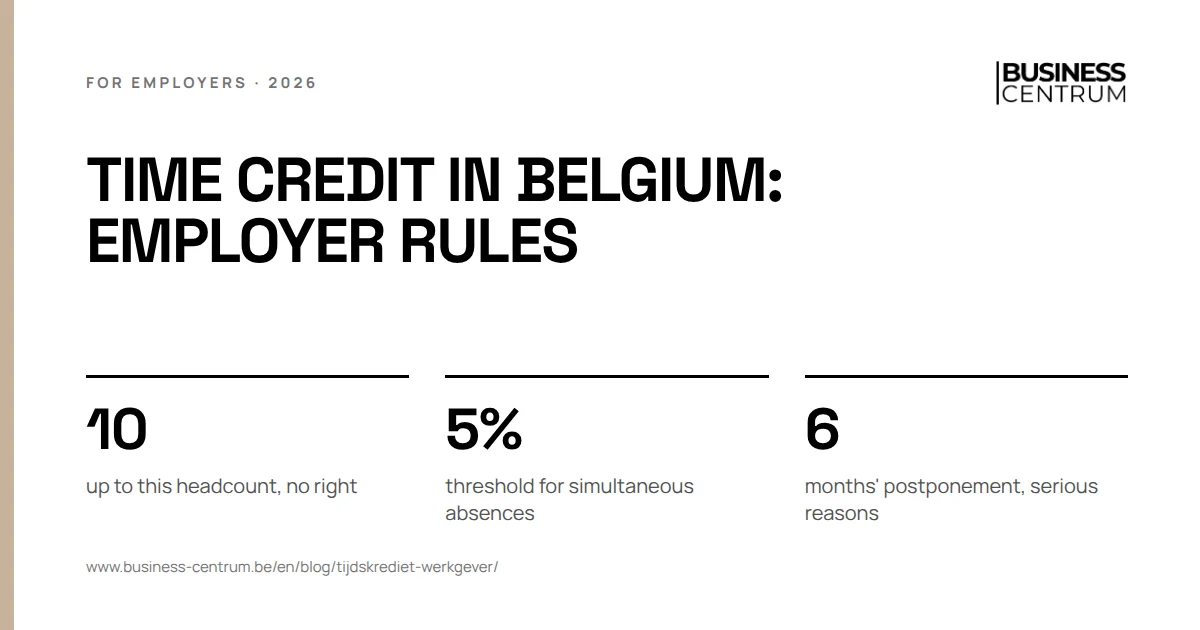
Time credit is an employee's right in Belgium, but not in every company. If you employed no more than 10 people on 30 June of last year, the decision is yours. Above that, you cannot refuse if the conditions are met, but you can postpone: up to 6 months for serious reasons, or longer if more than 5% of your staff would be absent at once.
Can an employer refuse time credit?
It depends on the size of your company and on the conditions the employee meets.
| Headcount on 30 June last year | What applies | Employee's notice |
|---|---|---|
| No more than 10 | No right, only with your agreement | 6 months ahead |
| More than 10, up to 20 | A right, with threshold and postponement | 6 months ahead |
| More than 20 | A right, with threshold and postponement | 3 months ahead |
You count heads, full-time and part-time together. By mutual written agreement you can set a shorter notice period.
In a company above that limit, you can only refuse a request if the employee does not meet the conditions. The main ones:
- Length of service. The employee must have worked for you for 24 months at the time of the request, unless the time credit with a reason directly follows parental leave that has been fully used up.
- Reason. Time credit with a reason can last up to 51 months for care (a child under 8, a seriously ill relative, palliative care, a disabled child, a seriously ill minor child) and up to 36 months for recognised training, with a combined maximum of 51 months over the whole career. The employee attaches a certificate from the ONEM, the federal unemployment office (RVA in Dutch), showing what they have already used.
- Working pattern. For a 1/5 reduction, the employee must work full-time, over 5 days or more, during the 12 months before the request (24 months for a landing job). For a half-time reduction, they must have worked at least 75% of a full-time job during that period.
Full-time or half-time credit to care for a child under 8, for palliative care, for a seriously ill relative or for training is only possible if your sector or company has a collective agreement allowing it. The 1/5 form is always possible. For a disabled child or a seriously ill minor child, every form is possible, even without a collective agreement. If in doubt, you can ask the employee for evidence.
The 5% threshold: how to calculate it
If more than 5% of your staff take time credit at the same time, new requests can be made to wait. A collective agreement or your work rules can change that percentage.
Who counts? Everyone on time credit or an older career break. Parental leave and other thematic leave do not count. Employees aged 55 or over on a 1/5 landing job fall entirely outside: they count neither as absent nor in your headcount. For each band of 10 employees over 50, one extra place is added, with priority for landing jobs.
Worked example. A wholesaler has 60 employees on 30 June, 12 of them over 50.
- Base threshold: 5% of 60 = 3 places.
- Extra place: one band of 10 employees over 50, so +1. Total 4.
- Currently absent: two office staff on 1/5 time credit for their children and a 61-year-old warehouse worker on a half-time landing job.
- The warehouse worker takes the extra place, which has priority for landing jobs. The two office staff take 2 of the 3 base places.
- A new request for 1/5 time credit for training still fits. The next request goes to the preference and planning mechanism.
That mechanism is set by the works council, or otherwise by the employer with the union delegation. If there is no consultation body, or it sets nothing, the order in CLA no. 103 applies: first care for a disabled child, palliative care or care for a seriously ill relative, if the employee has already used up the thematic leave for it, then dual-income households and single parents with children under 12, then landing jobs (1/5 before half-time), then training. You apply it at the end of each month to the requests received up to the 15th of that month.
Postponing time credit as an employer: when and for how long
Apart from the threshold, you can postpone for serious internal or external reasons: organisation, continuity or the lack of a replacement. The time credit must then start no later than 6 months after the requested date, unless you agree otherwise.
For an employee aged 55 or over in a key role, a 1/5 reduction can be postponed for up to 12 months, with reasons. A key role is one whose absence puts the organisation at risk and which you cannot cover internally. The two forms of postponement cannot be added together.
The deadlines are tight:
- Announce a postponement within a month of the written request.
- Reply no later than the last day of the month after the month of the request. Request on 10 March, reply by 30 April.
- Agree on the arrangements within the same period: which day or half days the employee takes off.
Landing jobs: the rules since 2026
For requests received after 1 January 2026, landing jobs are stricter. The employee must be 60 and have a career of 31 years for men or 26 years for women. That number rises every year.
From 55, it is only possible in specific schemes: arduous work, long-term night work, a company in difficulty or restructuring, a long career, unfitness for construction work or a sheltered employer. The employee must then prove a career of 25 years, or 35 years for a long career. For arduous work, a long career and a company in difficulty, a sector or company agreement is also required. Below 55, landing jobs no longer exist. If your employee's request predates 2026, the old rules apply.
Declaring time credit: what the employer does with the ONEM
Once you have agreed and the start date is fixed, the employee applies online through Break@work. You fill in your part. The application is only complete once both parts are in. It must be filed no earlier than 6 months before the start and no later than 2 months after. If it comes in later, the allowance only starts on the date of the complete application.
For a 1/5 or half-time credit, you sign a part-time employment contract no later than the first day of the reduction, with the new schedule. That schedule must be in your work rules. After the time credit, the employee returns to their job or an equivalent one.
Template reply to a time credit request
The wording is free, but a written reply avoids disputes. It contains:
- the date you received the request;
- your decision: agreement, postponement with reasons and a new start date, or refusal with the condition not met;
- the agreed form (full-time, half-time or 1/5) and the free day or half days;
- the start date and duration;
- the agreement to fill in the ONEM form together.
For example: "We received your request for 1/5 time credit to care for your child on 10 March. We agree to a start on 1 September, for 12 months, with Wednesday as your day off. We will fill in our part of the ONEM application in the week of 18 August."
Mistakes we often see
- Replying too late and so losing the right to postpone.
- Counting the threshold wrongly: including parental leave, or employees aged 55 or over on a 1/5 landing job.
- Not drawing up a part-time contract, so the old full-time contract formally stays in force.
- Not putting an SME refusal in writing. Even with no more than 10 employees, you reply within the deadline.
Parental leave has its own rules for refusal and postponement, which we explain in refusing parental leave as an employer.
What Business Centrum does for you
For every request we check length of service, the remaining balance and your threshold, and prepare the reply within the deadline. We draw up the part-time contract, fill in your part of the ONEM application and adjust payroll, together with Acerta. With our workforce analysis you see in advance who could request a landing job in the coming years. Day-to-day handling sits in our leave and absence service.