
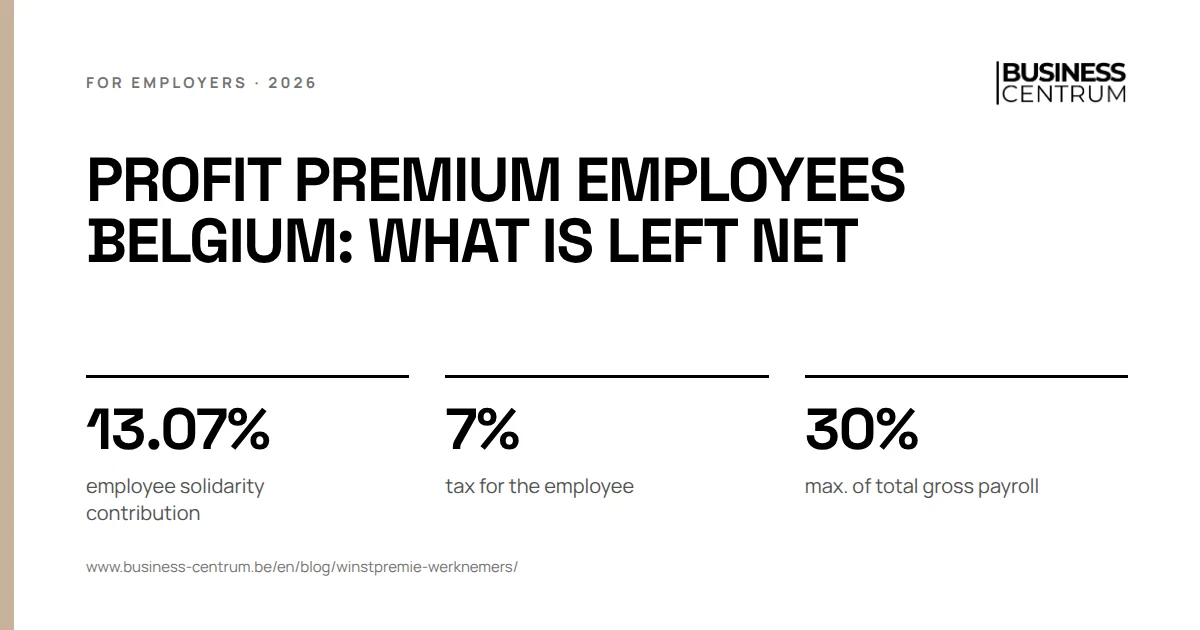
With a profit premium, you give your employees a share of the profit of the closed financial year. The employee pays 13.07% solidarity contribution and 7% tax; you pay no employer contributions. From € 1,000 gross, € 808.45 is left net. The premium is not deductible and may not exceed 30% of gross payroll in total.
Conditions for a profit premium: who can grant it and to whom?
The profit premium is part of the Act of 22 May 2001 on employee participation and has existed since 1 January 2018. It is meant for companies subject to corporate income tax or non-resident tax that have had a good year. The conditions:
- There is a profit. The premium depends on the profit of the last closed financial year, not on a target.
- All employees receive it. You do not choose who gets it. Directors and managers who are not employees are excluded. What they can receive is on our page about the company director.
- It does not replace pay. You may not convert existing pay, a bonus or a benefit into a profit premium, nor a running bonus plan.
- It is capped. All profit premiums together amount to no more than 30% of the total gross payroll for the financial year.
- The general meeting decides. An identical premium needs a simple majority.
You may exclude three groups: those who left during the closed financial year after dismissal for serious cause, those who resigned (unless for serious cause on your part), and those without the required service if you set a condition of no more than 1 year. If you give everyone the same amount, you calculate it at least pro rata to actual work: part-timers and long-term absentees receive less. Periods of guaranteed pay, maternity leave, birth leave, adoption leave and foster care leave do count as work. For a categorised premium, the pro rata rule is a choice.
Identical or categorised?
Identical profit premium. The same amount for everyone, or the same percentage of pay. The general meeting decides and the minutes state the amount or percentage, the service rule, the pro rata calculation and any exclusions. You inform employees in writing; an email or intranet post is enough.
Categorised profit premium. The amount varies by objective criteria such as seniority, job or pay scale. The highest premium may be no more than 10 times the lowest. You arrange it through a company agreement or, without a union delegation, through an accession deed. You notify the draft in writing or by posting it, with a comments register for 15 days. Without comments, the deed takes effect on day 15 after notification. After conciliation by the inspectorate, it is at the earliest day 8 after the conciliation.
For an SME, the identical premium is almost always the simplest route.
From gross to net: a profit premium next to a CBA 90 bonus and an ordinary bonus
An office employee earns € 2,600 gross a month. You give him € 1,000 gross extra, in three ways.
| Profit premium | CBA 90 bonus | Ordinary bonus | |
|---|---|---|---|
| Gross | € 1,000.00 | € 1,000.00 | € 1,000.00 |
| Employee contribution | € 130.70 (13.07%) | € 130.70 (13.07%) | € 130.70 (13.07%) |
| Tax | € 60.85 (7%) | € 0.00 | € 351.02 (40.38%) |
| Net for the employee | € 808.45 | € 869.30 | € 518.28 |
| Employer contribution | € 0.00 | € 330.00 (33%) | € 250.00 (25%) |
| Cost to the employer | € 1,000.00 | € 1,330.00 | € 1,250.00 |
| Deductible for corporate tax | No | Yes | Yes |
| Cost after corporate tax (25%) | € 1,000.00 | € 997.50 | € 937.50 |
Per euro the company spends after tax, the profit premium and the CBA 90 bonus deliver about one and a half times as much net pay as an ordinary bonus. For a company at the standard rate, the CBA 90 bonus is even slightly better. If your company pays the reduced SME rate, the saving on the deductible bonus is smaller and the two come close. For the net of ordinary pay, use our gross-to-net calculator.
How is a profit premium taxed?
- No employer contributions. You pay no social security on the premium.
- Not deductible. The premium comes out of profit after corporate tax. To pay € 1,000 at the standard rate, you need € 1,333.33 of profit before tax.
- Final tax for the employee. You withhold the solidarity contribution and the tax on payment. The employee no longer declares the premium.
- Outside the wage norm. The profit premium does not count towards wage cost growth.
Difference between a CBA 90 bonus and a profit premium
| Profit premium | CBA 90 bonus | |
|---|---|---|
| Condition | Profit in the closed financial year | An uncertain target set in advance |
| Who decides | General meeting | Bonus plan via agreement or accession deed, filed before a third of the reference period |
| Ceiling | 30% of gross payroll, all employees together | € 4,255 gross per employee, tax-free up to € 3,701 net |
| Deductible | No | Yes |
| Company director | No | No |
You may use both side by side. A CBA 90 bonus pays off when you want to reward a concrete target, such as less damage to the fleet. A profit premium suits a year that was simply good and that you want to share. All details of the bonus plan are in our guide to the CBA 90 bonus.
Granting a profit premium: the steps
- Close the financial year and establish the profit.
- Calculate the budget. No more than 30% of total gross payroll. With a payroll of € 420,000, that is € 126,000.
- Choose identical or categorised, and set the service rule, the pro rata calculation and the exclusions.
- Have the general meeting decide, usually at the annual meeting that approves the accounts. Include the required items in the minutes.
- Inform employees in writing.
- Pay it in one go through the payroll, withholding the solidarity contribution and the tax. The NSSO treats staggered payments, monthly for example, as a conversion of pay.
Mistakes employers make
- Granting the premium to the company director. He is not an employee.
- Converting the end-of-year bonus into a profit premium. That is a prohibited conversion of pay.
- Forgetting the premium is not deductible, and planning with gross profit instead of profit after tax.
- Excluding long-term sick employees entirely although their period of guaranteed pay counts.
What Business Centrum does for you
We calculate the budget within the payroll limit in advance and set the net and the cost per employee next to a CBA 90 bonus. After the general meeting's decision, we process the premiums in your payroll, together with Acerta, with the right deductions and the social security return.