Guide • Flexi-jobs for employers
Flexi-jobcost foremployers
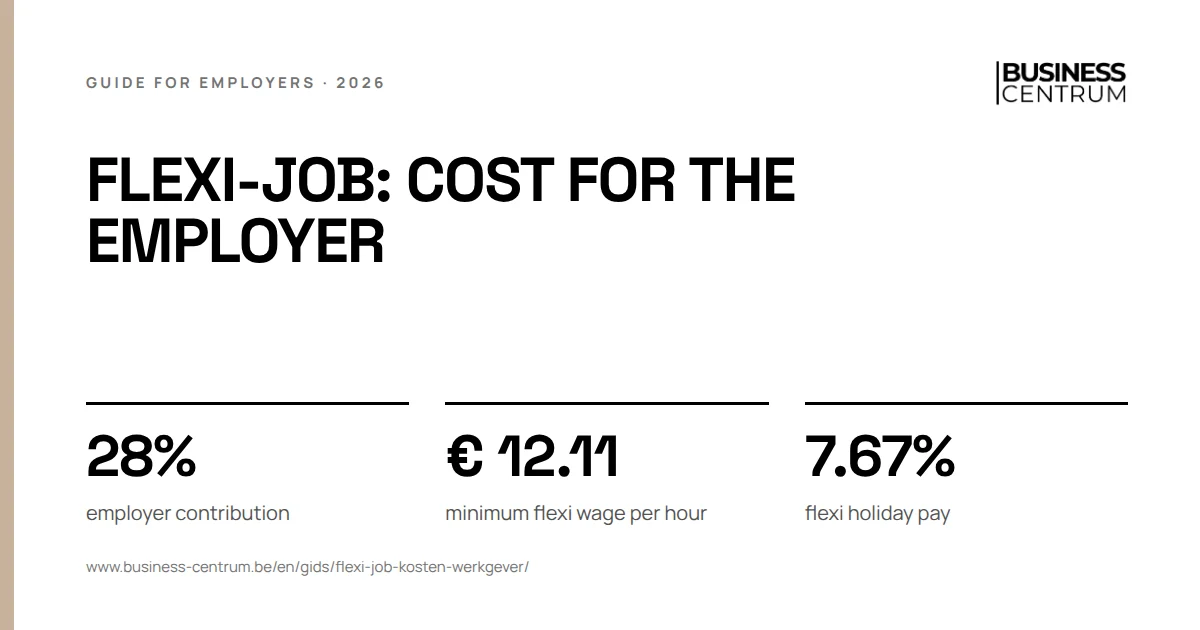
A flexi-job worker costs you the flexi wage plus 7.67% flexi holiday pay, and on that total you pay a special employer contribution of 28%. At the hospitality minimum of € 12.11 an hour, that comes to € 16.69 an hour, with no deductions for the worker.
It is allowed if the worker worked at least 4/5 for another employer in reference quarter T-3, or is legally retired. Since 1 July 2026, that applies in almost every sector.
28%
special employer contribution
By Business Centrum editorial teamPublished
Updated and figures checked on
How the NSSO calculates
What does a flexi-job cost the employer?
Flexi wage
€ 12.11
hospitality minimum per hour
Flexi holiday pay
€ 0.93
7.67% of the wage
Contribution base
€ 13.04
what the worker receives net
Special contribution
€ 3.65
28% on the base
Your cost per hour
€ 16.69
excluding sector extras
The special employer contribution of 28% replaces all ordinary social security contributions. That rate has applied since 1 January 2024. The worker pays no employee social security and, up to the tax ceiling, no income tax: gross is net. The status itself is covered on our page on flexi-jobs as an employer.
You pay the flexi holiday pay with every payroll, together with the wage. When the flexi-job worker later takes holiday, you pay nothing more: no wage for that day and no double holiday pay. The contribution does apply to the full amount, holiday pay included.
The contribution is a fixed rate with no discounts. Flexi work is excluded from the structural reduction and from every target group reduction. A first-hire reduction or an older-worker reduction never applies to a flexi-job.
Some sectors charge more
A sector collective agreement can make contributions to a Subsistence Security Fund or a sector supplementary pension mandatory for flexi-job workers too. This is the case for funeral services, sea fishing, inland shipping and park and garden maintenance, among others. Check the rules of your joint committee before you calculate.
Worked example
Flexi-job or regular worker: the difference for the employer
The same gross hourly wage of € 12.11, once as a flexi-job and once as a regular blue-collar worker in the private sector. All amounts per hour worked.
| Per hour | Flexi-job worker | Regular blue-collar worker |
|---|---|---|
| Gross hourly wage | € 12.11 | € 12.11 |
| Holiday pay | € 0.93 flexi holiday pay (7.67%), paid immediately | paid by the holiday fund, financed by the holiday contribution below |
| Contribution base | € 13.04, wage plus flexi holiday pay | € 13.08, 108% of gross pay |
| Employer contribution | € 3.65 (28%) | € 3.27 (25% base rate including wage moderation) |
| Holiday contribution | none | € 2.07 (15.84%) |
| Your cost per hour | € 16.69 | € 17.45, before reductions |
| After structural reduction | no reduction possible | € 14.62: € 2.83 an hour less for a full-time worker |
| What the worker receives | € 13.04 net | € 12.11 gross, minus € 1.71 employee social security (13.07%) and withholding tax |
Before reductions the costs are close: in this example the flexi-job worker is € 0.76 an hour cheaper. But at this pay level you get the structural reduction for a regular worker, € 2.83 an hour for a full-timer. That brings the cost to € 14.62 an hour, € 2.07 less than the flexi-job worker. The reduction shrinks as pay rises.
The big difference is on the worker’s side. A flexi-job worker receives every gross euro net. To give a regular employee the same net amount, gross pay has to rise substantially, and so does your cost. A flexi-job never gets a contribution reduction, nor a target group reduction. A permanent employee does bring costs that are not in this hourly rate, such as paid public holidays and guaranteed pay during sickness. Sector bonuses such as an end-of-year bonus apply to both, if the worker meets the conditions of the collective agreement.
Want to see it for your own pay level? Try our gross-net calculator or let us work out what an employee costs in your joint committee.
What this example leaves out
No sector fund contributions, no workplace accident insurance and no special contributions that depend on the size of your workforce. The structural reduction is for a full-time category 1 worker on a 38-hour week, with no target group reduction. The example shows the ratio, not a quote.
The flexi wage
Minimum and maximum flexi wage
Hospitality (PC 302)
- Minimum € 12.11 an hour, since 1 September 2026.
- Plus € 0.93 flexi holiday pay per hour, € 13.04 in total.
- Maximum € 21.00 an hour, or € 22.61 including flexi holiday pay.
- Both amounts follow the index.
All other sectors
- Minimum: the scale wage for the job in your joint committee, converted to an hourly wage. Without a scale: the guaranteed average minimum monthly income (GGMMI).
- Maximum: 150% of that minimum base wage.
- Since 1 July 2026 the cap applies to the base wage only. Supplements and bonuses set by law or a collective agreement, such as overtime, night premiums, public holiday supplements and an end-of-year bonus, can come on top.
A flexi-job worker is entitled to the supplements and bonuses in your sector’s collective agreement, such as a night supplement or an end-of-year bonus. Forget them and you calculate too low. The maximum is there to stop well-paid specialists from working through a flexi-job. In hospitality? Also read about our social secretariat for hospitality.
Conditions
When is it allowed?
The main condition: in reference quarter T-3, three quarters before the quarter of the flexi-job, the worker worked at least 4/5 of a full-time job (80%) for one or more other employers. Work in any sector counts, as do paid periods and suspensions such as sickness, maternity leave and temporary unemployment. Time credit, parental leave and unpaid leave lower the volume.
Not counted: work as a student under the solidarity contribution, as an occasional worker in hospitality or agriculture and horticulture, as an apprentice in work-based learning, as a young worker until the end of the year they turn 18, as a political office holder, and earlier flexi-jobs.
Legally retired people do not need to meet the T-3 condition and have no tax ceiling. Someone on a transition allowance does not count as retired. For many employers, retirees are therefore the most flexible group.
One more brake: anyone who cuts back from 100% in T-4 to 80% in T-3 cannot do a flexi-job for 2 quarters, in T and T+1. The same applies when time credit or unpaid leave starts.
Dimona OK is not a free pass
The OK response to a Dimona FLX only confirms that the worker worked enough in T-3 or is retired. Whether all conditions in the current quarter are met is, according to the NSSO, entirely your responsibility.
Same and former employer
Where a flexi-job is not allowed
Same employer
Not allowed
Your own employee on a regular employment contract cannot do a flexi-job for you in the same quarter, not even for different work.
Allowed
Switching from a flexi-job to a regular employment contract within the quarter. Not the other way round.
Related company
Not allowed
A flexi-job at a company related to the company where the worker works 4/5 or more.
Allowed
Since 1 July 2026 it is allowed if the worker already works full-time for one or more other companies, related or not.
Temp worker
Not allowed
Working as a flexi-job worker through a temp agency at a user company where the worker already has a regular employment contract.
Allowed
Since 1 July 2026 a temp agency may place someone as a regular temp and as a flexi-job worker, as long as it is not with the same user company. Their hours as a temp with that same agency do not count towards T-3.
Former employer
Not allowed
A flexi-job with the employer who dismissed the worker, during the notice period or during a period covered by a severance payment or dismissal compensation.
Allowed
After that, yes. But hours worked for you do not count towards the T-3 condition: your former employee first has to work enough for another employer, or be legally retired.
In practice: someone who leaves you and starts elsewhere can only do a flexi-job for you once their reference quarter T-3 falls entirely with the new employer. A retired former employee can come back sooner. If they still worked for you on a regular contract in the current quarter, wait until the next one: the NSSO only allows the switch from flexi-job to regular job.
Sectors since the extension
Which sectors are allowed?
For a long time a flexi-job was only possible in a list of approved sectors, starting with hospitality. Since 1 July 2026 the system is in principle open to the entire private and public sector. Sectors can still opt out fully or partly, based on joint committee, employer category or NACE code.
Construction (PC 124) is not among the exclusions: the royal decree of 30 August 2026 only confirms the existing list, so the NSSO accepts flexi-jobs in construction. A sector agreement of 16 July 2026 does exclude blue-collar flexi-jobs for work on a temporary or mobile construction site for which you must provide basic safety training. Retired people with at least 5 years of site experience in the last 10 years may do that work. Other work, such as in the workshop or warehouse, can be a flexi-job.
That agreement runs until 30 June 2027. It has not yet been declared generally binding; the sector has asked for that so inspectors can enforce it. It also states that you pay no sector subsistence security contributions for flexi workers and that they get no sector meal vouchers. Planning flexi-job workers in a construction company? Have it checked first. More about the sector: our social secretariat for construction. Not sure which joint committee you fall under? That is the first question.
Excluded or limited
- PC 323
Domestic staff
Excluded.
- PC 144
Agriculture
Excluded.
- PC 145
Horticulture
Excluded, except landscaping and maintenance of parks and gardens.
- PC 143
Sea fishing
Only shore staff and warehouse staff. Not at fish auctions.
- PC 320
Funeral services
Only blue-collar workers doing the work of an occasional worker.
- PC 331
Childcare
Flexi-jobs may make up at most 20% of the employer’s annual work volume.
- PC 322.01
Service vouchers
Only during the first 3 months after the first Dimona at the company.
- All
Certain jobs
Artistic, artistic-technical and artistic support jobs, tasks covered by the law on healthcare professions, and sex work under an employment contract.
For the worker
The tax ceiling
€18,440
euros a year tax-free, income year 2026
A flexi-job worker earns tax-free up to € 18,440 a year, across all flexi employers combined. Above that, flexi income is taxed as normal. Legally retired people have no ceiling.
For you as the employer, going over the ceiling changes nothing for social security: the worker stays a flexi-job worker and you keep paying the special contribution. The worker tracks their own position through Flexi@work in mycareer.
There is no cap on what a flexi-job worker earns in total: the ceiling only sets how far their flexi income stays tax-free. There is no separate maximum number of hours either. The normal rules on working time and rest periods still apply.
Declaration and paperwork
Dimona FLX step by step
- 01
Framework agreement
In writing, before the first shift. With the identity of both parties, the jobs, the base wage, how and when you will offer the flexi employment contract, and the text of the legal 4/5 condition, unless the worker is retired. Without a valid framework agreement there is no flexi-job. We can draw up these employment contracts for you.
- 02
Flexi employment contract per assignment
Oral or written, per day, for a fixed term or for a clearly defined task. Never retroactively.
- 03
Dimona FLX before the start
A timely Dimona FLX with an OK response is an absolute condition. You file it per quarter, IN and OUT, even if the contract runs across quarters, and no earlier than 1 month before the quarter starts. For an oral contract: one Dimona per day, with start and end time. What a late Dimona costs is covered in our separate guide.
- 04
Recording the hours
Through a registered cash system in hospitality, electronic time tracking, the attendance registration linked to Dimona, a digital tachograph or, in cleaning, Check In and Out at Work. A daily Dimona with start and end time is enough.
- 05
Flexi@work and DmfA
Since 1 January 2025 you report payslip data for every flexi assignment through Flexi@work. In the DmfA, flexi-job workers have their own worker codes. We take over the full Dimona declaration and the DmfA.
What goes wrong
Flexi-job pitfalls for employers
The main job disappears
The status does not end right away, because the check looks at T-3. But three quarters later the Dimona turns NOK, and anyone who still has shifts planned is left without staff. Replan every quarter.
Your own employee helping out
A permanent staff member doing extra Saturday shifts as a flexi-job worker is not allowed. Overtime, more contract hours or a different contract is the right route.
Dimona late or after the start
Without a timely Dimona FLX with an OK response there is no flexi-job. The work is then declared as regular employment, with regular contributions.
Pay off the scale
Below the scale wage or above 150% of it, or the sector night supplement forgotten. Inspectors check the minimum and maximum on site.
A drop in hours overlooked
Your candidate went from full-time to 4/5. Then they cannot do a flexi-job for 2 quarters, even if they seem to meet the condition on paper.
Declaring without the conditions
A flexi-job in the DmfA that does not meet the conditions becomes regular employment. You then pay regular contributions on the flexi wage increased by 125%.
What Business Centrum does
Your flexi-job workers, handled
You give us the name and the schedule. We make sure the flexi-job is in order before the first shift starts.
Business Centrum works as a partner of Acerta, a licensed social secretariat, and handles the full personnel administration for SMEs in hospitality, transport, construction and wholesale.
- We check each candidate’s joint committee, the sector rules and how the job combines with their other jobs.
- We draw up the framework agreement and test the flexi wage against the scale and the maximum.
- We file the Dimona FLX per quarter or per day and read the response. We see a NOK before the shift.
- We process flexi wage, flexi holiday pay, special contribution and Flexi@work in the same payroll run as your permanent staff.
Frequently asked questions
Questions about flexi-jobs
Sources
Every amount and deadline on this page was checked against these official sources, last consulted on .
- Cao PC 124 van 16 juli 2026, flexi-jobs (nr. 201194/CO/124)
- FOD WASO, databank minimumlonen, PC 302 (uurstelsel op weekbasis)
- FOD WASO, Flexi-jobarbeidsovereenkomst
- Justel, KB van 13 december 2016 (flexi-jobs), art. 3, ter uitvoering van art. 26 van de wet van 16 november 2015
- KB van 30 augustus 2026 over het toepassingsgebied van de flexi-jobs, art. 2, 1° (BS 9 september 2026)
- RSZ, Administratieve instructies 2026/3, De bijdragen
- RSZ, Administratieve instructies 2026/3, De structurele vermindering
- RSZ, Administratieve instructies 2026/3, Dimona voor flexi-jobwerknemer
- RSZ, Administratieve instructies 2026/3, Flexi-jobs
- RSZ, Administratieve instructies 2026/3, Toepassingsgebied en beperkingen flexi-jobs
Flexi-job cost
Rather have someone check it for you?
Your dedicated contact at Business Centrum looks at it for your situation, together with Acerta.