
Joint committee 140
and 140.03:
wages and rules 2026
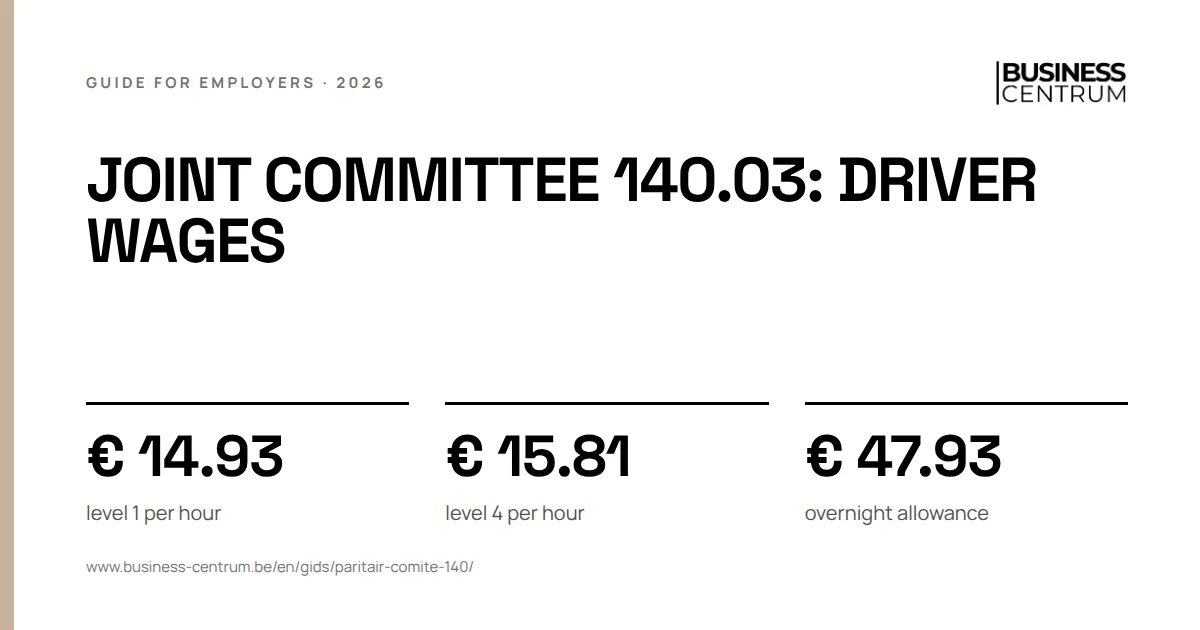
Joint committee 140 (paritair comité 140) covers transport and logistics; blue-collar workers in road haulage and logistics for third parties fall under subcommittee 140.03. Since the 2.18% indexation on 1 January 2026, a driver there earns at least € 14.9255 to € 15.8075 gross per hour.
JSC 140.03 • Road haulage and logistics
By Business Centrum editorial teamPublished
Updated and figures checked on
- Indexation
- 2.18%on 1 January 2026
- Next index
- 2027in January, automatically via the health index
- End-of-year bonus
- 5%of gross pay, paid by the SFTL
- Meal benefit
- € 2employer share per day, from 1 July 2026 at the latest
Scope
Who falls under joint committee 140?
Joint committee 140 is the umbrella committee for transport and logistics. Wages and rules are set in subcommittees, each with its own collective agreements. Which subcommittee applies depends on your company's main activity, not on one employee's job. If in doubt, we review it together when we set up your payroll administration.
What does 'for third parties' mean?
Logistics counts as work for third parties if your company never becomes the owner of the goods. Receiving, storage, weighing, packing, labelling, order picking, stock management and dispatch all qualify, as long as you do not make new products.
- 140.01Buses and coachesPublic and special bus services and coach companies, such as school transport and tourism.
- 140.02TaxisTaxi companies.
- 140.03Road haulage and logistics for third partiesRoad freight for other companies, whatever the propulsion, logistics companies working exclusively for third parties and escorting exceptional loads. The subcommittee covers blue-collar workers: drivers, warehouse staff and garage staff.
- 140.04Airport ground handlingCompanies handling aircraft, baggage and cargo at the airport.
- 140.05RemovalsRemoval companies, furniture storage and related activities.
Not covered by 140.03
- White-collar staff of a transport or logistics company
- JC 226
- Carrying your own goods with your own trucks (own-account transport)
- The committee of your main activity
- Logistics that is part of your own production or trade
- The committee of that activity
- Transport by a construction company, the fuel trade or the petroleum sector
- JC 124, 127 or 117
- Logistics in the port or for the chemical industry
- JC 301 or 116
Pay scale for driving staff
Minimum wages for drivers
A driver earns the wage of his level in the sector's job classification. The level follows from 10 criteria: driving licence, autonomy and planning, number of delivery addresses, physical effort, handling equipment, load checks, loading and unloading, technical knowledge, side tasks and training colleagues. Each criterion scores points; the total sets the level.
| Level | Points | 38 hours | 39 hours* | Availability | Availability Sunday and public holiday |
|---|---|---|---|---|---|
| Level 1 | 10 - 14 | € 14.9255 | € 14.5425 | € 14.7760 | € 22.1640 |
| Level 2 | 15 - 18 | € 15.4490 | € 15.0530 | € 15.2945 | € 22.9415 |
| Level 3 | 19 - 25 | € 15.6285 | € 15.2275 | € 15.4720 | € 23.2080 |
| Level 4 | 26 - 36 | € 15.8075 | € 15.4020 | € 15.6495 | € 23.4740 |
Gross minimum hourly wages since 1 January 2026. The 38-hour column also applies to a 39-hour week with 6 unpaid compensation days. *With 6 paid compensation days. Availability time is paid at 99% of the hourly wage.
Setting the level is your job
For each criterion, the employer marks what usually applies to the job. A driver with a CE licence who plans his own trips scores higher sooner than a colleague in a van on a fixed round. Record the score in writing: during an inspection you must be able to explain the classification.
Pay scale for logistics staff
Warehouse and logistics wages
Non-driving staff have their own classification in classes, from warehouse operative to supervisory roles. Here too the job sets the class, not the diploma.
| Class | Jobs | 38 hours | 39 hours* |
|---|---|---|---|
| Class 1 | Warehouse operative type 1 | € 15.6465 | € 15.2435 |
| Class 2 | Handyman, warehouse operative types 2, 3 and 5, cleaner | € 16.3745 | € 15.9530 |
| Class 3 | Warehouse operative types 4, 6 and 7 | € 16.8015 | € 16.3735 |
| Class 4 | Warehouse operative type 8, supervisory warehouse role type 1 | € 17.2310 | € 16.7895 |
| Class 5 | Quality controller, supervisory warehouse role type 2 | € 17.6625 | € 17.2095 |
| Class 6 | Supervisory warehouse role type 3 | € 18.0260 | € 17.5635 |
| Class 8 | Supervisory warehouse role type 4 | € 18.3915 | € 17.92 |
Gross minimum hourly wages since 1 January 2026. *With paid compensation days. Garage staff have a separate scale. For night work, non-driving staff receive an extra 12.5% of the scale wage, for shift work 7.5% per hour worked.
Indexation
How does the PC 140.03 index work?
2.18%
on 1 January 2026
Wages in 140.03 follow the health index once a year, always in January. On 1 January 2026 the increase was 2.18%. The next adjustment is on 1 January 2027.
The index applies to the pay scales and to the allowances: subsistence allowance, ARAB allowance, night allowance and seniority supplement. If you pay above the scale, the actual wage rises by the same amount in euros as the scale, not by the same percentage.
If you employ student workers, they receive at least 90% of the hourly wage for their job.
Cents index from the next indexation
For full-time gross pay above € 4,000 a month, the first 2% of indexation applies only to that € 4,000, after that to the full wage again. In 140.03 you will see this for the first time on 1 January 2027.
Subsistence allowances
Subsistence and ARAB allowances
When a driver has to take his daily or weekly rest away from home or his fixed workplace, you pay a flat-rate subsistence allowance. It covers costs and is paid net, without social security contributions.
Long night
Per started period of 24 hours, if the driver is away for more than 24 hours and rests on the road.
€ 47.9310
Short night
If the driver is away for less than 24 hours and takes a single daily rest on the road, or for his first daily rest after less than 8 hours of work and availability, outside a multi-day trip.
€ 19.4285
Fixed stay
On top of A, if the driver does no work between two rest periods, for example a weekend abroad. He then also receives a flat wage of 8 working hours.
€ 13.0310
ARAB allowance
Per hour of presence, meaning every hour of working time and availability time. Per pay period you add up the hours and round up.
€ 1.8175
Free of social security, within the limit
The NSSO accepts subsistence and ARAB allowances as cost reimbursements. In international transport you may add a supplementary allowance, but only if the driver must rest abroad and the total stays below the daily rate that Foreign Affairs pays its civil servants. Anything above is wages.
Worked example
A level 2 driver makes a trip of 3 full days and sleeps in his cab every night. He works 38 hours of working time and 6 hours of availability.
- Working time: 38 × € 15.4490
- € 587.06
- Availability: 6 × € 15.2945
- € 91.77
- Gross wage, with social security
- € 678.83
- ARAB: 44 × € 1.8175
- € 79.97
- Allowance A: 3 × € 47.9310
- € 143.79
- Allowances, net
- € 223.76
- Total
- € 902.59
25% of what the driver receives that week is cost reimbursement. Booking those allowances as wages means paying too much social security. Booking wages as allowances risks a reassessment with late-payment interest.
Every trip, every night on the road, correctly on the payslip.
Working time and premiums
What counts as work?
For drivers, the sector separates working time from availability time. Working time is driving, loading, unloading, cleaning, maintenance and paperwork. Availability is waiting without working: at the border, during a driving ban, next to the driver or in the sleeper cab.
Waiting at loading or unloading counts as availability up to 2 hours per operation in Belgium and 4 hours abroad, at the border up to 2 hours, unless you announce a different duration in advance. Beyond that, it becomes working time.
- 99%
- Availability timeof the hourly wage for the level
- 90%
- On the ferry or trainunless the driver can take his normal rest there
- 200%
- Work on Sundays and public holidaysovertime included
- 150%
- Availability on Sundays and public holidaysof the ordinary availability pay
- +50%
- Overtime premiumfor work beyond the limits of the Labour Act
- +50%
- Service time above 60 hoursper week, averaged over the month
Driving and rest times
Driving and rest times and the tachograph
EU Regulation 561/2006 sets the limits for every driver of a truck over 3.5 tonnes, whether driving for third parties or on own account.
- Driving4.5 h
- Break45 min
- Driving4.5 h
- Daily rest11 h
A full driving day: two driving periods with a break in between, 9 hours behind the wheel in total.
- Driving per day
- 9 hours, 10 hours 2 times a week
- Driving per week
- 56 hours
- Driving over two weeks
- 90 hours
- Break
- 45 minutes after 4.5 hours of driving
- Daily rest
- 11 hours, 9 hours 3 times a week
- Weekly rest
- 45 hours, reduced at least 24 hours
Tachograph, in vans too
A digital tachograph is in principle mandatory in every truck over 3.5 tonnes. Since 1 July 2026, the obligation also applies to vans over 2.5 tonnes doing international transport or cabotage for third parties, including the empty return trip.
Purely domestic transport in a van up to 3.5 tonnes remains exempt.
At a roadside check
The driver must be able to show the data for today and the previous 56 days: his driver card, any manual entries and attestations of activities.
Working time records
Recording and monitoring working time
Besides driving time, total working time counts. A mobile worker works on average no more than 48 hours a week, calculated over at most 6 months, and never more than 60 hours in a single week. That total applies across all employers.
The driver enters all other work and availability manually in the tachograph, including work for another employer. You ask him in writing for his hours with other employers, and he must provide them in writing. Tachograph data is also your best evidence during an inspection, for example to show that a driver really works part-time.
For overtime due to an exceptional increase in work, the employee can have up to 130 hours per calendar year paid out instead of taking time off. If you use a flexi-job worker, his hours with other employers also count towards the 48- and 60-hour limits.
High flexibility
Under the new work scheme, a full-time driver works an average of 38 hours a week over 6 months: 988 hours per reference period. Extra hours go into a counter on the payslip, with an internal ceiling of 143 hours. The scheme must be in your work rules, with the schedule and the start and end of the reference period.
Flexi-jobs in transport
Since 1 July 2026 you may also employ drivers and logistics staff as flexi-job workers. Driving and rest times still apply across all employers. The sector end-of-year bonus is calculated on wages subject to ordinary social security contributions. Flexi pay is not, so in practice a flexi-job worker builds up no bonus with it.
Bonuses and benefits
End-of-year bonus and sector premiums
End-of-year bonus via the SFTL
5%
In 140.03, the Social Fund for Transport and Logistics (SFTL) pays the end-of-year bonus, not the employer. It amounts to 5% of the gross wages declared to the NSSO in the reference period.
For the 2026 bonus, the reference period runs from 1 July 2025 to 30 June 2026. The worker must have at least € 2,500 in declared gross wages. The fund pays directly into his account from 20 December 2026.
If you pay a higher bonus yourself, you deduct the SFTL's gross bonus and pay only the balance, with the usual social security and withholding tax. Do not include the fund's bonus in your DmfA or on form 281.10: the SFTL does that.
Meal vouchers or meal allowance
By 1 July 2026 at the latest, every worker receives a meal voucher or meal allowance with an employer share of € 2 per day worked. If you already gave a meal benefit, you raise the employer share by € 2. If you already introduced or raised a meal benefit between 1 January 2025 and 30 June 2026, you only top it up to € 2. The worker needs 6 months of uninterrupted seniority; temp work counts, students are excluded. For a meal allowance, he must work at least 4 hours that day.
Night allowance
A driver who, in a month, works at least 5 consecutive working days or half of his working days with night work receives a sector night allowance of € 1.8870 per hour, for all nights worked that month. Night work falls between 20:00 and 6:00, and he must work more than 5 hours of work or availability in that window. Since 1 June 2026 the law sets a shorter night period for new employees in logistics, but a sector agreement of 17 September 2026 keeps the existing rules in 140.03.
Commuting
For train and public transport you pay 90% of the ticket, or 80% for the train under a third-payer scheme. Employees who cycle receive € 0.27 per kilometre.
Supplementary pension
Every worker builds up a sector supplementary pension with Pensio TL, set up by the SFTL and fully funded by the employer.
Seniority supplement
Per hour of working time and availability, for driving and non-driving staff, from the month in which the uninterrupted seniority is reached.
| Uninterrupted service | Supplement per hour |
|---|---|
| from 1 year | € 0.0695 |
| from 3 years | € 0.1415 |
| from 5 years | € 0.2135 |
| from 8 years | € 0.2855 |
| from 10 years | € 0.3575 |
| from 15 years | € 0.4295 |
| from 20 years | € 0.5015 |
Social fund
The Social Fund for Transport and Logistics
The SFTL is the sector's subsistence security fund. It pays bonuses to workers and reimburses costs to employers. An employer in 140.03 is recognisable by NSSO employer category 083.
- Driver card
- € 53.72 refunded for a Belgian card, up to € 65 for a foreign one, once per validity period.
- Medical screening
- Up to € 104 for the medical examination for a C or CE licence.
- Hospital insurance
- For workers after 6 months of uninterrupted service. At every hire you inform the worker in writing about prefinancing, and on departure about individual continuation.
- Training
- Contributions to C and CE licence training, ADR courses and a training budget per company.
- Assistance and premiums
- The union premium, assistance during business travel and a payment in case of a fatal workplace accident.
Dimona
Dimona in transport
You report every driver and warehouse worker through a Dimona declaration before the first trip or shift. Family members or friends who drive your truck for third parties also count as employees for the NSSO. Too late? See what a late Dimona costs.
- OTHPermanent drivers and warehouse staffThe ordinary declaration, for a fixed-term or open-ended contract.
- STUStudent workersWith a student employment contract, at least 90% of the scale wage for the job.
- FLXFlexi-job workersPossible since 1 July 2026, per assignment and only if the legal conditions are met.
No Dimona means undeclared work
Letting a driver drive without a prior Dimona exposes you to the heaviest sanction in the Social Criminal Code.
Pitfalls
Where 140.03 goes wrong
Paying out the flexibility counter monthly
Under high flexibility you may not pay extra hours every month and reset the counter to zero. They are taken as time off. What remains at the end of the reference period, you pay.
Classifying a driver too low
A driver who drives CE, plans his own trips and checks complex loads rarely belongs on level 1. The difference becomes back pay with retroactive effect.
Mixing up allowances and wages
Subsistence and ARAB allowances are net. A supplementary allowance above the Foreign Affairs rate is wages, with social security.
The SFTL bonus in the DmfA
The fund's end-of-year bonus does not belong in your declaration. Declaring it twice means double contributions and a wrong tax form.
The van that crosses the border
A van over 2.5 tonnes without a tachograph in international transport has been an offence since 1 July 2026, even on the empty return trip.
A flexi driver without oversight
A flexi-job worker who drives elsewhere during the day cannot drive without limit for you. You must be able to check his driving and rest times across all employers.
The warehouse in the wrong committee
Logistics for third parties falls under 140.03, logistics for your own goods does not. A wrong choice means wrong pay scales, bonuses and fund contributions.
No work rules in the cab
Employees must be able to consult the work rules at all times, including on the road. Keep a copy in every vehicle, digital or on paper.
What Business Centrum does
Your transport payroll, done right
Business Centrum handles HR administration for transport and logistics companies in and around Ghent, as a partner of Acerta. We classify your drivers under the job classification, process working time, availability, subsistence and ARAB allowances in the payroll and keep the flexibility counter on the payslip up to date.
We apply the January indexation, file the Dimona for every new driver and draft employment contracts and work rules. Read more about our approach for the sector on social secretariat for transport.
Frequently asked questions
Questions about PC 140.03
The questions transport companies ask us most often.
Sources
Every amount and deadline on this page was checked against these official sources, last consulted on .
- Cao PC 140 van 17 oktober 2019, financiële vergoeding voor nachtarbeid rijdend personeel (155156), art. 3
- Cao PC 140 van 19 oktober 2017, indexmechanisme en koppeling van de lonen en vergoedingen aan de index (143004)
- Cao PSC 140.03 van 15 januari 2026, toekenning en/of verhoging van maaltijdcheques en/of maaltijdvergoedingen (197738)
- Cao PSC 140.03 van 18 december 2025, koppeling van de lonen en vergoedingen aan de index op 1 januari 2026 (196981), bijlage
- FOD Mobiliteit en Vervoer, Digitale tachograaf
- FOD Mobiliteit en Vervoer, FAQ rij- en rusttijden lichte voertuigen vanaf 1/07/2026
- FOD Mobiliteit en Vervoer, Rijtijden
- FOD Mobiliteit en Vervoer, Rusttijden
- FOD WASO, Centenindex (Programmawet van 30 mei 2026, titel 3, hoofdstuk 1)
- FOD WASO, infofiche PSC 140.03 rijdend personeel (laatste aanpassing 16/01/2026)
- FOD WASO, Minimumlonen per paritair (sub)comité: PSC 140.03
- FOD WASO, Nachtarbeid (nieuwe regels vanaf 1 juni 2026)
- RSZ, administratieve instructies 2026/3, bijzondere loonmatigingsbijdrage (centenindex)
- RSZ, administratieve instructies 2026/3, flexi-jobs: toepassingsgebied
- SIOD, Guidelines transportsector (versie 28/03/2024)
- Sociaal Fonds Transport en Logistiek, Eindejaarspremie (arbeiders)
- Sociaal Fonds Transport en Logistiek, Hospitalisatieverzekering AG Insurance
- Sociaal Fonds Transport en Logistiek, Terugbetaling bestuurderskaart digitale tachograaf
- Sociaal Fonds Transport en Logistiek, Terugbetaling geneeskundige schifting
More at Business Centrum
JC 140 transport
Rather have someone check it for you?
Your dedicated contact at Business Centrum looks at it for your situation, together with Acerta.