
Guide for employers
Which social
secretariat
to choose?
Choose a recognised social secretariat that knows your joint committee, gives you a fixed contact person and charges a price you can calculate in full beforehand. Legally, all recognised secretariats are on an equal footing, so you choose on service, sector knowledge and clear costs.
The seven criteria83%
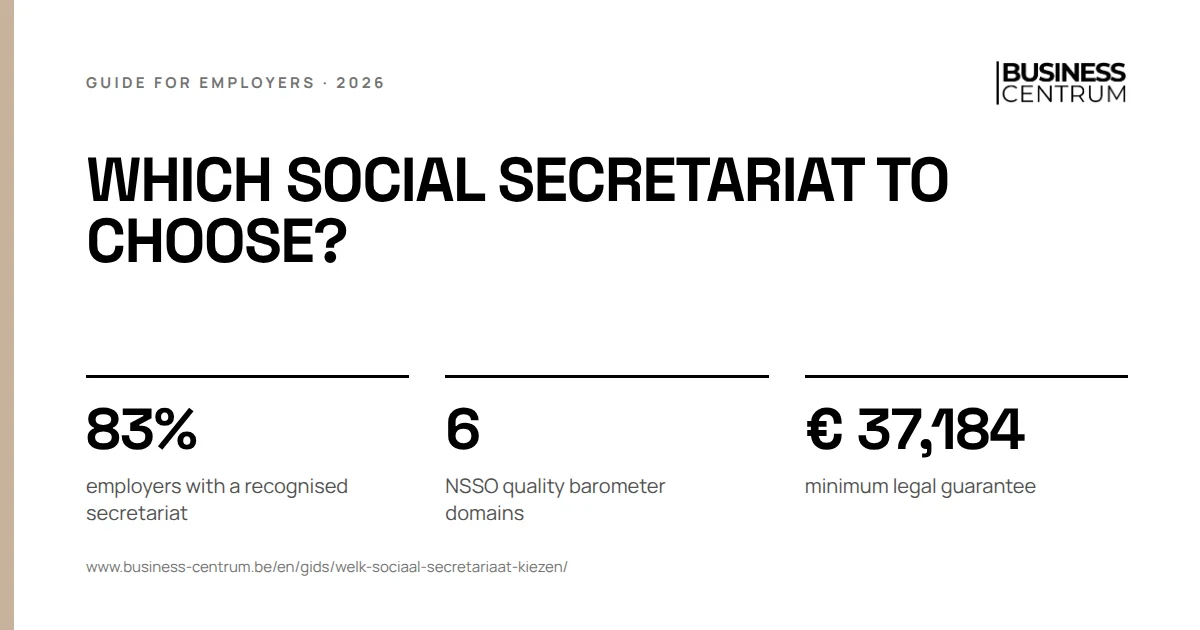
of employers were affiliated with a recognised social secretariat in 2025 (NSSO).
By Business Centrum editorial teamPublished
Updated and figures checked on
The legal basis
What is a recognised social secretariat?
A recognised social secretariat is a non-profit association (vzw/asbl) that handles social security formalities in the name and on behalf of employers: the Dimona declaration for every new hire, payroll calculation, the quarterly declaration (DmfA) to the NSSO and the payment of contributions and withholding tax. You give the secretariat a mandate for this, which is registered with the NSSO.
Recognition is granted by the Minister of Social Affairs, based on a report by the NSSO inspection. It gives the secretariat an exclusive right: only a recognised social secretariat may collect the social contributions of its affiliated employers and pass them on to the NSSO.
Every year in the fourth quarter, the Belgian Official Gazette publishes the full list of recognised social secretariats. You can also request a copy from the NSSO Inspection Department.
What the law requires for recognition
A non-profit association
The secretariat is a non-profit association. Its sole purpose: to carry out social formalities for its members and inform them about them.
An employers' organisation
A representative employers' organisation is a founding member and has at least 2 representatives on the board.
A minimum size
At least 300 affiliated employers, or at least 100 employers who together employ at least 5,000 people.
A guarantee
From € 37,184.03 for fewer than 3,000 employees to € 185,920.14 from 20,000 employees, deposited with the National Bank or the Deposit and Consignment Office. It covers the damage if the secretariat fails to pass employers' money on to the NSSO.
A company auditor
An independent, registered company auditor supervises all financial transactions.
A complete file
For each employer, a complete file on the application of social legislation, kept in Belgium and open to inspection.
Who checks
The NSSO inspection checks whether declarations are correct, whether employers' money reaches the NSSO correctly and on time, and whether the secretariat still meets the conditions. In 2025 it carried out 6,650 inspections at recognised social secretariats. If a secretariat falls below the minimum size for 4 consecutive quarters, or its quality stays clearly below standard, the minister can withdraw recognition.
The obligation
Is a social secretariat mandatory?
No. No law requires you to join a social secretariat. As an employer, however, you must meet every obligation: a Dimona for every employee, correct payslips, the DmfA every quarter, payment of contributions and withholding tax, and the rules of your joint committee. Most employers outsource this: in 2025, 83% of employers were affiliated with a recognised social secretariat.
You have three options. This is how they differ.
| Do it yourself | Non-recognised service provider | Recognised social secretariat | |
|---|---|---|---|
| Dimona and DmfA | You, via the social security online services | The provider, as your mandatary | The secretariat, as your mandatary |
| Contributions to the NSSO | You pay directly | You pay directly: a provider may not collect contributions | The secretariat collects and pays on |
| Payroll and sector rules | You look everything up and follow every change | Depends on your contract | Included in the service |
| NSSO supervision | Of your own declarations | Quality barometer, without financial checks | Quality barometer, with financial checks |
| Legal guarantee | Not applicable | None | Yes, with the National Bank or the Deposit and Consignment Office |
| Liable | You | You | You |
Since 20 February 2017, the NSSO has measured the quality of secretariats and service providers with a quality barometer covering 6 control areas. Financial checks apply only to recognised secretariats.
You remain liable
A social secretariat acts as your agent. According to the NSSO, only the employer remains liable under civil and criminal law if an obligation is not met. So choose a partner that warns you in time, and does more than process what you send.
Recognised or not
How to check a social secretariat
How do I recognise a recognised social secretariat?
A recognised secretariat must state on all its documents, invoices and publications its name with the words 'VZW - Sociaal Secretariaat' or 'ASBL - Secrétariat social', its recognition number and the date of the ministerial decree granting recognition. That is why payslips show wording such as 'erkend sociaal secretariaat nr.' followed by a number.
Where can I find the list of recognised social secretariats?
In the Belgian Official Gazette, which publishes the full list every year in the fourth quarter. You can also request a copy from the NSSO Inspection Department.
Which social secretariat am I with?
As an employer, you can see your mandates in Mahis, the application on the social security portal where you consult your mandataries. As an employee, check your payslip: it usually shows the name and recognition number of the secretariat that processes your employer's payroll.
What about a secretariat's offices and partners?
Recognised secretariats work with branch offices and often with partners who handle day-to-day contact with the employer. Declarations and the collection of contributions then go through the recognised secretariat itself. Always ask which recognised secretariat stands behind your contact person.
Comparing
How to choose a social secretariat: seven criteria
Every recognised secretariat files the same legal declarations. What you notice as an SME is how it does so. Compare these points before you sign.
Sector knowledge and joint committee
Your joint committee sets minimum wages, bonuses, indexation and sector funds. A construction company in joint committee 124 follows different rules from a transport company in joint committee 140 or a restaurant in joint committee 302. A file manager who handles your sector every day spots a classification error before it lands on a payslip.
Ask it like this“How many employers in my joint committee do you handle, and who knows the sector rules?”
Fixed contact or call centre
When you hire someone, an employee falls ill or you dismiss someone, you want a person who knows your file. Ask whether you get a fixed file manager with a direct number and email address, and who takes over during holidays. A general line with changing staff is fine for simple questions, but costs time once your situation needs explaining.
Ask it like this“Who is my fixed contact person, and who stands in for them?”
Pricing model
Secretariats usually charge a combination: an affiliation fee, an amount per payslip or per employee, and separate rates for extra work such as certificates, a dismissal file or Dimonas for students and flexi-jobbers. So compare the total per year for your actual workforce. Our guide on the cost of a social secretariat shows how that bill is built up.
Ask it like this“What will I pay per year for my situation, and what falls outside the base price?”
Digital tools
How do you pass on hours worked, absences and new employees: via an online platform, an app or by email? Do your employees receive their payslip digitally? Can you pull your own overviews of payroll costs and leave? Good tools save time, provided they fit the way your business works. A construction firm with crews on site has different needs from an office.
Ask it like this“Can I see a demo with a file like mine?”
Legal advice
A secretariat calculates pay, but you also have questions about an employment contract, a dismissal, temporary unemployment or a labour inspection. Ask what is included and what is billed separately, and who answers your question: a lawyer, or the person who also runs your payroll.
Ask it like this“Which legal questions are included, and who answers them?”
Availability
A Dimona must be filed no later than the moment your employee starts. If you call on a Monday morning about a new hire, how quickly someone answers matters. A late Dimona exposes you to a penalty, even when the delay was on your provider's side. Ask about opening hours, response times to email and whether you can visit an office near you.
Ask it like this“How quickly will I get an answer, and where is your office?”
Size
A large secretariat has specialists for every topic and invests in software. A smaller team or a local office often knows your business better. For an SME with a handful of employees, what matters most is who handles your file day to day and how many other files that person has. Look at that team more than at the name above it. Our overview of the largest social secretariats in Belgium shows how big each one is.
Ask it like this“How many files does my contact person manage, and how many are SMEs like mine?”
Checklist
Ten questions to ask before you choose a social secretariat
Ask every secretariat the same questions. That way you can compare the answers side by side.
- Which recognised social secretariat processes my declarations, and under which recognition number?
- Which joint committee do you see for my company, and why?
- Who is my fixed contact person, and how do I reach them?
- What does it cost per year for my number of employees, all-in?
- Which services do you charge separately?
- How do I pass on hours and absences, and by when?
- What happens if you make a mistake in a declaration?
- Do you help with contracts, dismissals and a labour inspection?
- What notice period is in your contract if I want to leave later?
- How does the switch from my current secretariat work, and who does what?
Pitfalls
What goes wrong when you choose a social secretariat
Mistake
Consequence
How to avoid it
Choosing on the price per payslip
ConsequenceExtras for certificates, Dimonas and advice push the annual bill above what you expected.
How to avoid itAsk for an annual simulation for your actual staff and a typical month.
The wrong joint committee
ConsequenceWages too low or missed bonuses. An inspection leads to back pay plus contributions.
How to avoid itHave the committee justified on your main activity, and not only on your NACE code.
Switching at any random moment
ConsequenceA mandate with the NSSO only transfers at the start of a new quarter.
How to avoid itPlan the switch for a change of quarter. Your old secretariat reports the end of the mandate to the NSSO inspection at least 15 days in advance and must give your new secretariat the data it needs. More in our guide on changing social secretariat.
Thinking the secretariat is liable
ConsequenceIf a declaration contains an error, the NSSO holds you, the employer, to account.
How to avoid itRead in the service agreement what the secretariat does and refunds if it makes a mistake.
No fixed contact person
ConsequenceQuestions pile up, a Dimona comes too late, a bonus is forgotten.
How to avoid itChoose a contact person you can reach directly and who knows your file.
Not to be confused
Social secretariat or social insurance fund?
Self-employed without staff? Then you are probably looking for a social insurance fund. Every self-employed person and, as a rule, every company director must join one for their own social contributions. A company must also join in its own right. A social secretariat handles something else: the administration of your employees.
Two separate affiliations
Many groups offer a social insurance fund and a social secretariat under the same name. They remain two separate affiliations, each with its own contract.
Business Centrum
How Business Centrum works
From Ghent, Business Centrum handles the full personnel administration of SMEs, as a partner of Acerta, a recognised social secretariat. You have one fixed contact person with us. As the recognised secretariat, Acerta files the declarations and collects the contributions. How Acerta differs from the other big names is set out in our comparison of Acerta, SD Worx, Securex, Liantis and Partena.
- 01
Your company
You pass on a new employee, hours worked or an absence.
- 02
Business Centrum, Ghent
Your fixed contact checks everything, applies your joint committee's rules and prepares the file.
- 03
Acerta
The recognised social secretariat files Dimona and DmfA and pays the contributions on.
- 04
NSSO and tax authorities
Receive correct declarations and payments, on time.
What we handle for you
- The Dimona declaration for every employee, student and flexi-jobber
- Payroll administration and your payslips
- Employment contracts, leave and absences
- Sector rules for transport, construction, hospitality and wholesale
We plan a switch together for a change of quarter, so no declaration falls through the cracks. Read how our social secretariat service in Ghent works, or book a meeting right away.
Frequently asked questions
Questions about your choice
Is your question not listed? We are happy to answer it, even if you are still with another secretariat.
Free consultationSources
Every amount and deadline on this page was checked against these official sources, last consulted on .
More at Business Centrum
Choosing a social secretariat
Rather have someone check it for you?
Your dedicated contact at Business Centrum looks at it for your situation, together with Acerta.