
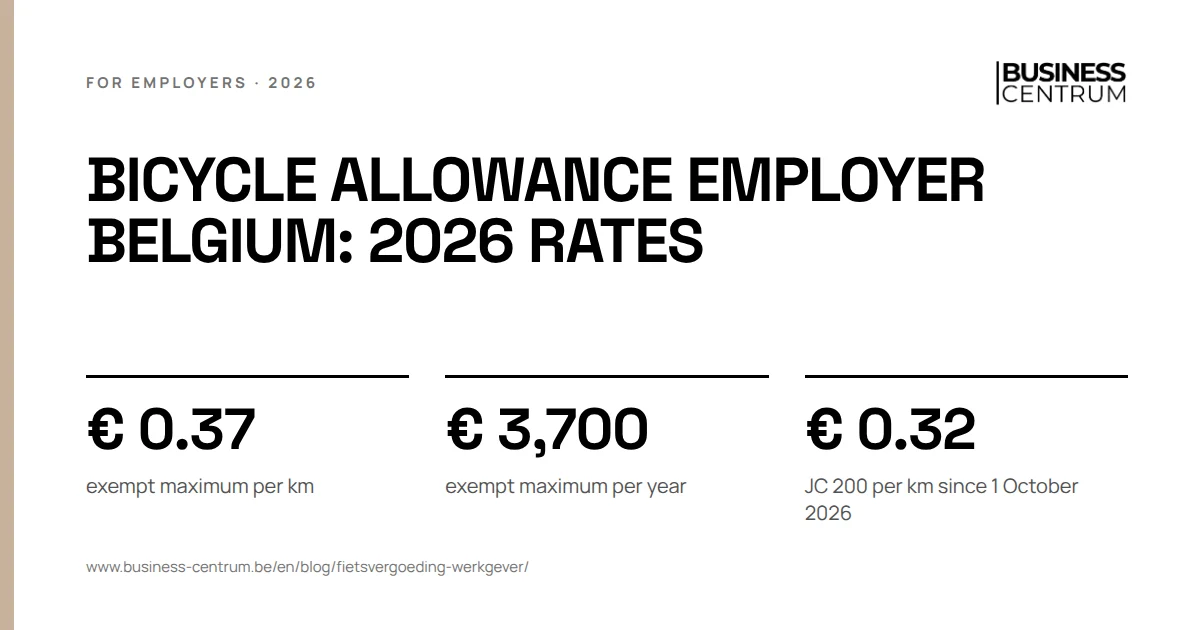
Yes, in Belgium employers must pay a bicycle allowance to employees who regularly cycle to work. Your sector sets the rate, for example € 0.32 per km in joint committee (JC) 200 since 1 October 2026. Without a sector rule, CBA No. 164 applies: € 0.30 per km. The NSSO and tax exemption runs up to € 0.37 per km and € 3,700 per year.
Is the bicycle allowance mandatory in Belgium? Yes, through your sector or CBA No. 164
Since 1 May 2023, every private-sector employee has been entitled to a bicycle allowance. Collective bargaining agreement (CBA) No. 164 of the National Labour Council is supplementary: it only applies if your joint committee has no bicycle allowance of its own. If your sector has one, you follow the sector's rate and conditions, even if that rate is lower than the one in CBA No. 164.
It only covers commuting: the journey between home and the fixed place of work. Cycling between two customers or sites counts as business travel, with its own rules. If the employee comes by car, train or bus, other rules apply. You will find them in our blog on the commuting allowance.
The bicycle allowance per km in your joint committee
| Joint committee | Rate per km | Limit | Since |
|---|---|---|---|
| JC 124 construction (blue-collar) | € 0.32 | Per km actually cycled, instead of travel costs and mobility allowance | 1 October 2026 |
| JSC 140.03 road haulage (blue-collar) | € 0.27 | Both ways, only on cycling days | 1 January 2024 |
| JC 200 white-collar | € 0.32 | Up to 40 km return, so € 12.80 per day | 1 October 2026 |
| JC 302 hospitality | € 0.24 | Both ways | Sector CBA of 2018, amended in 2019 |
| No sector rule: CBA No. 164 | € 0.30 (2025: € 0.29) | Up to 20 km per one-way trip | 1 May 2023 |
The other rules of your sector are in our guides on joint committee 200 and joint committee 124.
How much bicycle allowance can an employer pay free of NSSO and tax in 2026?
Up to € 0.37 per kilometre cycled, you pay no NSSO contributions and deduct no withholding tax. Each employee has an annual cap of € 3,700. All sector rates are below the maximum per km. You may voluntarily pay more than your sector, up to that maximum, without NSSO contributions or withholding tax.
Anything above the rate per km or above the annual cap is ordinary pay. You pay NSSO contributions on it and deduct withholding tax. The annual cap counts per calendar year, so keep a running total per employee.
Worked example: the bicycle allowance per month
White-collar employee in JC 200. She lives 12 km from the office and cycles 18 days in October. She cycles 24 km a day, which is 24 x € 0.32 = 7.68 euros, below the daily maximum of € 12.80. For the month you pay 18 x 7.68 = 138.24 euros, fully exempt. If she lives 25 km away, she cycles 50 km a day, but you pay for at most 40: € 12.80 a day.
Construction worker. He lives 28 km from the site and cycles 56 km a day: 56 x € 0.32 = 17.92 euros. Over a full year of 200 cycling days he reaches 3,584 euros, below the 2026 annual cap. If he cycles 210 days, that becomes 3,763.20 euros. The 63.20 euros above € 3,700 is taxable pay.
Cook in hospitality. He lives 8 km from the restaurant and cycles 20 days: 16 km x € 0.24 = 3.84 euros a day, or 76.80 euros for the month.
Can an employer refuse the bicycle allowance?
Not without reason. If the employee cycles to work regularly, you must pay. According to the commentary to CBA No. 164, cycling is already regular from 1 time per week, or when the employee only cycles in summer. An employee may also try it out first.
You may pay less or nothing in these cases:
- No declaration. The employee does not give you a declaration on their honour stating the kilometres and the number of cycling days.
- The distance exceeds the limit. Under CBA No. 164 you pay for up to 20 km per one-way trip, in JC 200 up to 40 km per day. Your sector limit applies, not the actual distance.
- The same journey is already reimbursed. For the same distance at the same time you pay only one allowance.
- Only the part by bike counts. Someone who cycles to a colleague's home and then rides along in the van only receives a bicycle allowance for the part they cycle.
How to check the kilometres
CBA No. 164 leaves the checks to you. You decide how often the employee submits a declaration and how you verify it. Put this in the work rules or in an internal memo.
- Ask for a declaration on honour with the address, the distance per trip and the number of cycling days per month.
- Check the distance yourself with a cycling route planner, once at the start and after every house move.
- Compare cycling days with attendance. A cycling day during leave or sickness stands out straight away.
- Have changes reported immediately. In road haulage, the employee must report a change of transport before the end of the month, and you may check the declaration at any time.
Misuse is sanctioned under the work rules. A bicycle allowance is also a condition if you want a bonus plan with a mobility target. More on that in our guide to the CBA 90 bonus.
Three mistakes with the bicycle allowance
- The wrong rate. A restaurant pays € 0.24, an office in JC 200 pays € 0.32 since 1 October 2026. Applying the CBA No. 164 rate when your sector has its own rule means paying too much or too little.
- A fixed monthly amount. The exemption applies per kilometre cycled. A monthly flat rate, unrelated to the number of cycling days, may be treated as pay by the NSSO.
- Losing track of the annual cap. Over long distances an employee reaches € 3,700 sooner than you think, like the construction worker above. The surplus must appear as pay on the payslip, or an inspection will lead to a correction.
What Business Centrum does for you
Business Centrum processes the bicycle allowance in your payroll, together with Acerta. We apply your joint committee's rate, including after a change such as the one of 1 October 2026, track the annual cap per employee and record the surplus correctly as pay on the payslip. On request, we prepare the model declaration on honour for your employees.