
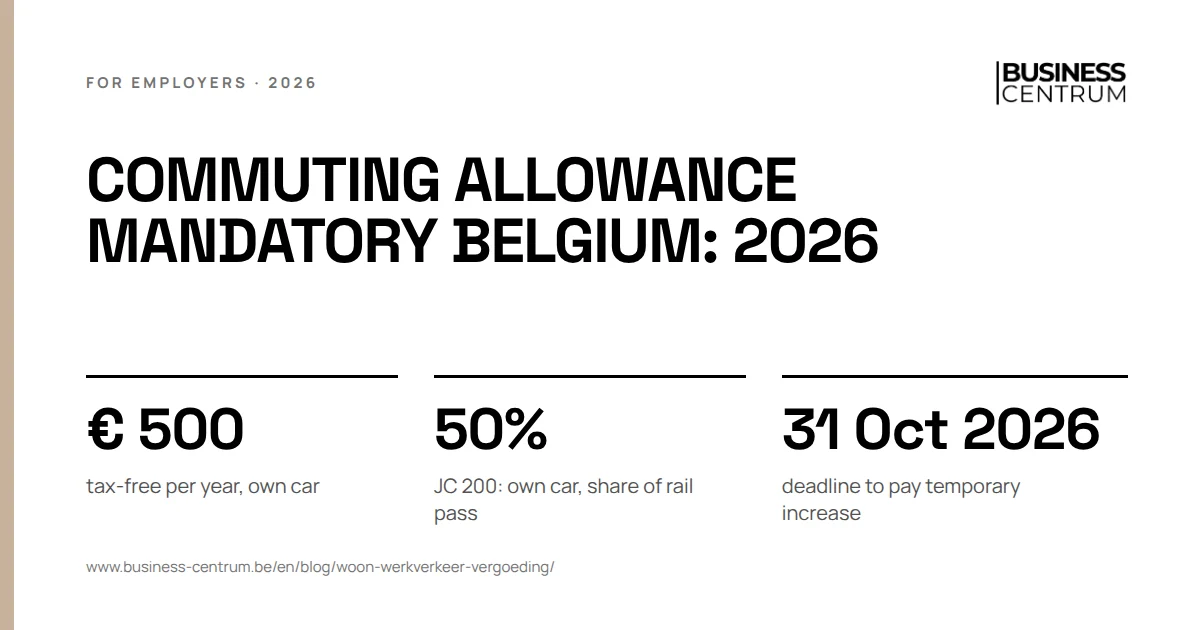
In Belgium only the employer contribution to train and other public transport is mandatory by law, along with the bicycle allowance. For the employee's own car you only pay if your joint committee (JC) requires it, as JC 200, JC 302 and road haulage do. For tax, an allowance for the own car is exempt up to € 500 per year.
Is a commuting allowance mandatory in Belgium? The answer per mode of transport
The basis is collective bargaining agreement (CBA) No. 19/9 of the National Labour Council, amended by CBA No. 19/11, which has applied since 1 June 2024. These national rules are a minimum. Your sector may give more, not less.
| Mode of transport | Mandatory? | What you pay at least |
|---|---|---|
| Train | Yes, whatever the distance | A fixed amount per distance and type of season ticket, which rises with SNCB prices |
| Tram, bus, metro with a distance fare | Yes, no minimum distance | The train amount, capped at 75% of the actual price |
| Tram, bus, metro with a flat fare | Yes, no minimum distance | 71.80% of the actual price, at most the train amount for 7 km |
| Bicycle | Yes | The rate of your sector or of CBA No. 164 |
| Own car or motorbike | No, unless your sector or your company requires it | Whatever the sector agreement or your own policy sets |
The bicycle has its own rates and its own cap. You will find them in our blog on the employer's bicycle allowance. Below we cover train, bus and car.
The commuting allowance per joint committee: 124, 140, 200 and 302
For the own car, your sector makes the difference. These are the rules in the four joint committees where most of our clients operate.
| Joint committee | Train and public transport | Own car |
|---|---|---|
| JC 124 construction (blue-collar) | Travel costs under the sector scale for the train, plus a mobility allowance of € 0.09 per km shown on the rail pass | Travel costs from the first kilometre under the sector scale, plus a mobility allowance from 10 km a day |
| JSC 140.03 road haulage (blue-collar) | 90% of the ticket, 80% for the train under a third-payer scheme | From 1 km, under the sector table per distance |
| JC 200 white-collar | 100% of the 2nd class rail pass, since 1 January 2026 | 50% of the price of a monthly rail pass, from 3 km one way, for gross annual pay up to € 36,688 |
| JC 302 hospitality | Train under the national scale; tram, bus and metro 80% of the price paid, capped at the scale amount for 16 km | 70% of the price of a 2nd class rail pass, from 1 km |
Commuting allowance in construction. A construction worker receives two allowances. Travel costs cover the means of transport. The mobility allowance in practice compensates the travel time: for someone travelling by own transport or as a passenger up to 59 km a day, € 0.06 per km. All bands are in our guide to joint committee 124.
JC 200. The pay threshold counts salary and bonuses together. An employee below it is entitled to the contribution, even if colleagues are above it. The other sector rules are in our guide to joint committee 200.
A commuting allowance for car travel in 2026: NSSO and tax
NSSO. Reimbursing the cost of travel between home and work is not pay. You pay no contributions on it, as long as it covers real costs. For a mileage allowance with the own car, the NSSO accepts at most € 0.45 per km in the fourth quarter of 2026. A fixed amount unrelated to the distance is treated by the NSSO as pay.
Tax. A contribution to train, tram, bus or metro is fully exempt. For the own car or motorbike, the allowance is exempt up to € 500 per year, and only if the employee uses the flat-rate professional expenses. Anything above is taxable pay on which you deduct withholding tax. The exempt part is shown on the 281.10 tax form.
Worked example: an employee who comes by own car
White-collar employee in JC 200. She lives 25 km from the office and earns 34,000 euros gross a year including bonuses, below the threshold of € 36,688. You pay € 64 a month, or 768 euros a year.
- NSSO: nothing, because it reimburses commuting costs.
- Tax: € 500 is exempt. The remaining 268 euros is taxable pay.
- Your cost: 768 euros, with no employer contributions.
Road haulage worker (JSC 140.03). He lives 20 km from the depot. The sector table gives € 44.69 per full month. If he worked only 18 days in a month and you convert the monthly amount into a daily amount, as the sector CBA allows, you use the daily amount for a five-day week: 18 x € 2.06 = 37.13 euros. With twelve full months he reaches 536.28 euros: 36.28 euros above the tax exemption.
Mistakes employers make with the commuting allowance
- Not paying for short bus journeys. Since CBA No. 19/11 there is no minimum distance for tram, bus and metro.
- One fixed car amount for everyone. Without a link to the distance, the NSSO treats it as pay, with contributions and a correction afterwards.
- Not knowing the sector rule for cars. In JC 302 and road haulage, a contribution for the own car is already mandatory from 1 km. If you have not paid it, you must pay it retroactively.
- Ignoring the tax limit. If the allowance exceeds € 500 a year, the surplus must appear as taxable pay on the payslip and the 281.10 form.
What Business Centrum does for you
Business Centrum applies your joint committee's rules in your payroll, together with Acerta: the rail pass, the table for the own car, the daily amounts for incomplete months and the tax limit. We keep the declarations on means of transport and distance up to date, adjust the tables when SNCB changes its prices and show the exempt and taxable parts correctly on the 281.10 form.