
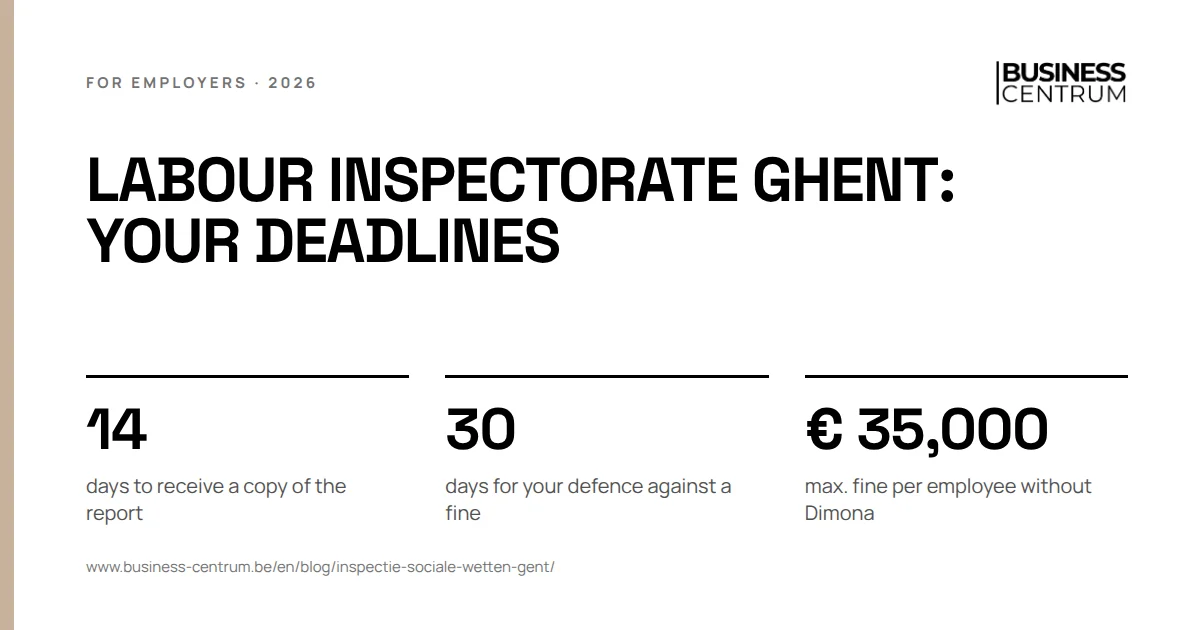
The labour inspectorate in Ghent is Supervision of Social Laws (TSW), East Flanders office, in Savaanstraat. During an inspection, the inspectors ask for your work rules, schedules, Dimona declarations and payroll documents. Advice, a warning, a deadline or an official report then follows. If a report is drawn up, you normally receive a copy within 14 days.
Who is the labour inspectorate in Ghent?
Supervision of Social Laws is the labour inspectorate of the FPS Employment. The East Flanders office covers the whole province, from Eeklo to Ninove, and has a single office: Savaanstraat 11/002, 9000 Ghent. For a meeting or a complaint, book an appointment on 02 233 44 40 or at tsw.oost-vlaanderen@werk.belgie.be. General questions go to the contact centre on 02 235 55 55 (Dutch) or 02 235 55 60 (French and German).
TSW is not the only social inspection. The NSSO has its own inspection for contributions and declarations, the Wellbeing at Work inspectorate checks safety and health, and the Flemish government checks employment measures among other things. For transport and logistics, TSW has two separate Transport teams. A haulier in East Flanders does not always get a visit from Savaanstraat.
TSW checks, among other things:
- working time, schedules, breaks, Sunday rest and public holidays;
- part-time work and the publication of variable schedules;
- work rules and social documents;
- pay, pay scales, bonuses and guaranteed wages;
- temporary agency work and the hiring out of staff;
- discrimination and compliance with sector agreements.
Labour inspection in Ghent: how does a visit go?
An inspection starts on the inspectorate's own initiative, after a complaint from an employee or competitor, at the request of the labour prosecutor, after a workplace accident or during a targeted campaign. The inspector may not reveal who complained, or even that the inspection follows a complaint.
Inspectors may enter any workplace at any time of day or night, without notice. They show an ID card. They may only enter an inhabited space with your prior written consent, a warrant from the investigating judge, to establish an offence caught in the act, or after a call from that space, a fire or a flood.
During the visit, they identify the people at work, compare them with your Dimona declarations and ask for documents. If you are not there, they contact you to have the documents produced. An inspection can also start with a letter inviting you to bring your documents to Savaanstraat.
Which documents must be ready?
| Document | Where it must be |
|---|---|
| Work rules with the current schedules | at every place where you employ people |
| Notices with the schedules of variable part-timers | with the work rules as long as the schedule applies, then kept for 1 more year |
| Register or system for deviations from part-time schedules | somewhere the inspectorate can consult at any time |
| Copy or extract of part-time contracts | with the work rules |
| Employment contracts, including students and flexi-jobs | in the personnel file |
| Individual accounts and payslips | at your NSSO address, your registered office or your social secretariat |
| Proof of Dimona declarations | digitally, through your social secretariat |
| Attendance registration or registered cash system | among others in hospitality, construction, the meat sector and cleaning, where it is mandatory |
You keep social documents for 5 years. Digital storage is allowed, as long as the copies are legible and the inspector can search them easily. We recommend keeping your work rules and this week's schedules ready at the workplace, on paper or on a tablet. That is where things go wrong most often in practice.
Your rights during the interview
The inspector may interview anyone: you, your employees, your manager. Every interview follows these rules:
- You may ask for all questions and answers to be recorded word for word.
- You may ask the inspector to carry out specific checks you consider useful.
- You may use documents you have with you and ask for them to be attached to the record.
- You read the record before signing, or have it read to you, and may correct or add to it.
- You may make your statement in your own language; an interpreter is then called in, or you write it down yourself.
- You get a free copy of your statement, immediately or within 1 month.
What you say can be used as evidence. Be correct and factual. Do not guess hours or dates: say you will check and send them in writing afterwards.
After the social inspection visit: warning, deadline or report?
The inspector decides how to respond. They can give advice, issue a warning for the future, give you a deadline to put things right (often retroactively, such as paying wage arrears) or draw up an official report.
If a report is drawn up, this is what follows:
- Copy. You receive a copy within 14 days of the finding. Only then does the report carry special evidential weight until proven otherwise.
- Labour prosecutor. The report goes to the labour prosecutor, who can prosecute before the criminal court or drop the case. If no decision is taken within 6 months, the administrative route can start. A level 1 offence can be handled directly by the administration.
- Defence. The Administrative Fines Directorate invites you by registered letter. You have 30 days to respond in writing or orally and may inspect the file.
- Decision. Case dropped, a fine or, in exceptional cases, a simple declaration of guilt.
- Pay or appeal. You pay within 3 months, or appeal to the labour court within 3 months. The appeal suspends payment. You can request a payment plan of up to 12 months in writing.
Always use your right of defence. It is your chance to show mitigating circumstances. The fine can then fall to 40% of the minimum. If you had no level 2 to 4 fine in the past 5 years, a suspended fine is also possible.
Which fines do you risk? Sanctions up to level 4
The Social Penal Code places every offence in one of four levels. For offences from 1 February 2026, these administrative fines apply:
| Offence TSW often finds | Level | Administrative fine | Per employee? |
|---|---|---|---|
| Employee without Dimona | 4 | € 3,000 to € 35,000 | yes |
| Obstruction of supervision | 4 | € 3,000 to € 35,000 | possible |
| Wages not paid or paid late | 3 | € 1,000 to € 10,000 | yes |
| Variable part-time schedule not communicated | 3 | € 1,000 to € 10,000 | yes |
| Work outside the schedules in the work rules | 2 | € 250 to € 2,500 | yes |
| No copy of the work rules for employees | 2 | € 250 to € 2,500 | yes |
Worked example
On a Friday evening, TSW inspects a brasserie in Ghent. Two employees are serving without a Dimona. Three part-timers are working without a communicated schedule.
- No Dimona: 2 x € 3,000 = € 6,000 minimum, up to 2 x € 35,000 = € 70,000
- Schedules not communicated: 3 x € 1,000 = € 3,000 minimum, up to 3 x € 10,000 = € 30,000
Together at least € 9,000, before the NSSO contributions that are reclaimed for the undeclared hours. If you repeat an offence within 3 years of an earlier fine or conviction becoming final, the maximum can double. What changed in these amounts in 2026 is explained in our news item on the Social Penal Code. How to correct a forgotten declaration is covered in our guide on a late Dimona.
What Business Centrum does for you
We make sure the documents TSW asks for are in order before the inspector calls: a Dimona for every start, work rules that match your schedules, payslips and individual accounts on time. If you get a letter or a visit, we gather the requested documents, prepare the interview with you and write the defence against an administrative fine. With our compliance check, you see in a few minutes where your risk lies. Your payroll runs through Business Centrum in Ghent, together with Acerta.