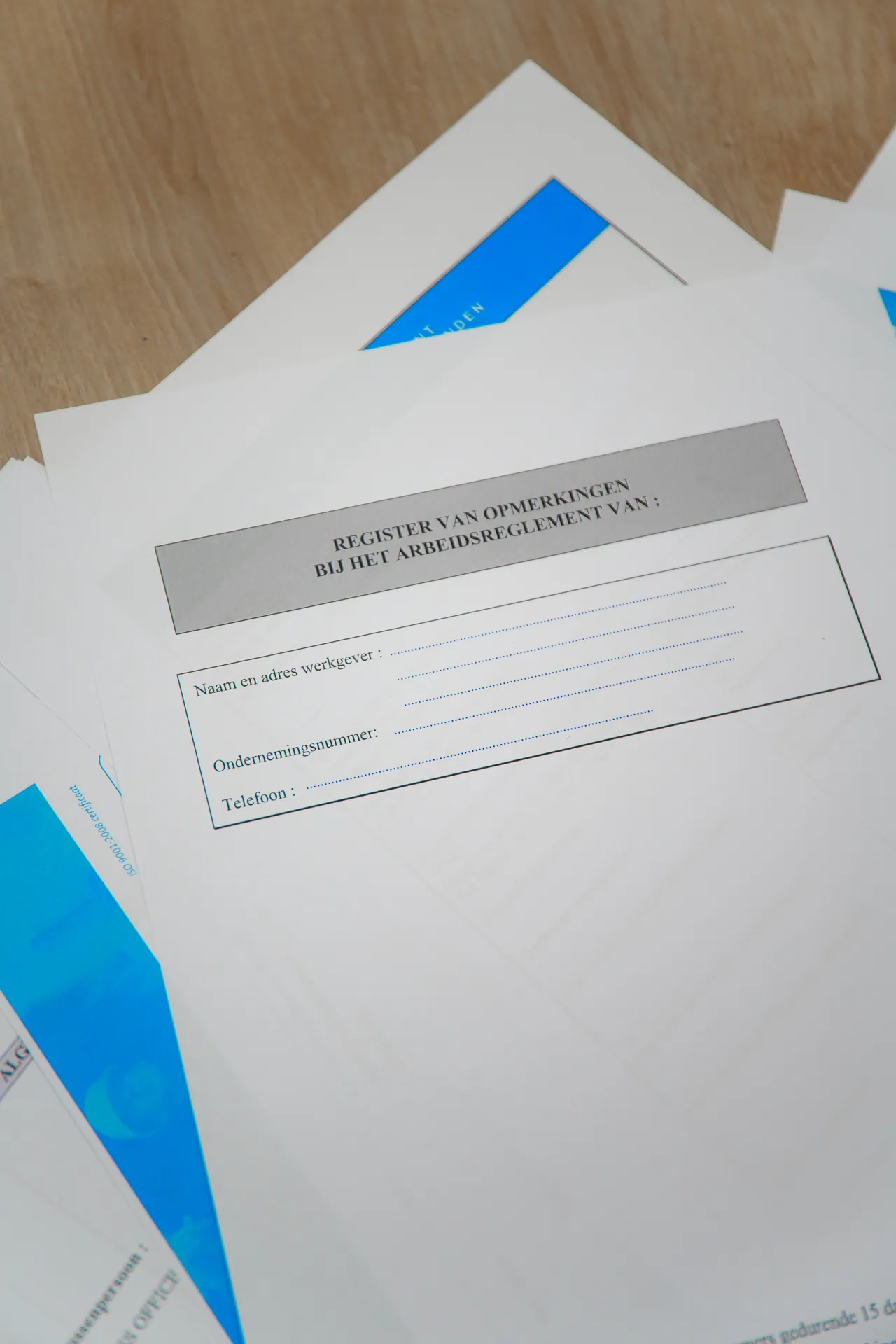
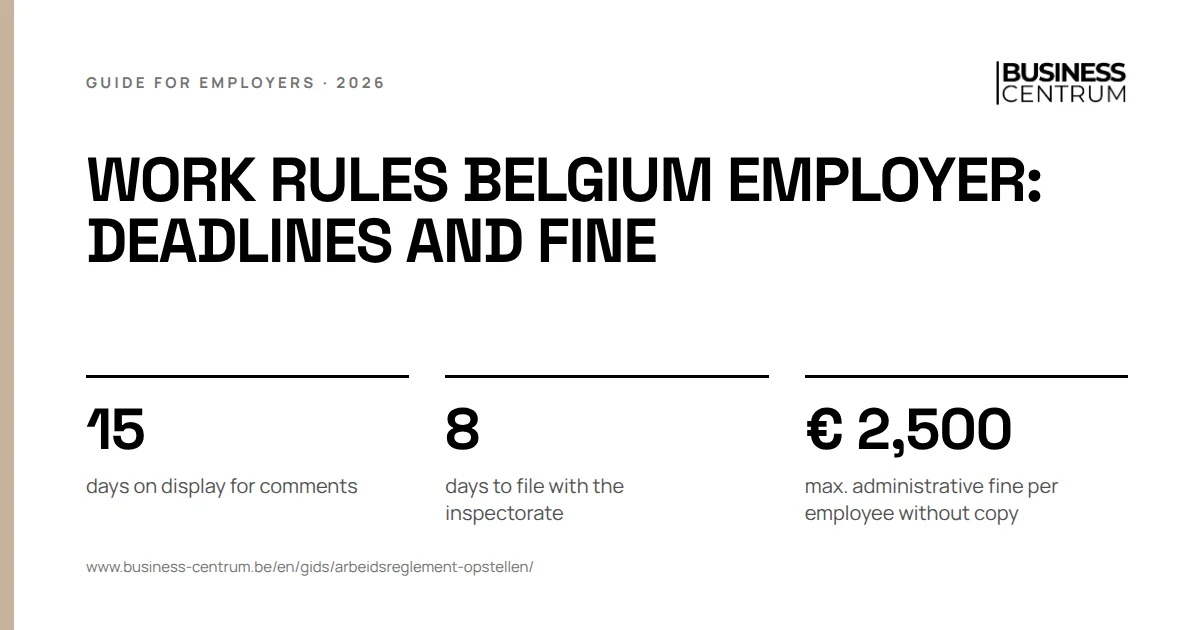
In Belgium, every employer needs work rules from the first employee. Without a works council, you draft the rules, display them for 15 days with a register for comments, and they take effect on the 15th day after posting. You then file them online with the inspectorate within 8 days.
Are work rules mandatory for a Belgian employer?
Yes. The Act of 8 April 1965 requires every private-sector employer to draw up work rules, whatever the number of employees. A sole trader with a part-time shop assistant is covered, and so is a haulier with forty drivers.
You may draw up separate rules per category (blue-collar and white-collar) or per department. A wholesaler with a warehouse team and an office team often does this, because their schedules are so far apart.
The rules bind both employer and employee. For discipline they are the only basis: a sanction that is not in the rules may not be imposed. So this is not a document for the drawer. It is the rulebook you fall back on in every dispute about hours, absence or conduct.
What must your work rules contain?
Article 6 of the Act lists the mandatory items. For an SME, they come down to these blocks:
| Block | What you fill in |
|---|---|
| Schedules | All full-time and fixed part-time schedules, or a framework of normal working time, plus the framework for variable part-time schedules and shift schedules |
| Pay | How you measure and check work, and when, where and how you pay wages |
| End of contract | The procedure and notice periods, or a reference to the law, and the serious reasons for dismissal without notice |
| Discipline | The sanctions, the amount and use of fines, the failings they punish, and how an employee can challenge a sanction |
| Holidays and public holidays | The length of annual leave, collective holidays, public holidays and replacement days |
| Wellbeing | Where the first aider and first-aid kit are, the details of the prevention adviser for psychosocial aspects, and the procedure for violence or harassment |
| Illness | What the employee must do when ill during their holiday, and how you keep in touch with an employee on sick leave |
| Consultation and inspection | Names of the members of the works council, committee and union delegation where they exist, and the addresses of the inspection services |
| Other | The rights and duties of supervisory staff, the applicable collective agreements and the competent joint committee (JC), the right to training, the body that collects social security contributions, and the provider that stores electronically signed contracts |
In practice, the item on electronically signed contracts is the one most often missing. If you have contracts signed electronically, the rules must state which provider stores them and how the employee can access them, also after leaving.
The framework of normal working time
Since 1 June 2026, you no longer have to list every full-time schedule separately. You may set a framework of normal working time instead. It contains four elements:
- the days of the week on which work can be scheduled;
- the daily time window within which work can be scheduled;
- the minimum and maximum daily working time;
- the normal and maximum weekly working time.
Full-time and fixed part-time schedules that fall within that framework no longer need to appear separately. For a business with changing shifts, this is a major simplification. Special rules for specific working arrangements still apply.
A work rules template for an SME with variable schedules
The FPS Employment template gives you the structure but leaves every block empty. Below is a filled-in extract for a brasserie in Ghent with six employees, two of them part-timers on a variable schedule. Use it as a starting point and check it against the collective agreement of your joint committee.
Chapter 2: Working time
Article 4. Framework of normal working time for full-time employees and part-time employees on a fixed schedule. Days: Monday to Sunday, with two rest days per week according to the rota. Daily window: from 9.00 to 23.30. Daily working time: minimum 4 hours, maximum 8 hours. Weekly working time: normally 38 hours, maximum 40 hours.
Article 5. Framework for variable part-time schedules. Days: Monday to Sunday. Daily window: from 9.00 to 23.30. Daily working time: minimum 4 hours, maximum 8 hours. Weekly working time under a variable arrangement: minimum 12 hours, maximum 30 hours. The individual schedule is communicated to the employee through a written and dated notice in the rota app and on the notice board in the kitchen, at least 7 working days in advance.
Article 6. A copy of every notice with an individual schedule is kept where these rules can be consulted, for as long as the schedule applies and for 1 year after that.
The hours in Articles 4 and 5 are this brasserie's own choices, not legal limits. Even alongside a framework of normal working time, the rules must contain a separate framework for variable part-time schedules. The legal notice period for a variable part-time schedule is 7 working days, unless a sector agreement declared generally binding sets a shorter period, with a minimum of 3 working days. In the hotel and catering sector (JC 302), which covers this brasserie, the legal minimum is 3 working days; this brasserie opts for a longer period. Late shifts may fall under the night-work rules. Since 1 June 2026, night work that lies entirely outside the period between midnight and 5 am can be introduced through the ordinary work rules procedure.
Chapter 7: Sanctions
Article 21. In the event of a failing (arriving late without notice, unjustified absence, refusing a task within the job), the employer may impose the following sanctions: an oral warning, a written warning, a fine. Fines per day never exceed 20% of the daily wage in total. The proceeds go to the company's staff fund. Every sanction is notified no later than the first working day after it is established and entered in the sanctions register before the next payday.
Download this template in Word and PDF, in Dutch and French.
The one-fifth limit on the daily wage and the notification deadline come straight from the Act. A fine notified later is void. For how to word a warning, read our article on warning an employee.
Drafting and filing work rules in Belgium: the procedure step by step
Most SMEs have no works council. In that case, follow these steps.
- Draft the rules. Start from the FPS template and complete every mandatory block. Date and sign it.
- Post the draft. At the registered office, in a visible and accessible place. Each employee may also ask for a copy of the draft.
- Open a register. For 15 days from posting, employees write their comments in it. They may also send signed comments straight to the inspector. Their name then stays confidential.
- Send the register to the inspectorate. As soon as the period ends, the register goes to the inspector of the Social Legislation Inspectorate.
- No comments? The rules then take effect on the 15th day after posting.
- Comments? The inspector tries to reconcile the positions within 30 days. If that works, the rules apply 8 days after the conciliation. If not, the file goes to the joint committee, which decides.
- Give each employee a copy. Have them sign for receipt. The FPS has a template receipt for this.
- File the rules. Within 8 days of entry into force, you send a copy to the regional office of the Social Legislation Inspectorate. Since 15 May 2019, this can be done online with your eID.
- Post a notice. The notice says where the rules can be consulted. Keep a copy at every place where you employ people, including temporary sites.
If there is a works council, it draws up the rules. They take effect 15 days after agreement in the council. If there is disagreement, the same conciliation by the inspector and the joint committee follows.
Amending work rules: which procedure applies?
An amendment in principle follows the same procedure as drafting: draft, posting, a register for 15 days, entry into force, a copy for every employee and filing within 8 days. In practice, you amend the rules more often than you think:
- you introduce a new schedule outside the existing framework;
- you start signing contracts electronically;
- your prevention adviser or external service changes;
- the collective holidays or replacement days for public holidays change;
- you hire more staff and set up a consultation body.
Since 1 June 2026, there is some relief. If there is no agreement on an amendment that extends an existing framework of normal working time or introduces a new schedule, the joint committee decides validly with the votes of all present representatives of at least one employers' and one employees' organisation. For other disputes, 75% of the votes of each side is still required.
Some changes can be made faster. A temporary change to the start and end of the working day, for example during an exceptional peak, must be announced at least 24 hours in advance by a dated and signed notice. Replacement days for public holidays and the formalities for illness during holidays also follow a simpler route. If you are unsure which procedure applies, read our article on changing a work schedule as an employer.
Which mistakes do employers make with their work rules?
With new clients, we see the same five problems again and again.
The rules were copied and never updated. Rules taken over from a previous owner or a neighbouring business mention other schedules, another joint committee and a prevention adviser who left years ago. During an inspection, what is written counts, not what you meant.
The schedules on the floor do not match the rules. An employee working outside the working time in the rules is one offence per employee. In hospitality and transport, where shifts move every week, this is the classic case. The framework of normal working time solves a lot, but only if you actually include it.
No proof of the copy. The rules are on the wall, but nobody signed for receipt. In a disciplinary dispute, you are then on weak ground.
Filing was forgotten. An amendment is only complete once it reaches the inspectorate within 8 days. Many employers post the draft correctly and stop there.
Fines the law does not allow. A fixed fine for every late arrival, without a cap, conflicts with the one-fifth-of-daily-wage rule. A fine that was not notified in time is void.
What do you risk without proper work rules?
The Social Penal Code punishes most work rules offences with a level 2 sanction. For offences from 1 February 2026, that means an administrative fine of € 250 to € 2,500, or a criminal fine of € 500 to € 5,000. Missing mandatory items, such as the schedules or the location of the first-aid kit, is level 1: € 100 to € 1,000.
| Offence | Level | Multiplied per employee? |
|---|---|---|
| No valid work rules | 2 | No |
| Mandatory item missing | 1 | No |
| No copy for every employee | 2 | Yes |
| Not filed in time | 2 | No |
| Amendment without proper procedure | 2 | No |
| Work outside the working time in the rules | 2 | Yes |
Worked example
A cafeteria in East Flanders with eight employees is inspected. The rules are posted, but no employee received a copy. That offence is multiplied by the number of employees concerned.
- Minimum: 8 x € 250 = € 2,000
- Maximum: 8 x € 2,500 = € 20,000
If the same eight people also worked shifts that are not in the rules, a second level 2 offence is added, again multiplied by eight. The multiplied fine cannot exceed 100 times the maximum. If you receive a letter or visit from the inspectorate, it pays to have rules that match your practice.
Your first employee: what else is needed?
Work rules are one of the documents that must be ready before day one. You also file the Dimona declaration, take out workplace accident insurance, join an external prevention service and draw up the employment contract. Do not forget the NSSO reduction for your first employee either: you have to have it applied in the declaration yourself.
What Business Centrum does for you
We draft your work rules or rewrite your existing ones, with your actual schedules or a framework of normal working time that fits your rota. We prepare the posting and the register, track the deadlines and file the rules with the inspectorate. With every new hire we add the receipt to the contract, and with every change in schedules or prevention service we update the rules. Your payroll runs through Business Centrum, together with Acerta.