
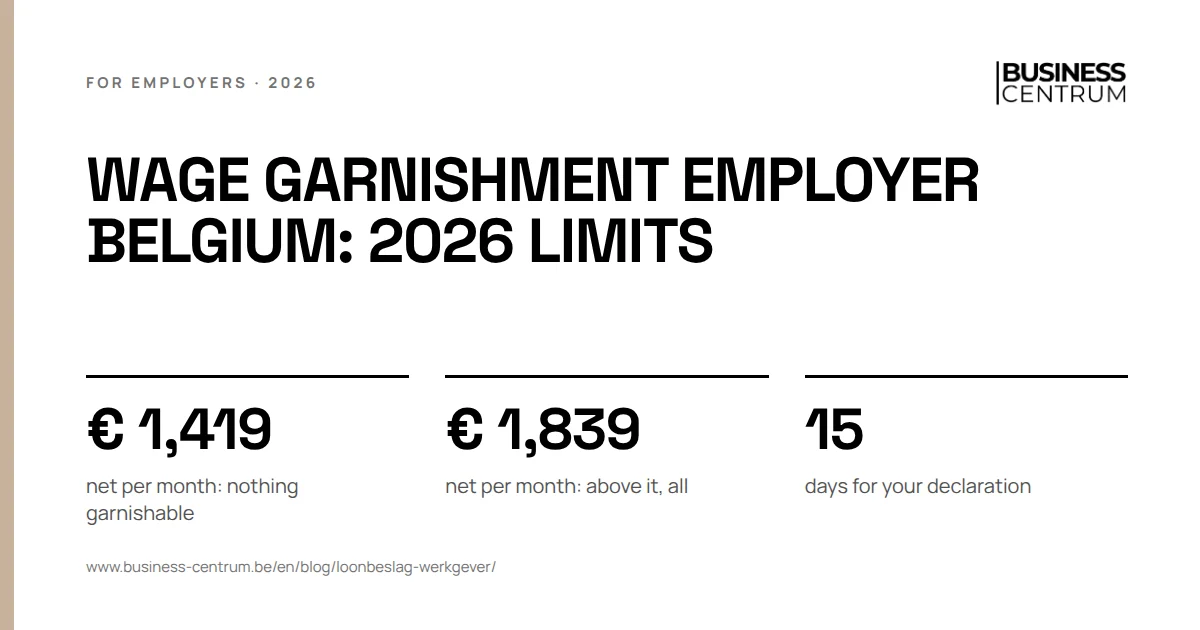
If you receive a wage garnishment as an employer in Belgium, since 1 January 2026 you withhold nothing on net monthly pay up to € 1,419 and everything above € 1,839. In between there are three bands of 20%, 30% and 40%, minus € 88 per dependent child. Within 15 days you send the garnishee declaration.
Is wage garnishment mandatory for employers?
Yes. In a wage garnishment you are the "garnishee": you owe the employee a wage, and one of the employee's creditors attaches that wage. The order usually comes from a court bailiff.
From the moment you receive the order, you may no longer pay the garnishable part to the employee. If you pay it out in full anyway, the court can declare you liable for the employee's debt. Nor do you choose whether to cooperate: you apply the garnishment until the bailiff lifts it.
A wage assignment is something else. There the employee has agreed himself, for a loan for example, that a creditor may receive part of his wage. You withhold then too, but under a different procedure, explained below.
How much do you withhold? The 2026 wage garnishment limits
The limits apply to net pay per calendar month, so after social security contributions, withholding tax and any personal contributions to supplementary social security, such as a supplementary pension. They are indexed every year on 1 January, and in between if the index moves by more than 5% during the year. The 2026 limits have applied since 1 January 2026.
| Net monthly pay | Garnishable part |
|---|---|
| Up to € 1,419 | Nothing |
| From € 1,419 to € 1,524 | 20% of that part |
| From € 1,524 to € 1,682 | 30% of that part |
| From € 1,682 to € 1,839 | 40% of that part |
| Above € 1,839 | Everything |
Holiday pay is also covered by the garnishment. Meal vouchers that meet the legal conditions cannot be garnished. If the employee does not work a full month or has other income, the calculation may differ. Have it checked by whoever runs your payroll.
Worked example with dependent children
A lorry driver earns € 2,100 net a month. He has two dependent children and gave you the form in time.
| Band | Calculation | Garnishable |
|---|---|---|
| Up to € 1,419 | nothing | € 0.00 |
| € 1,419 to € 1,524 | € 105 x 20% | € 21.00 |
| € 1,524 to € 1,682 | € 158 x 30% | € 47.40 |
| € 1,682 to € 1,839 | € 157 x 40% | € 62.80 |
| Above € 1,839 | € 2,100 - € 1,839 | € 261.00 |
| Subtotal | € 392.20 | |
| Two dependent children | 2 x € 88 | - € 176.00 |
| Withheld | € 216.20 |
The driver keeps € 1,883.80. If a colleague with one child earns € 1,600 net, the garnishable part is € 43.80. After deducting € 88 for the child, nothing is left: you withhold nothing. To see the net pay for another gross wage, use our gross-to-net calculator.
Dependent child: when does it count?
Not automatically. The employee receives an official form when the garnishment is served on him and gives it to you against a receipt or by registered post, with proof such as a household composition certificate or a health insurance fund certificate. The reduction applies from the month after receipt, provided you received the form at least 10 working days before the usual payday. One declaration per procedure is enough, even if more creditors join later.
The wage garnishment procedure for employers, step by step
- Receive the order and freeze. From that day you no longer pay out the garnishable part.
- Make the garnishee declaration within 15 days. By registered post or against a receipt to the bailiff or creditor, with a copy to the employee.
- The bailiff serves the garnishment on the employee within 8 days. That is not your job, but the employee often comes to you about it.
- Wait for the opposition period. In an executory garnishment, the employee has 15 days after service to lodge an objection with the attachment judge.
- Pay over. In an executory garnishment, you pay the bailiff no earlier than 2 days after that period ends. In a protective garnishment, you keep the amounts aside until further instructions.
- Recalculate every month. Net pay fluctuates, and so does the garnishable part.
- Stop only once it is lifted. The bailiff tells you when the debt has been paid.
If the employee leaves, tell the bailiff and apply the garnishment to the final settlement. The documents you still have to issue are in our article on social documents on dismissal.
A template garnishee declaration for employers
Garnishee declaration
[Employer name], [company number], [address]
To [court bailiff, office, address], file [reference]
Subject: garnishment against [employee name], served on [date]
- [Employee name] has been employed by us since [date] under a [permanent/fixed-term] employment contract.
- His net pay is approximately € [amount] a month. Pay is made on the [day] of the month.
- At the time of the garnishment we had received [no / the following] other garnishments or wage assignments: [creditor, date, amount].
- [If applicable:] The employee has submitted a dependent child declaration for [number] children.
- From the pay for [month] we withhold the garnishable part under Article 1409 of the Judicial Code.
A copy of this declaration is provided to the employee.
[Date, name and signature]
Download this template in Word and PDF, in Dutch and French.
Wage assignment: a different procedure
In a wage assignment, the creditor first sends the employee a notification and sends you confirmation of it. The employee has 10 days to object. If you receive his objection, you inform the creditor within 5 days and withhold nothing until the justice of the peace validates the assignment. Without an objection, you withhold from the creditor's decision to enforce the assignment. The same limits apply.
Competing garnishments, assignments and tax garnishment
If you receive several garnishments or assignments for the same employee, you withhold the garnishable part only once. You do not decide who gets paid first.
- Maintenance comes first. The limits do not apply to maintenance obligations. What you withhold for maintenance reduces what other creditors can still receive.
- Ordinary garnishments share. The bailiff divides the garnishable part in proportion to the debts. You then pay the bailiff, not the creditors.
- A wage assignment takes its rank through the notice the bailiff sends to the central register of attachment notices. An assignment registered before the garnishment in principle comes first. If two assignments clash, you pay the assignable part to a bailiff or a sequestrator, who decides the order.
- Tax garnishment. The tax collector can garnish by registered letter, without a bailiff, and has priority over ordinary creditors. The limits still apply.
If you are unsure about the order, ask the bailiff in writing and keep his answer.
Mistakes employers make
- Forgetting the declaration because the employee says he will "sort it out with the creditor".
- Calculating on gross pay instead of net pay.
- Forgetting dependent children after the employee handed in the form in time.
- Paying one creditor when claims compete instead of the bailiff.
What Business Centrum does for you
Every month we calculate the garnishable part in the payroll, take dependent children and competing claims into account, and make sure the payments are correct, together with Acerta. We also help you draw up the garnishee declaration correctly within 15 days.