What exactly is DIMONA?
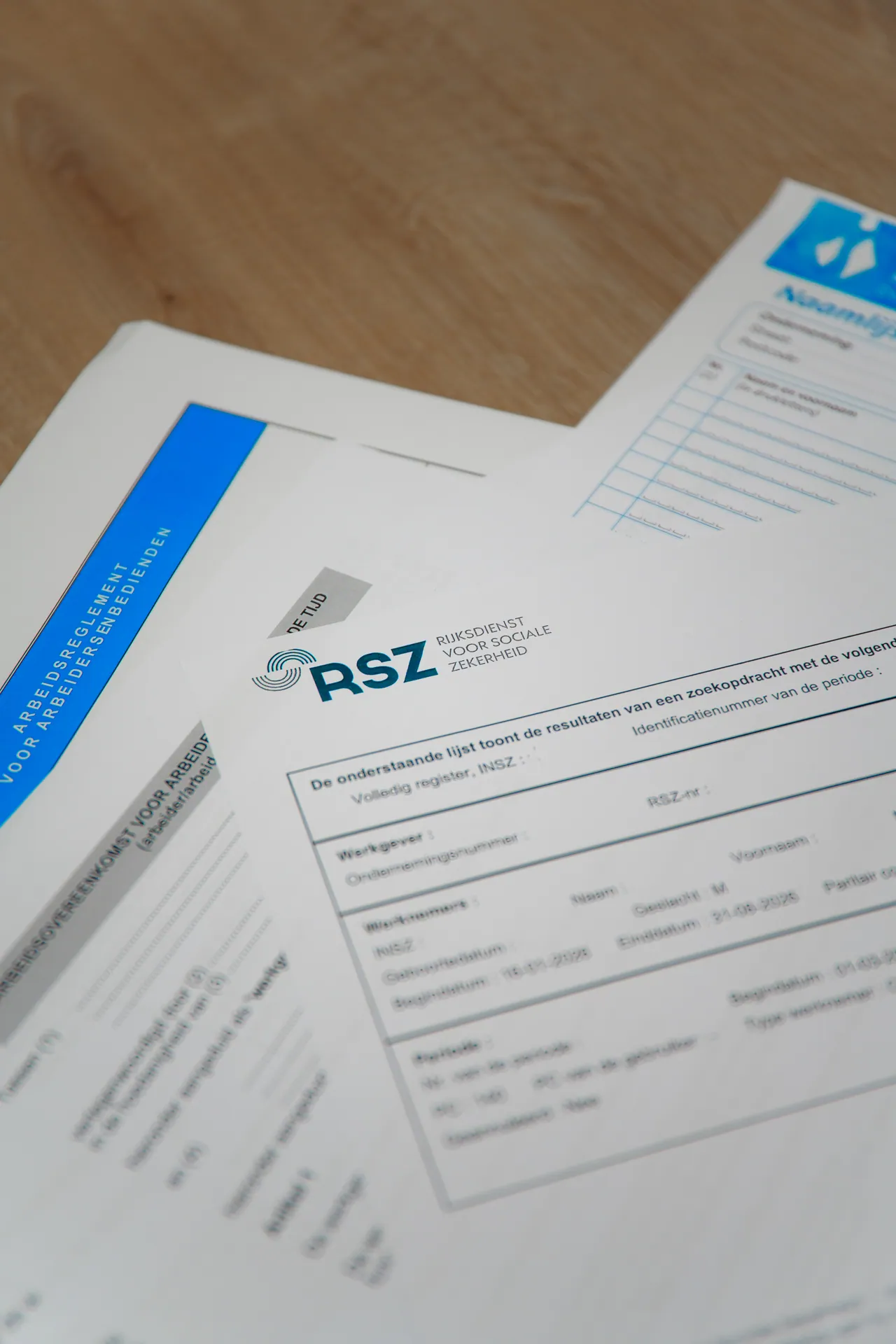
DIMONA stands for Déclaration Immédiate / Onmiddellijke Aangifte (Immediate Declaration). It is an electronic system through which employers immediately notify the National Social Security Office (NSSO) of the start and end of an employment relationship. The declaration is submitted via the social security portal or through an approved social secretariat. Pay and working time are then reported each quarter in the DmfA return.
Since 2003, the system has applied to all employers in the private sector, the public sector, provincial and local authorities, and the non-profit sector. Without a valid DIMONA declaration, the employer is in breach of the law, which creates problems for both employer and employee.
Who must submit a DIMONA declaration?
Every employer who employs staff in Belgium is required to submit a DIMONA declaration. This applies to permanent contracts, temporary contracts, student employment, flexi-jobs, and even occasional workers in the hospitality and agriculture and horticulture sectors. It makes no difference whether it concerns one hour a week or a full-time contract.
This also applies to foreign employers whose employees in Belgium are subject to Belgian social security. If posted workers remain under the scheme of their own country, there is no DIMONA, but usually a Limosa notification (the notification system for posted workers).
What information does a DIMONA declaration contain?
A DIMONA declaration contains the following information:
- National register number of the employee (national register number or BIS number)
- Employer number (NSSO number)
- Type of employee: ordinary employee, student, flexi-jobber, occasional worker
- Start date of employment
- End date (if applicable, for example for a fixed-term contract)
- Joint committee number under which the employee falls
For student employment, the system also records the quota of 650 hours per calendar year. Once that quota is exceeded, the reduced social security contributions no longer apply, and the student must be declared as a regular employee.
Deadlines: when must the declaration be made?
The timing of your DIMONA declaration is set by law and varies depending on the type of employment:
Regular employees (permanent or temporary): the declaration must be made at the latest at the moment the employee actually starts working. In practice, this means you submit the DIMONA before the first working day.
Students: here too, the declaration must be submitted before work begins. State the correct number of hours per quarter and the end date.
Flexi-jobbers: the declaration must be submitted per quarter or per day, depending on the contract: per quarter for a written flexi-job employment contract, per day with start and end time for an oral one.
Occasional workers (agriculture and horticulture): a daily declaration is mandatory here, stating the start and end time of the work.
End of employment: the termination notification must be submitted at the latest on the first working day after the end of the employment relationship.
What are the penalties for late or missing declarations?
The Social Inspectorate actively monitors whether employers comply with their DIMONA obligations. In the event of violations, you as an employer risk:
Administrative fines of 3,000 to 35,000 euros per missing declaration. These fines are multiplied by the number of employees involved. With five employees without a declaration, the fine therefore comes to 15,000 to 175,000 euros.
Criminal fines of 6,000 to 70,000 euros per violation, with the same multiplication factor. For a legal entity, such as a company, it is 30,000 to 720,000 euros. In serious cases, the labour auditor can also initiate criminal prosecution.
Joint and several liability in case of subcontracting. It does not depend on the DIMONA: for construction works, the client or contractor is jointly and severally liable for the social security debts of a (sub)contractor that already had such debts when the contract was concluded, up to the price of the works (art. 30bis of the NSSO Act).
In addition, you lose the right to certain NSSO contribution reductions if the DIMONA declaration is not submitted on time. This can significantly increase your total wage cost.
DIMONA for special employment statuses
Certain categories of employees require extra attention when it comes to the DIMONA declaration:
Flexi-jobs: require a framework agreement, a flexi-job employment contract for each period of work and a DIMONA FLX per quarter (per day with an oral contract). In the hospitality sector (PC 302), the minimum flexi hourly wage has been €12.11 per hour since 1 September 2026, plus €0.93 per hour in flexi holiday pay (= €13.04 all-in). For other sectors, the sectoral pay scale minimum applies.
Occasional workers in hospitality: are declared per day through the DIMONA system. The daily flat rate is 69.12 euros per day (11.52 euros per hour started) for the calculation of NSSO contributions, since the third quarter of 2026. That flat rate applies to a maximum of 50 days per calendar year per worker.
Internships and apprenticeship contracts: the declaration is mandatory for every intern or apprentice who performs work, even if unpaid. For apprentices in dual learning you use type ALT, for interns not subject to social security type STG.
How we handle this
We handle the complete DIMONA administration for our clients. From creating the declaration to tracking deadlines and correcting errors: you don't need to worry about a thing. Our team checks every declaration for completeness and accuracy before it is submitted.
At Business Centrum, we work with a proactive system. This means we notify you in good time when a contract is about to expire, when a student quota is nearly reached, or when a flexi-job framework agreement needs to be renewed. This way, you avoid fines and remain compliant with the law at all times.
Would you like certainty about your DIMONA declarations? Feel free to contact us for a no-obligation conversation.