
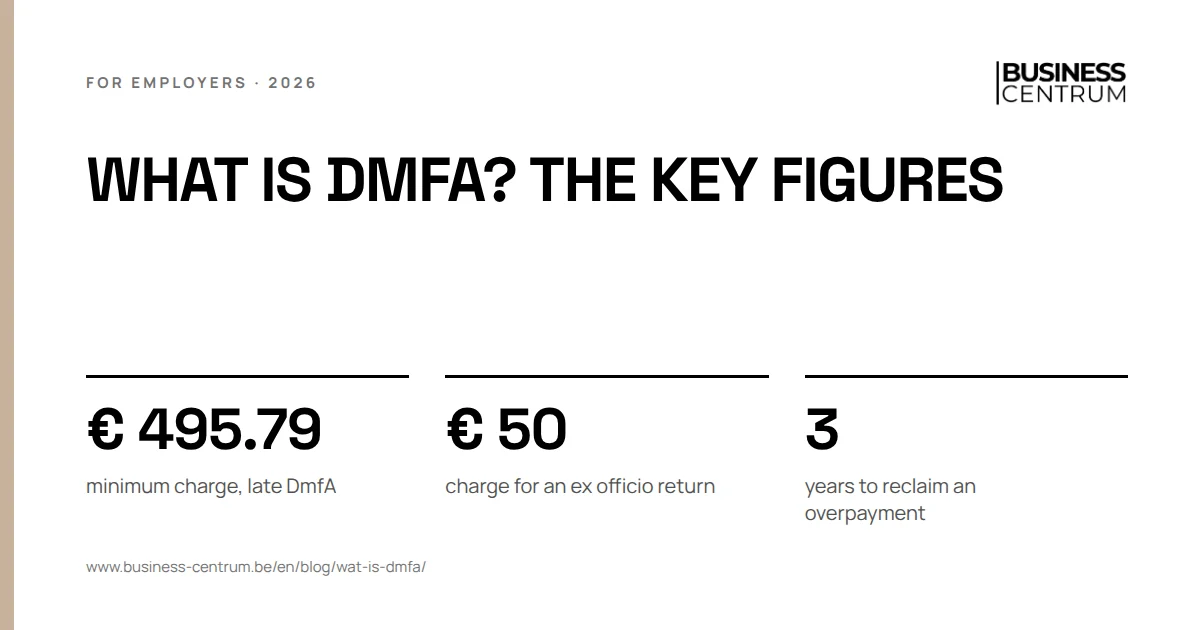
The DmfA is the quarterly return in which you, as the employer, tell the NSSO what pay you gave and how much each employee worked. The NSSO calculates your contributions from it. You file it electronically, by the last day of the month after the quarter at the latest. Filing late costs a flat-rate charge of at least € 495.79.
What is DmfA?
DmfA stands for Déclaration multifonctionnelle / Multifunctionele Aangifte, the multifunctional return. "Multifunctional" says what it is for: with a single return you pass data to the whole social security system. The NSSO uses it to calculate contributions. Health insurance funds, the National Employment Office, the pension service, Fedris and the holiday funds use the same data to calculate benefits.
That is why an error in the DmfA affects the employee. If days are missing, their sickness benefit, unemployment benefit or pension may come out lower. If a pay component is missing, you pay too little in contributions and a correction with a penalty follows.
You file one return per quarter for the whole company, with every employee in it. Each employee is identified once by their national registration number (INSZ).
DmfA and Dimona: what is the difference?
Employers often mix up the two returns. They complement each other:
| Dimona | DmfA | |
|---|---|---|
| What | start and end of an employment | pay, working time and contributions |
| When | before the employee starts, and at the end | every quarter, afterwards |
| Purpose | knowing who works for you and when | calculating contributions and granting benefits |
| Penalty | administrative fine of € 3,000 to € 35,000 per employee | flat-rate charges, see below |
Anyone reported through Dimona automatically appears in the staff file of the DmfA. A forgotten Dimona therefore often only comes to light with the DmfA. How Dimona works is explained in our article on Dimona. What a late report costs is set out in our guide on late Dimona.
What does the DmfA declaration contain?
For each employee, the return has three layers:
- The worker line. It holds the worker code, which determines which contribution rates apply, for instance for a manual worker, a white-collar employee, a student or a flexi-jobber. If a manual worker becomes white-collar during the quarter, they get two worker lines.
- The employment lines. They hold the joint committee, the type of contract, the working arrangement and the number of hours per week. If someone moves from full-time to part-time, you open a new employment line.
- Working time and pay. Each day gets a service code: worked, holiday, sickness with guaranteed pay, short leave, temporary unemployment. Each pay component gets a pay code: ordinary pay, bonuses, holiday pay on leaving, notice pay.
At the end of the worker line come the contributions and the reductions, such as the structural reduction and the first-hire reduction. The base contribution for most employees is 25%. How it is built up is explained in our article on what RSZ is.
DmfA deadline: when and how do you file?
You file the DmfA within the month after the quarter, so by the last day of April, July, October and January. The contributions must be in the NSSO's account on the same day.
- Online. Small employers fill in the return themselves on the secure social security portal.
- By file transfer. Social secretariats, software houses and large employers send files directly.
After filing you get an acknowledgement of receipt and a notice of the contributions due. The NSSO can still check and amend a filed return later, even if you already received an overview of contributions.
What if the DmfA declaration is late, incomplete or incorrect?
The NSSO then draws up or corrects the return ex officio and charges flat-rate amounts:
| Situation | Penalty |
|---|---|
| No return by the deadline | at least € 495.79, higher as contributions are higher |
| Ex officio return or correction after an inspection | € 50 plus € 4 per missing or amended employment line |
| Incomplete or incorrect two quarters in a row | the same amounts as for a late return |
A return is incomplete or incorrect if, 6 months after the quarter, at least 5% of the persons or of the payroll is still missing.
Amending a DmfA return
Found a mistake? You can amend a filed return yourself through the same channels as the original. You call up the return and adjust the data. That is possible while the limitation period runs. If you paid too much, for instance because a reduction was forgotten, you can reclaim those contributions up to 3 years after payment. A forgotten reduction for your first employee can still be recovered this way, see our guide on the first employee reduction.
What Business Centrum does for you
Every quarter, we enter each employee's working time, absences and pay components correctly in the DmfA and check that every reduction you are entitled to is included, together with Acerta. Differences between Dimona and DmfA are caught before the NSSO finds them. More on your payroll administration and the management of your Dimona returns.