
Joint committee 201
Independent retail
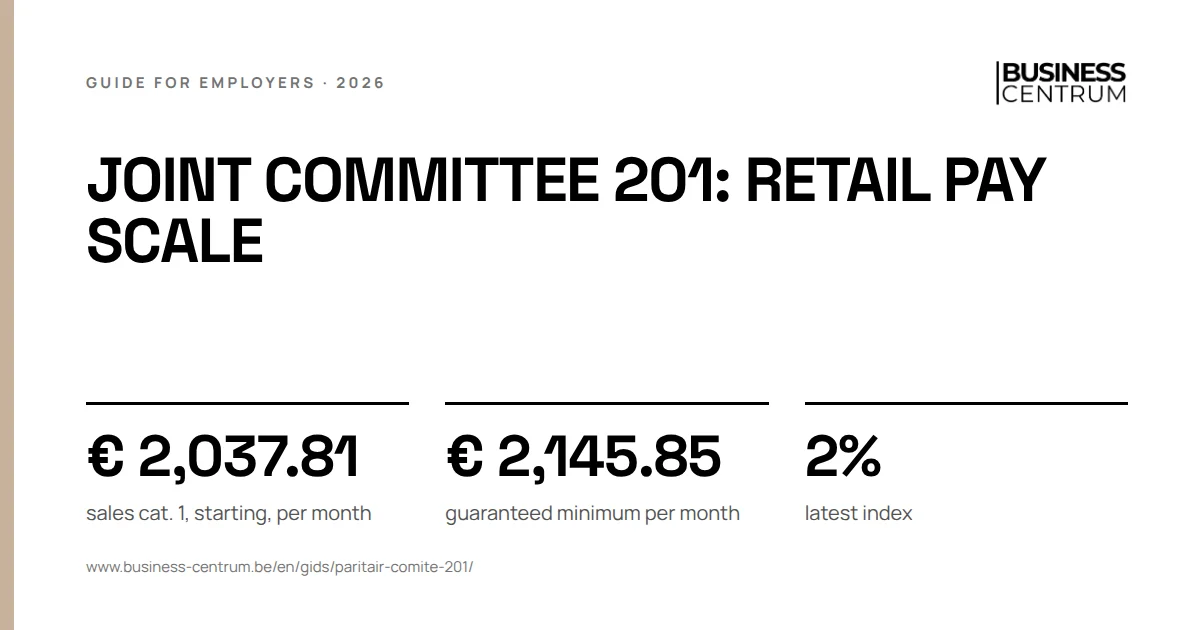
Joint committee 201 (PC 201) covers employees in independent retail in Belgium: non-food shops with fewer than 50 employees and food shops that stay below the PC 202 thresholds. Minimum wages rose by 2% on 1 May 2026. A sales assistant without experience in a business with fewer than 20 employees now earns at least € 2,037.81 gross per month.
PC 201 • Independent retail
By Business Centrum editorial teamPublished
Updated and figures checked on
- Latest indexation
- +2%
- 1 May 2026
- Lowest pay scale
- € 2,037.81
- sales staff, fewer than 20 employees
- End-of-year bonus
- 100%
- of monthly pay, in December
- Eco vouchers
- € 250
- per year, full-time
Scope
Who falls under joint committee 201?
PC 201 covers the employees of shops that sell to consumers and do not fall under another retail committee. Think of the independent shopkeeper, the franchisee and the small chain: a clothing shop, shoe shop, toy shop, bakery, butcher or convenience store.
Two questions decide the committee: what do you sell, and how many employees do you have? Once your business crosses a threshold, another committee becomes competent, with different pay scales and bonuses.
| Your business | Threshold | Committee |
|---|---|---|
| Non-food shop: clothing, shoes, home decor, electronics | fewer than 50 employees | PC 201 |
| Non-food retail chain | 50 employees or more | PC 311 |
| General food shop: convenience store, franchised supermarket | fewer than 20 employees | PC 201 |
| General food shop | 20 employees or more | PC 202.01 |
| Specialised food shop: bakery, butcher, cheese, wine | fewer than 50 employees | PC 201 |
| Specialised food shop or food chain | 50 employees or more, or a head office with at least 2 branches and 25 employees | PC 202 |
| Department store with a broad range across several branches | at least 3 trade branches and 50 employees or more | PC 312 |
| Wholesale, office or services without their own committee | none | PC 200 |
Group 1 or group 2
Within PC 201, the pay scale depends on your business group. Group 1 covers shops with a single outlet and on average no more than 10 sales staff and cashiers over the past year, and businesses with several outlets or itinerant trade with no more than 15 sales staff and cashiers in total. Anything above that is group 2, with its own scale and an extra category 2 bis for experienced sales staff.
Company size also counts: fewer than 20 employees, or 20 and more. That line decides which pay scale and which guaranteed minimum apply.
How to count your employees
For the 20-employee threshold, take the average number of employees on the payroll at the end of each quarter, from the last quarter of two years ago up to the third quarter of last year. In your first year, use the number at the end of the first quarter.
PC 201 covers white-collar employees: sales staff, cashiers, administrative staff and branch managers. Blue-collar workers in your business, for example in the workshop of a bakery or butcher, do not fall under these scales. Their committee depends on the activity.
Minimum wages from 1 May 2026
Joint committee 201 pay scale for sales staff
The table shows the gross minimum monthly wages for group 1 sales staff after the indexation of 1 May 2026. They apply to a full-time employee. For part-time work you pay pro rata.
Experience means professional experience in the broad sense of the sector agreement: not only time with you, but also previous jobs, self-employment, periods of unemployment or sickness, studies and time at home for the family. Student work does not count. Determine that experience carefully at hiring, because it sets the step on which the employee starts. What your employee takes home, you can check with the gross-net calculator.
| Experience | Cat. 1 | Cat. 2 | Cat. 3 | Cat. 4 |
|---|---|---|---|---|
| Fewer than 20 employees | ||||
| 0 years | € 2,037.81 | € 2,094.97 | € 2,126.02 | € 2,258.40 |
| 5 years | € 2,037.81 | € 2,178.55 | € 2,331.69 | € 2,441.74 |
| 10 years | € 2,052.07 | € 2,351.91 | € 2,560.51 | € 2,747.01 |
| 20 employees or more | ||||
| 0 years | € 2,040.78 | € 2,097.93 | € 2,137.26 | € 2,295.82 |
| 5 years | € 2,040.78 | € 2,189.80 | € 2,342.89 | € 2,479.18 |
| 10 years | € 2,061.55 | € 2,363.09 | € 2,571.73 | € 2,784.43 |
Minimum wages PC 201, sales staff group 1, gross per month, valid from 1 May 2026
A category 1 employee moves up to category 2 after 6 months of seniority in your company. The category follows the job and its responsibility. Administrative staff and group 2 have their own scales.
A branch manager who only handles sales and gets no housing from the employer earns at least € 2,493.97 below 20 employees and € 2,507.91 from 20 employees.
The guaranteed minimum is higher
For employees on a permanent contract, a sector guaranteed average minimum monthly income (GGMMI) also applies. It sits above the lowest pay scales. It is an average over the year, bonuses included: when you pay the end-of-year bonus, you settle the account and pay any shortfall.
| Size | Start | After 6 months | After 12 months |
|---|---|---|---|
| Fewer than 20 employees | € 2,145.85 | € 2,200.56 | € 2,262.47 |
| 20 employees or more | € 2,159.74 | € 2,214.48 | € 2,276.36 |
Indexation
PC 201 indexation: no fixed month
PC 201 does not index on a fixed date. Wages rise by 2% as soon as the average of the smoothed health index over the last two months reaches the sector's next pivot index. The increase applies from the first day of the following month.
Indexation applies to the minimum wages and also to the wages you actually pay. If you pay above the scale, that higher wage rises too. Since 1 June 2026, however, the cent index applies: for a full-time gross monthly wage above € 4,000, the first 2% of indexation applies only to that € 4,000, after that to the full wage again.
The latest step was on 1 May 2026. When the next one comes depends on inflation. We follow the index every month and adjust wages in the month it is due.
Recent indexations
- 1 May 2026+2%
- 1 April 2025+2%
- 1 October 2024+2%
Laid down in a sector agreement
The link to the health index is set out in a collective agreement of indefinite duration. It applies to every employer in PC 201, including those without a union delegation.
Bonuses and benefits
What you pay on top of wages
The PC 201 list is short, but every bonus is mandatory. A forgotten bonus usually returns later as a correction, with arrears.
End-of-year bonus
100%
Employees on the payroll on 31 December with at least 6 months of seniority are entitled. Anyone who worked the whole year receives a full month's pay. Otherwise the bonus follows the days worked and treated as worked, and up to 60 days of sickness or accident per year count as worked. Anyone who leaves after at least 6 months receives a share, also after dismissal by you, retirement or mutual agreement. After resignation or dismissal for serious cause, no bonus is due. You pay between 15 and 31 December.
Eco vouchers
€ 250
A full-time employee receives € 250 in eco vouchers per year, a part-timer pro rata. The reference period runs from April to March and you pay in April. Instead of eco vouchers you may pay a gross bonus of € 188.
Annual bonus
€ 188
Separately from the eco vouchers, you pay an annual bonus of € 188 gross for a full-time employee with the August salary, calculated over August to July. If your business already gave meal vouchers, the bonus could be converted into € 1 more per meal voucher.
Meal vouchers
Not required
The sector does not require meal vouchers. If you give them, you record this in a company agreement or a written individual agreement. Payroll administration tracks the days on which they are due.
Commuting
€ 0.29/km
For the train, you contribute to the season ticket under the national rules. By bike you pay € 0.29 per kilometre, up to 40 km there and back. If the employee comes only by private transport, such as a car, you pay per working day 50% of the price of a second-class NMBS/SNCB monthly season ticket for the same distance, capped at the amount for 10 km one way.
Evening work
+25%
In companies with more than 30 employees, employees receive a supplement of 25% on their normal pay for work after 19:00.
Social Fund bonus
€ 75/hr
If you give a part-time employee more hours in an open-ended contract of at least half-time, Social Fund 201 pays you € 75 per extra hour, up to 15 hours. The employee has worked for you for at least a year and you apply within 24 months.
Sunday work and opening hours
Sunday work in PC 201
Since 13 August 2026, a shop may open every day from 5:00 to 21:00: the mandatory weekly closing day is gone. The rules for your staff stayed the same. An open door on Sunday does not mean your employees may work the whole Sunday.
Sunday work remains prohibited in principle. Every shop may employ staff on Sunday from 8:00 to 12:00. Bakeries, butchers, food shops with fewer than 5 employees per shop, newsagents, tobacconists and florists may work the whole Sunday.
Work rules first
If you plan Sunday work or late hours, those schedules must be in the work rules before you use them. A shopping Sunday without a matching schedule is an infringement, even if the employee agrees.
- Free Sundays
- On top of that, you choose 3 Sundays per year to work all day, for example during the sales.
- Additional Sundays
- Another 3 Sundays are possible because the sector agreement sets the pay for them: you pay a supplement of 50%. With a works council or union delegation, a company agreement governs these Sundays. Without one, they are only possible there with an individual arrangement of at least 100% supplement.
- Compensatory rest
- Anyone who works on Sunday gets unpaid compensatory rest within 6 days: a full day for more than 4 hours of work, at least half a day for 4 hours or less.
- Overtime
- A full-time week is 38 hours. In businesses with fewer than 20 employees, overtime only starts above 39 hours. Overtime earns a 50% premium, on Sunday 100%.
- Free weekends
- Under the new sector agreement, an employee in a shop with more than 5 staff may ask for 8 weekends off per calendar year, on top of the main holiday. It is not extra leave: the usual rest day of that week moves to the weekend. You plan them by mutual agreement, not in July, August or December. Students and flexi workers do not have this right.
Students and flexi-jobs
Extra hands in the shop
Student workers
A student works up to 650 hours per calendar year with a solidarity contribution: 5.42% for you and 2.71% for the student. Above that you pay normal social security. You declare the hours in advance with a Dimona STU. The full rules are on student jobs as an employer.
PC 201 has its own student wage: a percentage of the category's starting wage, based on the student's age.
| Age | Of starting wage |
|---|---|
| 21 or older | 100% |
| 20 | 96% |
| 19 | 92% |
| 18 | 88% |
| 17 | 84% |
| 16 or younger | 80% |
Flexi-jobs
Flexi-jobs are allowed in PC 201. The flexi wage is at least the pay scale of the job and at most 150% of it. On top comes 7.67% flexi holiday pay. You pay a special employer contribution of 28%; the worker pays no social security.
The flexi worker has a main job of at least four-fifths elsewhere or is retired, and has no regular contract with you. For the worker, flexi income stays tax-free up to € 18,440 per year; for a pensioner there is no ceiling. What a flexi worker really costs you is explained in flexi-job cost for the employer.
Dimona
Dimona in the shop
Every employee is registered with a Dimona declaration before they start. In retail, three types come up most often.
| Type | For whom | Watch out |
|---|---|---|
| OTH | Employees on a regular contract, full-time or part-time | Declaration at the latest at the start, exit on departure. For a fixed-term contract you can give the end date straight away; no separate exit is then needed. |
| STU | Student workers with a student contract | Per quarter, in advance, with the planned number of hours. If the declaration is late, the solidarity contribution does not apply to the hours in that declaration and you pay ordinary social security contributions. |
| FLX | Flexi workers | Per quarter, in advance, and for an oral flexi contract per day with start and end time. The worker may only start as a flexi worker after an OK response to the Dimona. |
A forgotten or late Dimona leads to a penalty and puts the status of a student or flexi worker at risk. What happens then is covered in late Dimona.
Worked example
What does a sales assistant earn under joint committee 201?
Sarah works 80% as a sales assistant in a clothing shop with a single outlet, 6 sales staff and 8 employees: group 1, fewer than 20 employees. She has 5 years of experience, is in category 2 and has been employed for 24 months.
- Full-time pay scale
- € 2,178.55
- Gross pay at 80%
- € 1,742.84
- End-of-year bonus in December
- € 1,742.84
- Eco vouchers in April
- € 200
- Annual bonus in August
- € 150.40
Check against the guaranteed minimum
Her average monthly income including the end-of-year bonus comes to € 1,888.08. The guaranteed minimum for her seniority is € 2,262.47 full-time, or € 1,809.98 for her schedule. She is above it, so nothing extra is due at the December settlement. Employer contributions and holiday pay come on top. What she costs you in total, we work out with you in an analysis of what an employee costs.
Pitfalls
Where PC 201 goes wrong
The wrong committee
A convenience store that grows to 20 employees or more falls under PC 202.01. Staying on PC 201 payroll often means paying too little, with a retroactive correction.
Too long in category 1
A starter in category 1 must move to category 2 after 6 months of seniority. Miss it and you underpay every month, and the debt grows.
Indexing the scale only
The indexation of 1 May 2026 also applied to wages above the minimum. A wage that stayed the same is arrears.
No settlement in December
If an employee stays on the lowest scale, check at the end-of-year bonus whether the annual average reaches the guaranteed minimum. If not, you pay the difference.
Shopping Sunday without rules
Letting staff work in the afternoon on a Sunday that does not count as a free or additional Sunday, or without compensatory rest, breaches the Sunday rest rules. The new opening hours do not change that.
Student hours over the limit
Beyond 650 hours you pay normal contributions. Before each assignment, check how many hours the student has left across all employers.
Flexi wage below the scale
A flexi worker earns at least the pay scale of their job. One fixed hourly rate for all flexi workers rarely matches the scale.
Business Centrum
What we do for your shop
Business Centrum runs the HR and payroll administration of shops and SMEs from Ghent, as a partner of Acerta. We start by checking which committee and group your business belongs to, and we keep track as you grow. Your payroll then runs on the right scale every month.
- Check of committee, group and size at the start and with every growth step
- Indexation as soon as the pivot index is exceeded, also on wages above the scale
- End-of-year bonus, eco vouchers and annual bonus on time and pro rata
- Dimona for permanent staff, students and flexi workers
- Schedules for shopping Sundays and evening work that match the work rules
Frequently asked questions
Questions about PC 201
Sources
Every amount and deadline on this page was checked against these official sources, last consulted on .
- Cao PC 201 van 17 december 2020, gewaarborgd gemiddeld minimum maandinkomen (163735/CO/201)
- Cao PC 201 van 20 januari 2022, eindejaarspremie (172548/CO/201)
- Cao PC 201 van 23 juni 2026, vrije weekends (200898/CO/201)
- Cao PC 201 van 26 mei 2026, tegemoetkoming in de vervoerskosten van bedienden (200264/CO/201)
- Cao PC 201 van 30 november 2023, eindejaarspremie (184677/CO/201), vervangt art. 5 van de cao van 20 januari 2022
- Cao PC 201 van 30 november 2023, wekelijkse arbeidsduur (184683/CO/201)
- Cao PC 201 van 4 september 2017, ecocheques (142097/CO/201), art. 4
- Cao PC 201 van 4 september 2017, functieclassificatie (142094/CO/201), art. 7 en 8
- Cao PC 201 van 4 september 2017, jaarlijkse premie (142096/CO/201), art. 3 en 4
- Cao PC 201 van 4 september 2017, overloon voor arbeidsprestaties na negentien uur (142099/CO/201)
- Cao PC 201 van 4 september 2017, overloon voor zondagsarbeid (142098/CO/201)
- FOD WASO, bevoegdheidsgebied PC 202 (KB 22 maart 1973, gewijzigd tot KB 3 december 2006), art. 3
- FOD WASO, bevoegdheidsgebied PC 311 grote kleinhandelszaken (KB 22 maart 1973)
- FOD WASO, bevoegdheidsgebied PC 312 warenhuizen (KB 14 maart 1973)
- FOD WASO, bevoegdheidsgebied PSC 202.01 (KB 29 april 1999) en PC 202 (KB 22 maart 1973, gewijzigd)
- FOD WASO, Centenindex (Programmawet van 30 mei 2026, titel 3, hoofdstuk 1)
- FOD WASO, databank minimumlonen, PC 201 zelfstandige kleinhandel
- FOD WASO, historiek minimumlonen PC 201
- FOD WASO, zondagsrust
- Justel, Arbeidswet van 16 maart 1971, art. 29 §1
- Justel, wet van 10 november 2006 betreffende de openingsuren, art. 6 (gewijzigd bij wet van 20 juli 2026, in werking 13 augustus 2026)
- RSZ, administratieve instructies 2026/3, bijzondere loonmatigingsbijdrage (centenindex)
- RSZ, administratieve instructies 2026/3, flexi-jobs
- RSZ, administratieve instructies 2026/3, solidariteitsbijdrage studenten
- RSZ, administratieve instructies 2026/3, studenten
- Sociaal Fonds 201, premie verhoging arbeidsuren deeltijdse bedienden
More at Business Centrum
PC 201 retail
Rather have someone check it for you?
Your dedicated contact at Business Centrum looks at it for your situation, together with Acerta.