
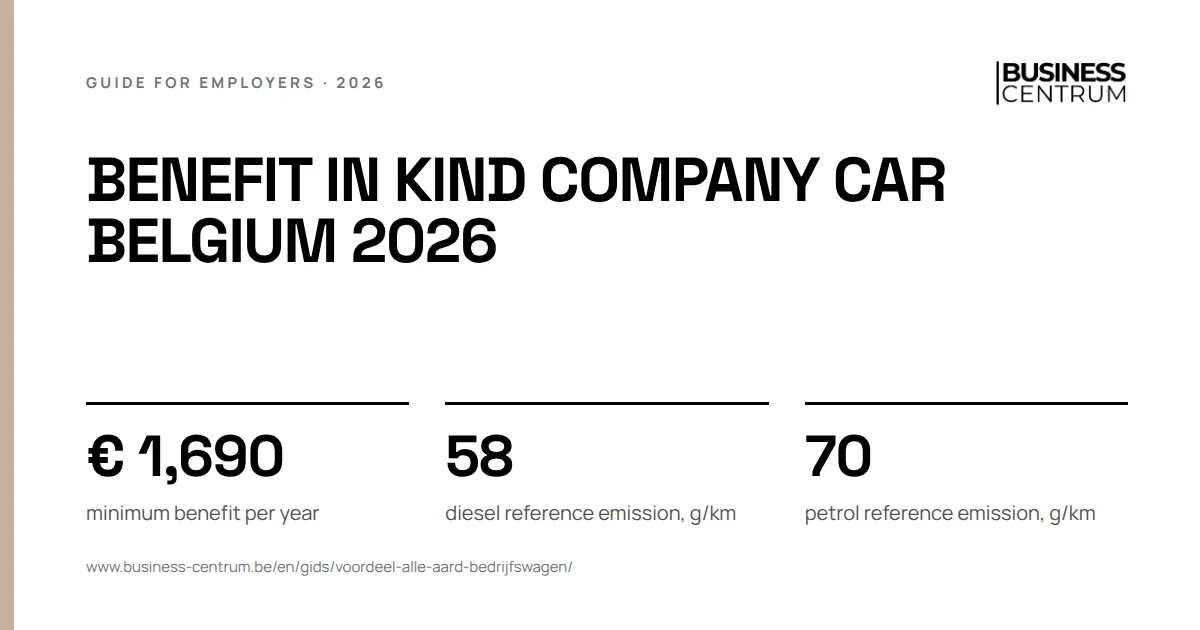
The benefit in kind (BIK) of a company car in Belgium is the catalogue value x 6/7 x an age percentage x a CO2 percentage. In 2026 the reference emission is 70 g/km for petrol and 58 g/km for diesel. The CO2 percentage lies between 4% and 18%, and the benefit is at least € 1,690 a year.
How do you calculate the benefit in kind of a company car in Belgium?
The formula has four parts. The employee pays tax on the result, through the withholding tax on his payslip and through tax form 281.10. A company director gets it on form 281.20.
1. The catalogue value. The list price of the car when new, sold to a private buyer, including options and the VAT actually paid. Discounts do not count, not even the fleet discount of your leasing company. For a second-hand car you use the catalogue value from when it was new.
2. The share that counts. The catalogue value counts for 6/7.
3. The age. The percentage depends on the date of first registration with the DIV, the Belgian vehicle registration service, not on the date you bought the car. Every month started counts as a full month.
| Months since first registration | Percentage of the catalogue value |
|---|---|
| 0 to 12 | 100% |
| 13 to 24 | 94% |
| 25 to 36 | 88% |
| 37 to 48 | 82% |
| 49 to 60 | 76% |
| from 61 | 70% |
4. The CO2 percentage. You start from a base of 5.50%. If the car emits more than the reference for the year, you add 0.10% for every gram above it. If it emits less, you subtract 0.10% per gram. The result is never lower than 4% and never higher than 18%. An electric car always gets 4%.
If the formula comes out below the minimum of € 1,690 a year, the minimum applies.
What changed in 2026 for the benefit in kind on a company car?
The reference emission falls every year. The CO2 percentage of the same car therefore rises, and so does the benefit. The minimum is indexed every year.
| 2025 income | 2026 income | |
|---|---|---|
| Reference petrol, LPG and natural gas | 71 g/km | 70 g/km |
| Reference diesel | 59 g/km | 58 g/km |
| Minimum benefit per year | € 1,650 | € 1,690 |
A diesel at 125 g/km went from 12.1% in 2025 to 12.2% in 2026. Small per car, but the new reference has to be in your calculation from the January payslip onwards.
The big change of 2026 is on the employer's side: the CO2 contribution for cars ordered from 1 July 2023 went up, and a new test now applies to the total of all benefits. Both are covered below.
Worked example
Calculating the benefit in kind for three company cars from an SME fleet
Three cars we come across in SMEs in East Flanders, with the 2026 figures.
Car 1: electric car for the sales rep. Catalogue value € 45,000, first registered in March 2026.
- Age: 100%. CO2 percentage: 4%.
- Formula: € 45,000 x 6/7 x 100% x 4% = € 1,542.86.
- That is below the minimum, so the benefit is € 1,690 a year.
For a new electric car with a catalogue value below roughly € 49,290, you therefore always tax the minimum. Only above that does the price of the car play a role.
Car 2: diesel estate for the site manager. Catalogue value € 38,000, 125 g/km, first registered in January 2024, ordered in September 2023.
- Age: all of 2026 falls in months 25 to 36, so 88%.
- CO2 percentage: 5.50% + (125 - 58) x 0.10% = 12.2%.
- Formula: € 38,000 x 6/7 x 88% x 12.2% = € 3,496.87 a year.
Car 3: double cab pick-up. Diesel, catalogue value € 52,000, 245 g/km, ordered and registered in 2026. Here the tax classification decides everything.
- As a genuine light goods vehicle, the flat-rate formula does not apply. The employee is taxed on the real value of the private use.
- If the tax authorities treat it as a car, a fake light goods vehicle, the formula applies. CO2 percentage: 5.50% + (245 - 58) x 0.10% = 24.2%, capped at 18%. Benefit: € 52,000 x 6/7 x 100% x 18% = € 8,022.86 a year.
When is a pick-up or van a light goods vehicle? It has a maximum authorised mass of 3,500 kg at most. In Flanders the load space must be at least 50% of the wheelbase in length, have a fixed horizontal floor without anchor points for extra seats or belts, and be fully separated from the cab. A vehicle the DIV registers as a light goods vehicle but which counts as a car or dual-purpose vehicle for road tax falls under the formula. With a double cab pick-up, measure the load bed against the wheelbase and check how it is registered for road tax. More on site vehicles in our approach to the construction sector.
What does the employer pay for a company car?
The benefit in kind is excluded from the NSSO definition of pay. The employee therefore pays no NSSO contributions on it. Instead, you pay a monthly solidarity contribution per car, based on CO2 emissions and fuel.
The monthly formula, with Y the CO2 emissions in g/km:
- diesel: (Y x 9 - 600) / 12;
- petrol: (Y x 9 - 768) / 12;
- LPG and natural gas: (Y x 9 - 990) / 12;
- electric: € 20.83.
For 2026 you multiply the result by 185.85 and divide it by 114.08. For a car ordered, rented or leased from 1 July 2023, you then multiply it by 4 in 2026, and by 5.50 from 1 January 2027. The date of the order form or the lease contract decides. The monthly minimum is € 33.93 for older cars and € 42.34 for cars ordered from 1 July 2023. The multiplication factor does not apply to that minimum. An electric car always pays the minimum.
The deduction in corporate income tax depends on the fuel and the purchase date:
| Car | Deductible |
|---|---|
| No CO2 emissions, bought before 1 January 2027 | 100% |
| With emissions, bought before 1 July 2023 | 120% - (0.50% x coefficient x CO2), minimum 50% (40% from 200 g/km), maximum 100% |
| With emissions, bought from 1 July 2023 to 31 December 2025 | same formula, maximum 50% |
| With emissions, bought from 1 January 2026 | 0% |
The coefficient is 1 for diesel and 0.95 for other fuels. A genuine light goods vehicle falls outside these car rules.
On top of that, the company adds part of the benefit in kind to its own disallowed expenses: 17%, or 40% if it pays all or part of the fuel for private use.
For our three cars, the employer side looks like this in 2026:
| Employee's benefit per year | CO2 contribution per year | Deductible | |
|---|---|---|---|
| Electric | € 1,690 | € 508.08 | 100% |
| Diesel, ordered 2023 | € 3,496.87 | € 3,421.20 | 50% |
| Pick-up as light goods vehicle | real value | no flat-rate contribution | ordinary rules |
| Pick-up as car | € 8,022.86 | € 10,458.96 | 0% |
The diesel: (125 x 9 - 600) / 12 = € 43.75, x 185.85 / 114.08 = € 71.27, x 4 = € 285.10 a month. Under the formula its deduction would be 120% - 0.50% x 125 = 57.5%, but it is capped at 50%. The pick-up as a car: (245 x 9 - 600) / 12 = € 133.75, indexed € 217.89, x 4 = € 871.58 a month. As a car, the same pick-up costs you over € 10,000 more in contributions a year, and you deduct nothing.
The new 20% test: not a cap on the benefit
From assessment year 2027, a new rule from the law of 15 July 2026 reforming personal income tax applies. Some texts call it a cap on the benefit in kind. That is not right: the employee's benefit stays fully taxable. The law looks at the total at employer level.
- You add up all flat-rate benefits in kind you grant your employees: company cars, but also for example free housing, a mobile phone or a laptop.
- The part of that total above 20% of all pay to your employees in the taxable period is the excess part.
- On that excess part you pay a separate assessment of 7.50%.
- For company directors you run the same test separately. If your company grants them an excess part, it loses the reduced corporate income tax rate.
With a normal payroll you will not reach that threshold quickly. The risk lies with a small team with expensive cars, and above all with the director on a low salary and a heavy car. How to build a director's pay is explained on our page on the company director.
Own contribution for a company car and the benefit in kind
If the employee pays towards private use himself, you deduct that contribution from the benefit. This happens after the minimum: the own contribution can take the benefit below € 1,690, down to zero.
- What counts: a monthly deduction from net pay, for example for extra options or a more expensive model than his job allows. A one-off contribution counts too, but only in the year he pays it.
- What does not count: fuel, tolls, car washes, winter tyres or an insurance excess after damage that the employee pays himself. These costs are not part of making the car available. If you do ask the employee to contribute to the fuel on his fuel card, that contribution does count as an own contribution.
Example: the site manager with the diesel pays € 50 net a month. His taxable benefit drops from € 3,496.87 to € 2,896.87. The sales rep with the electric car who pays the same goes from € 1,690.00 to € 1,090.00. What that means in net terms, you can see with our gross-net calculator.
The benefit on the payslip in five steps
- Calculate the annual amount per car, with the reference emission and the minimum of the income year.
- Work per calendar day. For the withholding tax you do not divide the annual amount by 12: you take the number of days in the month. For the diesel in October: € 3,496.87 x 31 / 365 = € 296.99.
- Add the benefit to taxable pay, without NSSO contributions for the employee, and deduct the own contribution.
- Declare it in the DmfA, the quarterly NSSO return. The benefit per employee, the solidarity contribution for the company as a whole, with the number plate of each car.
- Put the annual amount on the tax form. 281.10 for an employee, 281.20 for a company director.
Six mistakes with the benefit in kind of a company car
- Catalogue value after discount. The fleet discount or the price on the leasing company's invoice is not the catalogue value.
- Last year's reference. Anyone still calculating with 59 g/km for diesel in January withholds too little tax.
- Age counted from the purchase. For a second-hand car the first registration counts, even if it was abroad.
- An own contribution through gross pay. Only what the employee actually pays himself reduces the benefit.
- Not keeping the order form. Without the date of the order form or lease contract, you cannot show which multiplier applies.
- A van with a rear bench treated as a light goods vehicle. A passenger area that can be converted into load space makes it a dual-purpose vehicle, with benefit and contribution.
What Business Centrum does for you
We keep track, per car, of the catalogue value, the CO2 emissions, the date of first registration and the order date, calculate the benefit per calendar day and put it correctly on the payslip together with the own contribution. The solidarity contribution and the number plates go into the DmfA. That happens in your payroll, together with Acerta. If you are unsure whether a van or pick-up counts as a light goods vehicle, we check the registration with you before the car goes on the payslip.