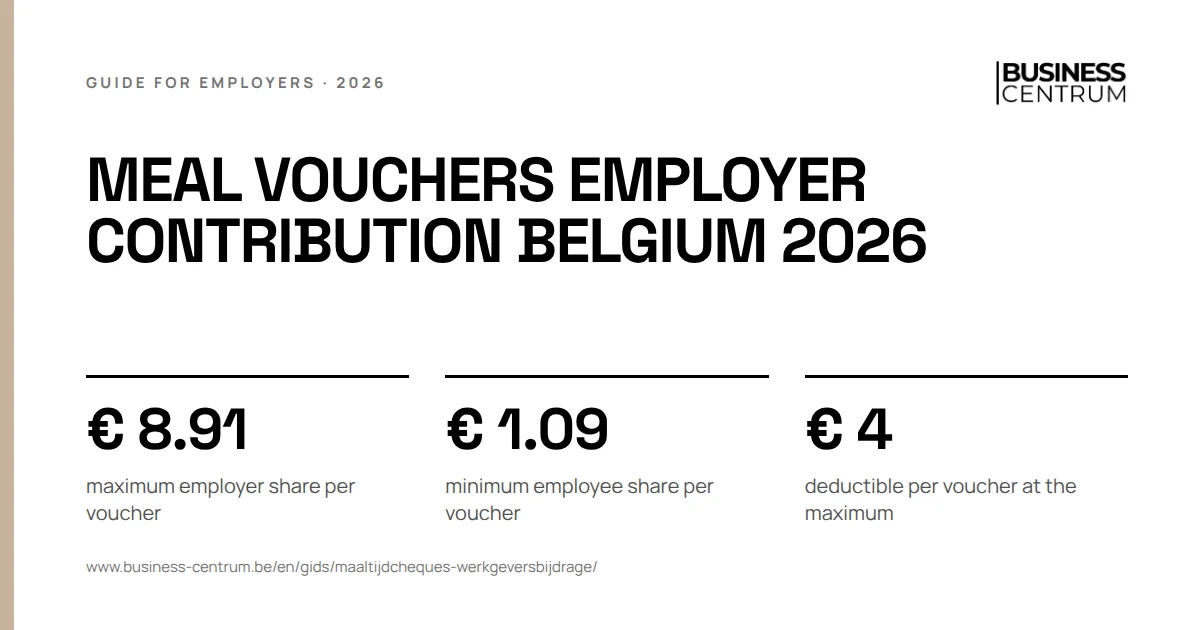
Since 1 January 2026, the employer contribution to a meal voucher in Belgium has been capped at € 8.91 per voucher. The employee pays at least € 1.09, making € 10 in total. If every condition is met, your share is free of NSSO contributions and tax. You deduct € 4 per voucher, but only at the maximum.
How does the employer contribution to meal vouchers work in Belgium?
A meal voucher has two parts. You pay the employer share to the issuer. The employee pays his part through a deduction from his net pay. The payslip shows the number of vouchers and their gross amount less his personal contribution.
What the employee gains is the difference between the value of the voucher and what he pays himself. On a voucher of € 10, that is € 8.91 per day worked, exactly your contribution. No NSSO contributions and no withholding tax come off it.
| Employer share | Employee share | Voucher value | Deductible for you per voucher |
|---|---|---|---|
| € 8.91 | € 1.09 | € 10 | € 4 |
| € 7.91 | € 1.09 | € 9 | € 2 |
| € 6.91 | € 1.09 | € 8 | € 2 |
| € 4.91 | € 1.09 | € 6 | € 2 |
You choose the amount yourself, between zero and the maximum, unless your joint committee (JC) sets a minimum. If you grant vouchers through individual agreements in a company that also has a collective labour agreement (CLA), the individual amount may not exceed the highest amount granted by CLA in your company.
Meal vouchers: employer contribution, employee contribution and the other conditions
Your contribution is only free of NSSO contributions if the vouchers meet every condition at the same time. The tax authorities use the same list to exempt the voucher from income tax for the employee.
- A written basis. The grant is set out in a sector or company CLA. If no CLA can be concluded because there is no union delegation, a written individual agreement with each employee is enough.
- One voucher per day with work. The number of vouchers follows the number of days the employee actually works.
- In the employee's name. The number and amount appear on his individual account and on his payslip.
- Electronic, through an approved issuer. Paper vouchers no longer exist.
- Valid for 12 months at most, only for a meal or for ready-to-eat food.
- Employer share at most € 8.91, employee share at least € 1.09.
- Not in place of pay. Vouchers that replace pay, a bonus or another benefit always count as pay. The only exception is converting eco vouchers.
How many meal vouchers per month?
The principle is simple: one voucher for each day the employee actually works, however long that day is. A part-time employee who works five half days a week therefore gets as many vouchers as a full-timer. A part-timer on a four-day week gets four a week.
The issuer credits the vouchers to the meal voucher account every month, based on the days the employee is expected to work that month. After the quarter you bring the number in line with the days actually worked.
If your staff work different schedules, for example 38 hours over five days next to 38 hours over four days, you may count differently: the hours actually worked in the quarter divided by the normal daily working time in your company, rounded up. The result may not exceed the number of working days of a full-timer. You lay this count down in a CLA. A company with on average fewer than 50 employees and no union delegation may include it in its work rules.
Are meal vouchers mandatory for employers in Belgium?
No law obliges you. Meal vouchers are a fringe benefit. An obligation comes from your joint committee, or from an arrangement you made earlier in your company.
If your sector sets a maximum, it also applies to your individual agreements. An individual agreement above it conflicts with the sector CLA, and the vouchers are then no longer exempt. Check after every new sector agreement whether your amounts still fit.
Can an employer stop meal vouchers?
Not unilaterally. What you can do depends on the basis on which you grant the vouchers.
| Basis of the grant | Stopping or reducing |
|---|---|
| Sector CLA | Not possible while the CLA runs. |
| Company CLA | Terminate it under the rules in that CLA. Employees who already received vouchers keep them in their individual contract, unless the CLA itself provides otherwise. |
| Individual agreement | Only with the employee's written consent. |
The rule on the company CLA is in article 23 of the law on collective labour agreements: an individual contract that was tacitly amended by a CLA stays unchanged when that CLA ends, unless the CLA itself provides otherwise. If you draft a new CLA, include that clause.
If you scrap the vouchers without consent, you cut pay unilaterally. Courts usually see a unilateral pay cut as a change to an essential term of employment. The employee can then treat it as you ending his contract and claim payment in lieu of notice.
What you can do: replace the vouchers, by mutual agreement, with a gross pay rise. The reverse, turning pay or a bonus into meal vouchers, is not possible. Only eco vouchers may be converted into meal vouchers, as several sectors did this year. See eco vouchers abolished in 2026.
Are meal vouchers tax deductible for the employer?
The employer share is in principle not a deductible business expense. The law makes an exception per voucher, provided the voucher meets every condition:
- € 4 per voucher if your contribution reaches the maximum of € 8.91;
- € 2 per voucher for any lower contribution.
What you cannot deduct is a disallowed expense. The higher deduction applies to vouchers granted from 1 January 2026.
| Your employer share | Deductible | Disallowed expense |
|---|---|---|
| € 8.91 | € 4 | € 4.91 |
| € 8.90 | € 2 | € 6.90 |
| € 7.91 | € 2 | € 5.91 |
The second row is not theory. An employer share one cent below the maximum costs you half the deduction. The third row is the position of a company that raises in steps, as some sectors require.
What does it save? At the standard corporate income tax rate of 25%, a deduction of € 4 saves you € 1 per voucher, a deduction of € 2 € 0.50. Over 220 days worked, that is € 220 against € 110 per employee per year. What the move from an € 8 voucher to € 10 costs you net, we work out in meal vouchers of 10 euros.
Worked example: meal voucher or gross pay rise?
You want to give an employee € 8.91 extra net per day worked. You can do it with a meal voucher of € 10, or with a gross pay rise that delivers the same net. We work out both for two employees:
- Full-timer: gross pay of € 3,500 a month, 220 days worked a year. His extra pay falls in the 45% tax band.
- Part-timer on a four-day week: gross pay of € 2,800 a month, 176 days worked a year. His extra pay falls in the 40% band.
On a pay rise the employee pays 13.07% NSSO contributions, then tax at his top rate plus 7% municipal surcharge, as in the withholding tax. You pay 25% employer contributions. At these salaries the flat-rate professional expenses have already reached their maximum, so every extra euro is taxed in full.
Per day worked, this is how it looks for the full-timer. To give € 8.91 net, you need € 19.77 gross: € 19.77 less 13.07% NSSO is € 17.19, and € 17.19 less 45% tax, increased by 7% municipal surcharge, is € 8.91. That costs you € 24.71. With the voucher you pay € 8.91.
| Per year | Full-timer, 220 days | Part-timer, 176 days |
|---|---|---|
| Extra net for the employee | € 1,960.20 | € 1,568.16 |
| Cost of the meal vouchers | € 1,960.20 | € 1,568.16 |
| Of which deductible | € 880.00 | € 704.00 |
| Voucher cost after corporate income tax | € 1,740.20 | € 1,392.16 |
| Gross pay rise for the same net | € 4,348.93 | € 3,153.73 |
| Your cost for that pay rise | € 5,436.16 | € 3,942.16 |
| Pay rise cost after corporate income tax | € 4,077.12 | € 2,956.62 |
For the full-timer the pay rise costs you 2.8 times as much as the vouchers, for the part-timer 2.5 times. After corporate tax, that is 2.3 and 2.1 times. The real gap is wider still: higher gross pay also raises holiday pay and the end-of-year bonus. The downside for the employee is that vouchers build no social rights. They do not count towards his pension or an unemployment benefit.
Watch part-timers with short days. Someone working five half days gets five vouchers a week, like a full-timer, for half the pay. In such a team the voucher weighs more in the payroll cost than you expect. If you want this calculated for your own team, with the real salaries and schedules, we do it in a workforce analysis.
Introducing meal vouchers in six steps
- Check what your joint committee requires. Some sectors make vouchers mandatory, others set a minimum or a maximum. That defines your room to move.
- Choose the amount. For tax, the maximum of € 8.91 is the most attractive, because only then do you deduct € 4 per voucher. Any lower amount gives € 2 deduction.
- Put the grant in writing. With a union delegation you conclude a company CLA. Without one, you sign an individual agreement with each employee, including those who join later.
- Choose an approved issuer. The issuer opens a meal voucher account for each employee and credits the vouchers every month.
- Pass on the days worked. The number of vouchers follows the work done. Holidays, public holidays and sickness do not count.
- Check after every quarter. Correct the number before the end of the month after the quarter, and check your amounts after every sector agreement.
If you raise the amount later, the rise follows the same route as the introduction: a new CLA or a written amendment to each individual agreement.
Five mistakes employers make with meal vouchers
- Vouchers for days without work. A fixed number per month, even in a month with holidays or sickness, turns the extra vouchers into pay.
- Forgetting the quarterly correction. Without a correction before the end of the month after the quarter, you owe NSSO contributions on every voucher too many and every voucher too few.
- An employer share just below the maximum. A contribution of € 8.90 halves your deduction.
- Turning a bonus into vouchers. Replacing an end-of-year bonus or a pay rise with meal vouchers makes those vouchers pay, with NSSO contributions and tax.
- No agreement for new employees. In a company without a CLA, every new employee needs his own written agreement. Without it, all his vouchers are pay.
What Business Centrum does for you
Every month we calculate the number of vouchers per employee from the recorded work, show the employer and employee shares correctly on the payslip and correct the number after each quarter, on time. That happens in your payroll, together with Acerta. We also draft the individual agreement and check your amounts against the CLA of your joint committee.