
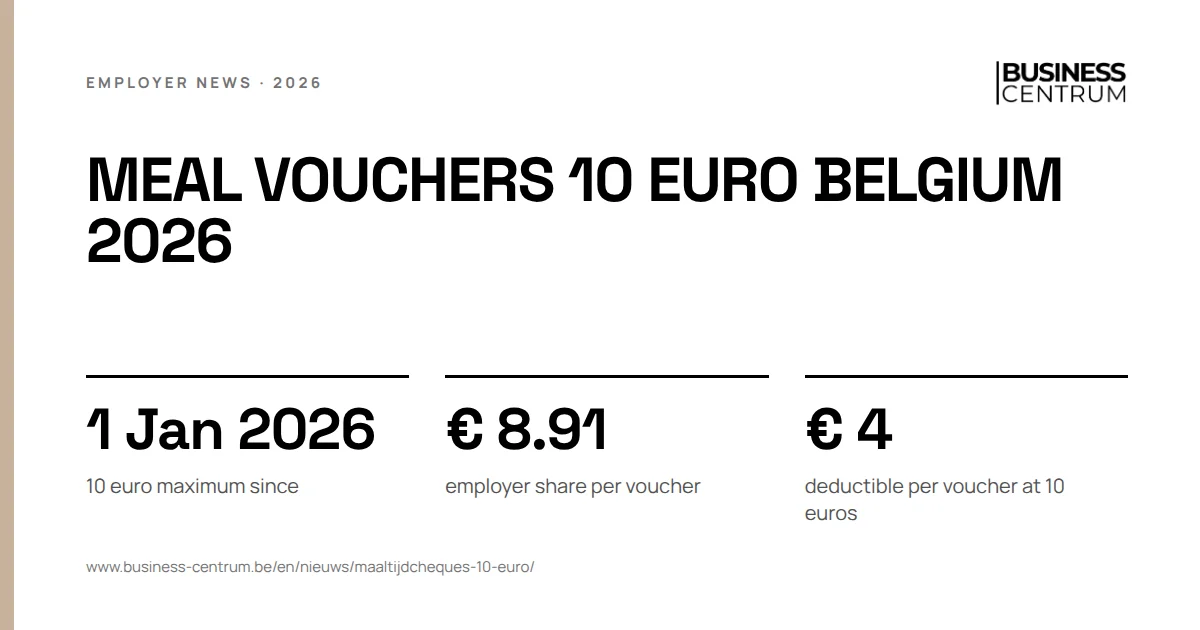
Since 1 January 2026, a meal voucher in Belgium may be worth € 10. The employer share went from € 6.91 to € 8.91, and the employee pays at least € 1.09. Raising the amount is not mandatory, unless your sector requires it. Employers who go to the maximum deduct € 4 per voucher instead of € 2.
Meal vouchers of 10 euros: since when, and on what basis?
The rise came through two texts, one on social security and one on tax.
- The NSSO side. The royal decree of 10 November 2025, published on 17 November 2025, replaced € 6.91 with € 8.91 as the maximum employer share in the NSSO rules. It took effect on 1 January 2026.
- The tax side. The law of 18 December 2025, published on 30 December 2025, did the same for the employee's income tax exemption. It also raised the employer's deduction from € 2 to € 4 per voucher, but only if the employer share reaches the maximum. This applies to vouchers granted from 1 January 2026.
The employee's minimum stayed at € 1.09. The full € 2 rise is therefore paid by the employer.
Are 10 euro meal vouchers mandatory?
No. € 10 is a maximum, not a minimum. A collective labour agreement (CLA) or individual agreement with € 8 vouchers stays valid, and the vouchers stay exempt.
An obligation can only come from your sector. Several joint committees used the new room in their 2025-2026 agreements, sometimes in steps, sometimes to replace eco vouchers.
Know your joint committee and read the latest sector agreement before you decide.
Employer contribution to 10 euro meal vouchers: what is the net cost?
We calculate per employee with 220 vouchers a year and the standard corporate income tax rate of 25%.
| Voucher value | Employer share | Cost per year | Deductible | Tax saving | Net cost |
|---|---|---|---|---|---|
| € 8 | € 6.91 | € 1,520.20 | € 440 | € 110 | € 1,410.20 |
| € 9 | € 7.91 | € 1,740.20 | € 440 | € 110 | € 1,630.20 |
| € 10 | € 8.91 | € 1,960.20 | € 880 | € 220 | € 1,740.20 |
Three things stand out.
- Going from € 8 to € 10 costs you € 330 net a year, for € 440 extra net for the employee. A gross pay rise with the same net costs a multiple of that. That comparison for a full-timer and a part-timer is in our guide to the employer contribution for meal vouchers.
- The last euro is the cheapest. Going from € 9 to € 10 costs € 220 gross but only € 110 net, because the deduction doubles. Per voucher you pay € 0.50 net for € 1 more for the employee.
- An intermediate step to € 9 is the least efficient choice for tax. You already pay most of the rise, but still only deduct € 2.
If your company qualifies for the reduced rate of 20% on the first € 100,000 of profit, the saving is smaller: € 176 instead of € 220 for a € 10 voucher, a net cost of € 1,784.20.
Raising to 10 euros: how to go about it
- Read your sector agreement. If it sets a maximum or a step plan, follow it. An individual agreement above a sector maximum turns the vouchers into pay.
- With a union delegation: a company CLA. It contains the new amount and the start date.
- Without a union delegation: a written agreement with each employee. An addendum to the existing individual agreement is enough. Do not forget employees who join later. If your company also has a CLA with vouchers, the individual amount may not exceed the highest CLA amount.
- Choose a start date on the first of a month and put it in the CLA or the agreement before the first € 10 voucher is credited. Ask the issuer to change the face value from that date.
- Adjust payroll: employer share € 8.91, employee deduction € 1.09, and the new gross amount on the payslip.
What Business Centrum does for you
We work out what the move to € 10 costs your team net, with your real number of days worked, in a workforce analysis. We then draft the addenda or the CLA text, check them against your sector agreement and process the new amount from the right month in your payroll, together with Acerta.