
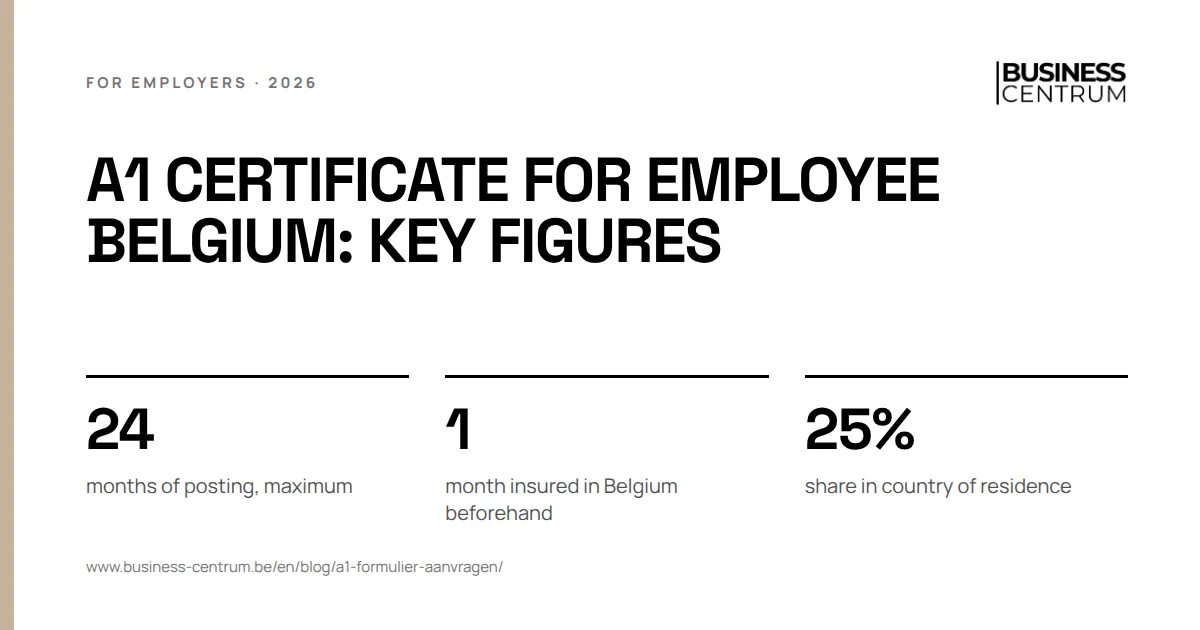
You apply for an A1 certificate for an employee in Belgium to the NSSO, through the Working abroad online service, before departure. For a posting to one other European country, the employee stays under Belgian social security for 24 months at most. For a driver working in several countries, the competent country depends on where they live and work.
What does an A1 certificate prove?
The A1 certificate proves in which country your employee is socially insured. As long as it is valid, you pay contributions in Belgium and not in the country where the employee is temporarily working. Within the EU, the EEA and Switzerland, Regulation 883/2004 governs this. In the EU it has applied since 1 May 2010, in Switzerland and the other EEA countries a little later.
The employer or the employee applies for the certificate to the institution of the competent country. For Belgium, that is the NSSO. There are two situations, each with its own application:
- Posting. Your employee works temporarily in one other country, for example a fitter installing a machine in France for three months.
- Working in several countries. Your employee normally works in two or more countries, like a driver in international haulage or a technician with clients in the Netherlands and Germany.
Outside Europe, Belgium has bilateral agreements, including with Turkey, Morocco, the United States and India. The rules resemble those of the Regulation, but the maximum posting period differs per agreement, from 1 to 5 years. The certificate is often called a Certificate of Coverage. You apply for it through the same online service.
The A1 only settles social security. The country where your employee works may also require its own notification, as Belgium does with the Limosa declaration for people who come to work here.
A1 certificate for a posting: the conditions
Your employee stays under Belgian social security during a posting if all of these conditions are met:
- the expected duration in the other country is no more than 24 months;
- your company carries out significant economic activity in Belgium, pure administration is not enough;
- the employee keeps working under your authority for the whole period;
- the employee was already socially insured in Belgium before leaving, as a rule for at least 1 month;
- the employee does not replace another posted worker.
You may hire someone in order to post them straight away, if they meet these conditions. If the assignment lasts longer than 24 months, the NSSO can agree an exception with the other country. The posting can then in principle run for up to 5 years.
Applying for an A1 certificate for an employee: step by step
- Check the Dimona. You can only submit an application if a Dimona exists for the whole period abroad. A contract that ends before the assignment does blocks the application. Have your Dimona management put that right first.
- Log in. The NSSO Working abroad online service (the application is called WABRO) is secure. You log in with your eID or another digital key. A social secretariat can file the application with a mandate in Mahis.
- Choose the type. Posting request for one other country, request for working in several countries for more than one.
- Enter the details. Have ready: the employee's identity and home address, the country, the client and the work address abroad, the start and end date and, for several countries, the percentage of working time per country.
- Submit before departure. The certificate serves as proof during an on-site inspection.
- Receive the A1 in your e-Box Enterprise. Give the employee a copy. If Belgian legislation turns out not to apply, the NSSO informs you by letter.
- Track the end date. If the assignment is extended, submit a new application before the end date on the certificate.
Transport: an A1 certificate for a driver in several countries
A driver who drives in Belgium, the Netherlands, France and Germany every week is not posted. The rules for working in several countries apply. Countries where the driver works less than 5% of their working time or pay do not count. The NSSO then asks one question: does the driver work at least 25% in the country of residence?
- Yes: the legislation of the country of residence applies, even if you are a Belgian employer.
- No, and the driver works only for you: the legislation of the country of your registered office applies, so Belgium.
If your driver lives in Belgium, Belgian social security applies in both cases. If the driver lives in another country, you apply to the institution of that country of residence. That institution decides.
Worked example
A Ghent haulier has two drivers, each with 210 working days a year. Both live in the Netherlands.
| Driver | Days in the Netherlands | Share | Competent country |
|---|---|---|---|
| Driver A | 48 | 22.9% | Belgium |
| Driver B | 58 | 27.6% | Netherlands |
For driver B, the Dutch institution issues the A1. You then pay Dutch contributions and may no longer include the driver in your Belgian NSSO return for that period. Ten extra driving days to the Netherlands flip the system. Review the route planning every quarter. The pay rules for your drivers are covered in our guide to joint committee 140.
If an office employee works partly from home in France or the Netherlands, a framework agreement offers a way out. If the employee teleworks less than 50% of their time in the country of residence and does the rest of the work in Belgium, you can jointly opt for Belgian legislation, even when the telework exceeds the 25% threshold. Both countries must have signed the framework agreement, as France and the Netherlands have. You request this through the same online service, each time for 12 months.
What mistakes do we see with the A1 certificate?
- Applying too late. The employee leaves on Monday, the application follows when the client asks for it. During an inspection on a foreign site, there is no proof.
- The wrong type. Applying for a posting for a driver who drives in four countries. The A1 then does not match reality.
- Forgetting the country of residence. A driver who lives across the border, with an application to the NSSO instead of the country of residence.
- A new hire who leaves straight away. Someone insured in another country just before being hired does not meet the condition of prior Belgian cover.
- No follow-up. The certificate expires, the assignment does not.
What Business Centrum does for you
We apply for the A1 in your name with a mandate, check the Dimona beforehand and track the end date. For hauliers, we work out per driver which country is competent and what that means for payroll costs. See our approach for transport companies. Your payroll runs through Business Centrum, together with Acerta.