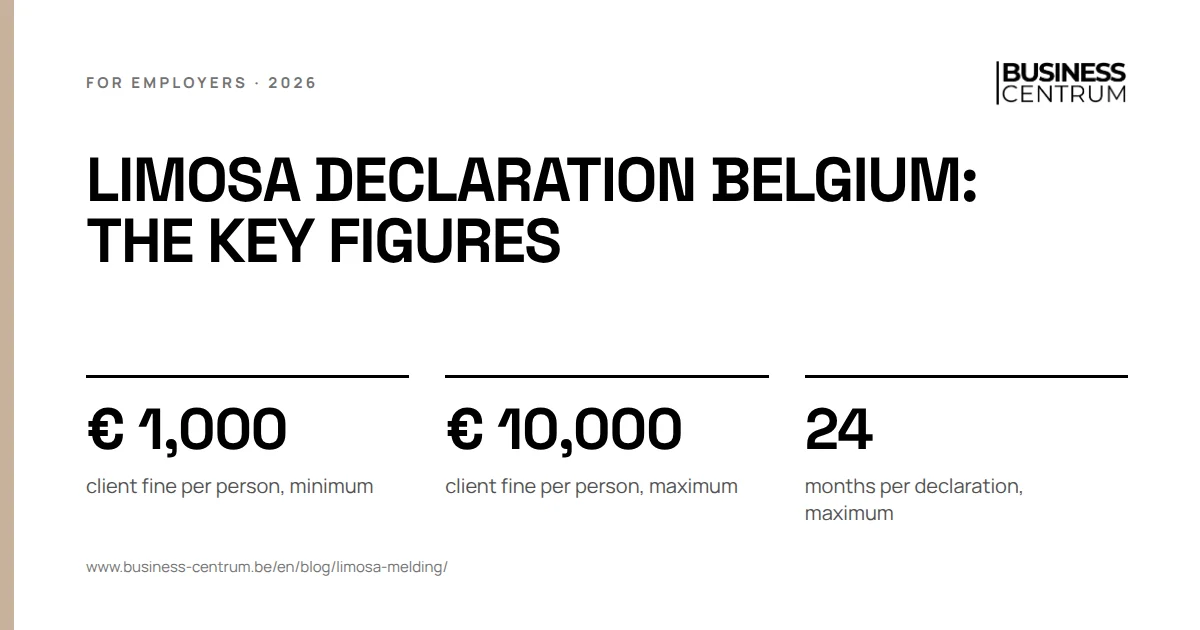
In Belgium, the foreign employer or self-employed person files the Limosa declaration before work starts. As the Belgian client, you ask for the Limosa-1 (L1) proof before day one and report a missing one to the NSSO before work starts. Otherwise you risk an administrative fine of € 1,000 to € 10,000 per person involved.
What is a Limosa declaration and who files it?
Limosa is the reporting system for people who come to work in Belgium temporarily or partly without falling under Belgian social security. The obligation has existed since 1 April 2007. It covers two groups:
- Posted workers. Their foreign employer, or an agent, files the declaration for each worker.
- Foreign self-employed people in a risk sector. Anyone working temporarily in Belgium in construction, meat processing or cleaning without being established here files their own declaration.
A declaration lists, among other things, the workplaces in Belgium, the Belgian clients, the period and the work schedule. One declaration covers up to 10 workers and 20 workplaces, over 24 months at most. The filer immediately receives a receipt: the L1 form, with a QR code.
The foreign employer benefits too. With a Limosa declaration, it is exempt for 12 months from several Belgian social documents, such as the work rules and the staff register.
Limosa tells you who works where. It does not tell you which social security applies. That is what the A1 certificate from the home country proves. If you send staff abroad yourself, read how to apply for an A1 certificate.
Limosa declaration and subcontractors: what must the client do?
The obligation lies with anyone for whom, or at whose premises, posted workers carry out work, directly or through subcontracting. If you are the project owner and your main contractor brings in a Polish subcontractor, the obligation applies to you as well. Only a private individual having work done for strictly private purposes is excluded.
Here is how to handle it:
- Ask for the L1 before the start. For every person who comes to work, employee or self-employed. Put it in your subcontract: no L1, no site access.
- Check the L1 with Check Limosa. Scan the QR code. The mobile online service confirms the declaration exists and shows the data held in the QR code. Compare it with the form: name, period, workplace and the Belgian client. If they do not match, you receive instructions for the next step.
- Look at the end date. The declaration must cover the whole assignment. If the site overruns, the foreign employer must file a new declaration before the declared period ends. Ask for the new L1.
- Report a missing L1 before work starts. You do this through the NSSO online service Limosa - Reporting obligation, with a username and password. A third party, such as your social secretariat, may do it for you. You can also file the original declaration in place of the foreign employer, if you have all the data. Responsibility for a correct declaration then stays with the employer.
- Register attendance on large sites. If you are a contractor on a construction site from € 500,000 excluding VAT, you register your own people and your subcontractors in Checkinatwork every day, before work starts. The QR code on the L1 speeds this up.
- Keep everything. For every report you make, you receive your own proof of report. You show it during an inspection, together with copies of the L1 forms.
Working with a foreign contractor in construction? Also check whether it owes money to the NSSO or the tax authorities. The method is explained in our article on checking a contractor's withholding obligation.
When is there no Limosa reporting obligation?
Short assignments in particular are exempt. The ones that matter most for an SME:
| Situation | Condition |
|---|---|
| First installation or assembly of delivered goods | 8 days at most, not in construction |
| Urgent repair or maintenance of delivered machinery | 5 days per month in Belgium at most |
| Meetings in a restricted circle | 60 days per year in total, 20 consecutive days per meeting at most |
| Self-employed business people | 5 days per month in Belgium at most |
| International transport | exempt, see below |
Someone who works only in Belgium for an indefinite period, even for a foreign employer, does not fall under Limosa. A Dimona and a DmfA are needed instead.
If you are unsure whether an exemption applies, ask for the L1 anyway. If the foreign employer gets it wrong, the risk stays with you.
Where does the Limosa check go wrong in practice?
We see four mistakes at clients again and again:
- The L1 belongs to another site. The subcontractor shows the L1 of an earlier job. An L1 is only usable if your workplace and the period are on it. Your company is not always on it as the client: in a chain, the L1 only names the party the foreign employer signed the contract with.
- The site overruns, the declaration does not. The end date on the L1 falls in week eight of a ten-week job. Put that date in your planning.
- The installation exemption on a building project. A technician who comes to install a machine seems exempt. In construction, that exemption does not apply.
- The self-employed foreman. A foreign self-employed person in construction must file their own declaration. If they actually work under the authority of your site manager, bogus self-employment comes into play, with a far bigger bill.
Limosa in transport: no L1 for drivers
For road transport drivers, the Limosa reporting obligation no longer applies. Their employer files a posting declaration in advance. An employer established in the EU or the United Kingdom does so through the public interface of the EU's IMI system. An employer established elsewhere uses the Belgian web application vervoer-detacheringsverklaring.belgie.be. The driver must carry a copy.
For you, as the Belgian client of a foreign haulier, that means: you do not ask drivers for an L1. If foreign warehouse staff or loaders come through a subcontractor, Limosa applies as normal. The rules for your sector are on our page on staff in transport.
What do you risk without a Limosa check?
The Social Criminal Code punishes each link in the chain separately. For offences from 1 February 2026, these administrative fines apply:
| Who | Failure | Level | Administrative fine |
|---|---|---|---|
| Foreign employer | no declaration, or no new declaration when extended | 4 | € 3,000 to € 35,000 per worker |
| Foreign self-employed person | no declaration | 3 | € 1,000 to € 10,000 |
| Belgian client | missing L1 not reported | 3 | € 1,000 to € 10,000 per worker or self-employed person |
The multiplication stops at 100 times the maximum. How the levels changed in 2026 is covered in our news item on the Social Criminal Code 2026.
Worked example
A Ghent contractor has a Portuguese subcontractor send six bricklayers. Two of them have no L1, and the contractor does not report it.
- Minimum for the contractor: 2 x € 1,000 = € 2,000
- Maximum for the contractor: 2 x € 10,000 = € 20,000
- The Portuguese employer itself risks 2 x € 3,000 = € 6,000 to 2 x € 35,000 = € 70,000
A report through the online service takes you a few minutes. It takes you out of the last row of that table.
What Business Centrum does for you
We set up your access to the Limosa - Reporting obligation online service and file the report in your name when an L1 is missing. For construction companies, we combine this with the withholding obligation check and attendance registration. If you send staff abroad yourself, we apply for the A1 certificate. See our approach for construction companies. Your payroll runs through Business Centrum, together with Acerta.