
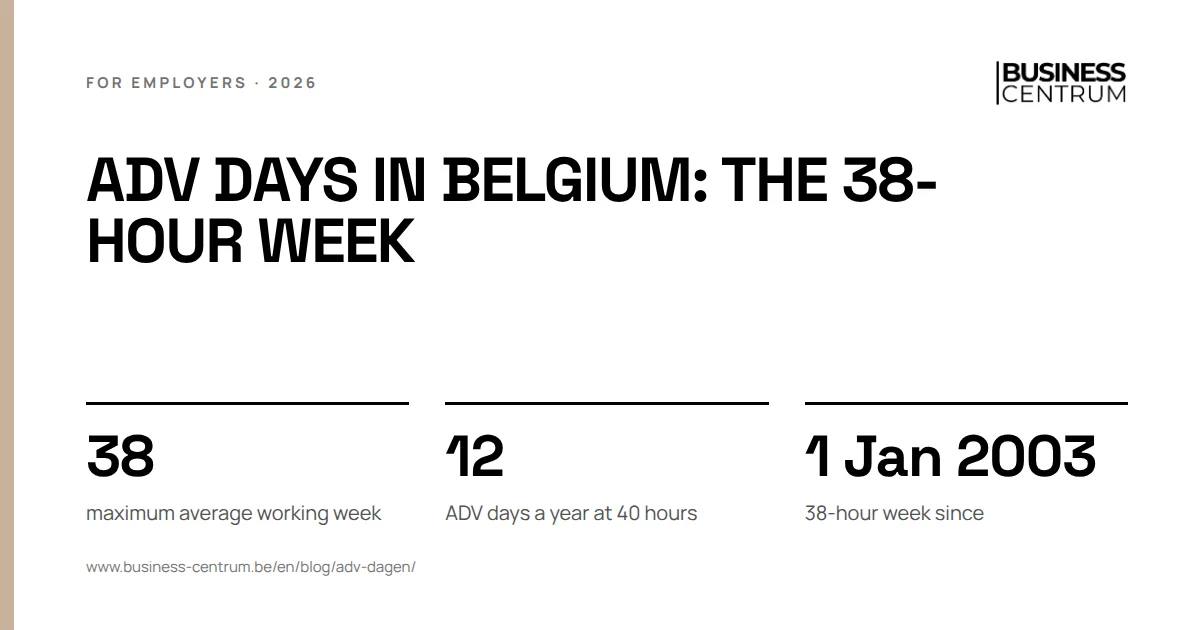
ADV days are paid rest days that reduce working time without shortening every working day. ADV stands for arbeidsduurvermindering, Dutch for reduction of working time. Since 1 January 2003, a full-time employee in Belgium may work at most 38 hours a week on average. If they work 40 hours every week, you compensate with about 12 ADV days a year.
What are ADV days?
An ADV day is a day off the employee gets because they work longer than the average working time during the rest of the year. The law calls them compensatory rest days. In practice, employers, payslips and collective agreements use all sorts of names: ADV days, compensation days, rest days. The principle is always the same: anyone who works more hours a week than the average gets those hours back as whole days off.
ADV days are not:
- statutory holiday days, which the employee builds up with their work in the previous year;
- public holidays, which apply to everyone;
- compensatory rest for overtime, which the employee gets when they exceptionally work beyond their normal schedule.
Why do ADV days exist? The 38-hour week
Since 1 January 2003, the maximum weekly working time has been 38 hours. A company can meet that limit in two ways:
- Work shorter every week. The employee works, for example, five days of 7 hours 36 minutes. No ADV days are needed then.
- Work longer and compensate with rest days. The employee works 8 hours a day and 40 hours a week, and gets extra days off so that they average 38 hours over the year.
The second form is popular because a full working day is more practical for planning, the customer and the employee. A Friday that ends at half past three achieves little. A whole day off does.
The reduction to 38 hours may not lead to a pay cut. An ADV day is therefore a paid day: the monthly or hourly wage is set on the average working time, and the employee loses nothing on the day they stay home.
How to calculate ADV days in Belgium
The number of ADV days follows from the difference between the hours someone works per week and the average working time in your company. The FPS Employment gives two examples:
| Schedule | Average working time | ADV days a year |
|---|---|---|
| 40 hours a week | 38 hours | 12 |
| 38 hours a week | 37 hours | 6 |
Here is how to check it yourself. Someone who works 40 instead of 38 hours works 2 hours too many each week. Over roughly 48 working weeks, after holidays and public holidays, that is 96 hours, or 12 days of 8 hours. If someone works 39 hours a week, half is enough.
Set the arrangement down in your sector's collective agreement, in a company agreement or in your work rules. Also decide what happens when an employee starts or leaves during the year. That situation causes most disputes in practice: someone who starts in September is not entitled to the full number of days. How to draw up or amend work rules is explained in our guide on work rules.
ADV days in construction and other sectors
Many joint committees arrange ADV days themselves. The best-known example is construction. A construction worker works 40 hours a week and gets 12 rest days a year, so they average 38 hours. The joint committee sets the dates every year, and the payment runs through the sector rather than the employer. The dates for 2027 are in our article on construction leave.
In other sectors, such as care, metalworking or food, the sector's working time can already be below 38 hours. That lower time then counts as the average, and you calculate ADV days on it. So always check first what your joint committee's agreement says before you draw up a schedule.
Can you pay out ADV days?
ADV days are meant to be taken. They make sure the employee does not work longer on average over the reference period than the law or the agreement allows. That period can run up to 1 year. Paying for a day instead of granting it keeps the employee working above the average, which does not fit the arrangement.
When an employee leaves, you work out how many ADV days they have built up and how many they took. If they worked hours above the average without being able to compensate them, you pay for those in the final settlement.
What Business Centrum does for you
We turn the schedule and ADV arrangement of your sector into a plan that matches the average working time, record ADV days correctly in payroll and calculate the balance when someone joins or leaves, together with Acerta. You follow absences and balances through leave and absence.