
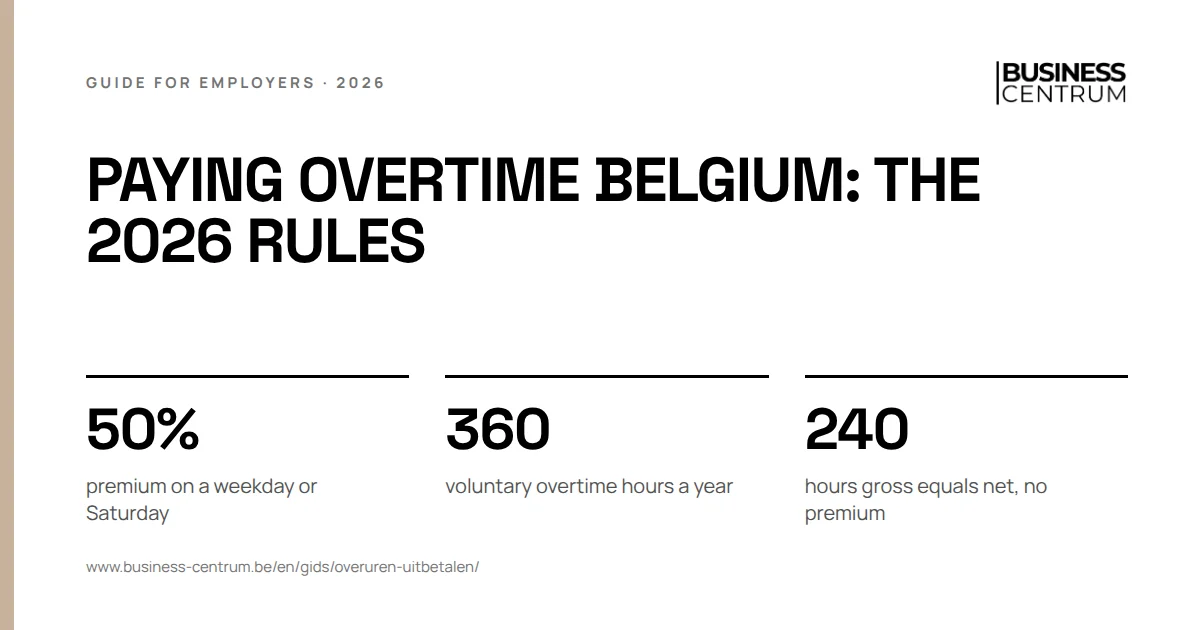
When paying overtime in Belgium, you pay the normal hourly wage plus a premium: 50% for an overtime hour on a weekday or Saturday, 100% on Sundays and public holidays. Ordinary overtime also gives a right to time off in lieu. Since 1 April 2026, 240 voluntary hours a year are free of premium, NSSO contributions and withholding tax.
When does an hour count as overtime?
The premium is due for every hour above 9 hours a day or above 40 hours a week. If a collective agreement sets a lower limit in your sector, that lower limit applies.
Every company had to move to an average of 38 hours a week. How your company did it determines where the premium starts:
- Actual reduction by collective agreement. Overtime starts above 38 hours a week and above 9 hours a day.
- A full week with extra rest days. Someone who works 40 hours every week and gets extra rest days (ADV days) in return is only entitled to a premium above 40 hours a week.
- Reduction through the work rules or the contract. The limit for the premium does not change: it stays at 40 hours, or the lower limit set by a collective agreement.
For white-collar staff in JC 200 the average working week is 38 hours. Check in your work rules how those hours are organised in practice. That decides from which hour you pay a premium. More on the sector in our guide to JC 200.
The normal wage on which you calculate the premium is more than the base wage. Bonuses tied directly to the work and paid with every wage payment are included: a shift bonus, a night bonus, a hazard bonus. An end-of-year bonus is not.
Paying overtime in Belgium or giving time off: which type do you have?
An employer cannot simply ask for overtime. There has to be a legal ground, and that ground decides whether the employee gets time off and whether you pay a premium. The absolute caps are 11 hours a day and 50 hours a week.
| Type of overtime | What you need beforehand | Time off | Premium |
|---|---|---|---|
| Exceptional increase in work | Union delegation approval (if you have one), permission from the inspectorate, schedule posted 24 hours ahead | Yes | Yes, above the daily or weekly limit |
| Unforeseen necessity | Union delegation approval, otherwise informing them afterwards; notice to the inspectorate | Yes | Yes |
| Voluntary overtime | Written agreement of the employee, in advance | No | Not on the first 240 hours |
| Peak period in construction | Union delegation approval or notice to the chair of the JC | Worker's choice | 20% if he does not take time off |
| Flexible schedule | Peak and off-peak schedules in the work rules | Average over the year | No, within the limits |
If your staff work beyond the schedule without one of these grounds, the premium is still due. You pay the premium and risk a fine.
Time off in lieu: taking overtime back
For ordinary overtime, time off is the rule. Over a reference period the employee may not work more than the normal weekly hours on average. That period is in principle a quarter, and can be extended to 1 year by royal decree, collective agreement or your work rules.
During that period an internal limit applies. The hours above the average may never exceed 143 hours. Once that limit is reached, you must first give time off before new overtime is allowed. Voluntary overtime does not count.
Paid out instead of taken back. The employee may choose not to take back hours worked for an exceptional increase in work or an unforeseen necessity, up to 91 hours per calendar year. After a consultation procedure in the company this can become 130 hours, and slightly more through a sector agreement. He must make that choice explicitly before the end of the pay period: for a salaried employee the end of the month, for a worker paid weekly the end of that week.
How you pay.
- Employee does not take time off: at the end of the pay period you pay the normal wage at 100% plus the premium.
- Employee takes time off: you pay the premium at the end of the pay period. The normal wage for those hours is paid when he takes the time off.
Converting the premium into rest. A collective agreement may allow you to convert the premium into extra time off. Each hour at 50% then gives at least 30 minutes of rest, each hour at 100% at least one full hour. That rest is paid and comes on top of the ordinary time off.
Overtime at 150 percent: a worked example
A white-collar employee in JC 200 earns € 3,200 gross a month and works 38 hours a week. His hourly wage is € 3,200 x 3 / (13 x 38) = € 19.43. He works 10 overtime hours. We compare four situations, with 13.07% employee NSSO contributions and about 25% base employer contribution.
| 10 overtime hours | Gross | Employee NSSO | Employer cost |
|---|---|---|---|
| Weekday, ordinary overtime (150%) | € 291.45 | € 38.09 | € 284.16 after tax relief |
| Sunday, ordinary overtime (200%) | € 388.60 | € 50.79 | € 405.60 after tax relief |
| Voluntary, within the 240 hours | € 194.30 | € 0 | € 194.30 |
| Voluntary, with premium | € 291.45 | € 0 | € 291.45 |
How the amounts are built up.
- Weekday. 10 x € 19.43 = € 194.30 normal wage, plus a 50% premium of € 97.15. Total € 291.45. The employer pays € 72.86 NSSO contributions on top, so € 364.31. He then keeps 41.25% of € 194.30 in withholding tax without paying it over: € 80.15. Net cost € 284.16.
- Sunday. 10 x € 38.86 = € 388.60. Employer NSSO € 97.15, relief again € 80.15. Net cost € 405.60.
- Voluntary without premium. € 194.30 gross is € 194.30 net. No NSSO, no withholding tax.
- Voluntary with premium. € 291.45 gross, no NSSO. You do withhold tax on this amount.
If the employee uses all 240 net hours, he receives € 4,663.20 net extra a year, and you pay exactly that amount. For ordinary overtime his net pay depends on his withholding tax. He gets a tax reduction for overtime that is already applied in the monthly withholding.
Voluntary overtime since 1 April 2026: what is net?
Since 1 April 2026 there is one scheme for all sectors: 360 voluntary overtime hours per calendar year, without a reason and without time off in lieu.
- 240 hours without premium, free of NSSO contributions and withholding tax.
- 120 hours with the statutory premium, free of NSSO contributions but not of withholding tax.
- Hospitality. An employer in JC 302 with a registered cash system in every outlet goes up to 450 hours, of which 360 without premium.
Employer and employee decide which hours they use first. Put that in the agreement. Voluntary overtime and recovery hours worked up to 31 March 2026 count towards the 2026 total.
The agreement. The employee gives his express written agreement in advance, for 1 year. It renews tacitly. Either party can end it in writing with 1 month's notice. You still decide whether overtime is needed: the agreement gives the employee no right to extra hours.
The limits. Voluntary overtime also stays within 11 hours a day and 50 hours a week. On top of that comes the EU cap of 48 hours a week on average over 4 months. The NSSO translates this into a maximum of 174 overtime hours per quarter.
How to draft the agreement and what happens to agreements from before April is in our news item on voluntary overtime in 2026.
Overtime in construction and transport
Construction. In summer or in a busy period a construction firm may raise the limits to 9.50 hours a day and 47.50 hours a week, up to 180 extra hours per calendar year. For the first 130 hours you need union delegation approval, or a notice to the chair of the joint committee if there is no delegation. For the rest you follow the Saturday work procedure. The changed schedule is posted 24 hours ahead.
The worker chooses before the end of the period:
- Time off: one day off for every 8 extra hours, to be taken within 12 months. You pay the extra hours when the time off is taken.
- No time off: a supplement of 20% per extra hour. These hours qualify for the 32.19% withholding tax relief.
More on site wages and allowances on our construction sector page.
Transport. For driving staff in JSC 140.03 the overtime premium is 50%. The employee can have up to 130 hours of time off per calendar year paid out instead of taking them. Drivers' working time is also counted differently from warehouse time. See our page on payroll in transport and the guide to JC 140.
Paying overtime through payroll: five steps
Overtime only costs the right amount if the records are right. This is how it works for a monthly salary:
- Record hours per day. Note start, end and breaks per employee. Without time records you cannot prove in a dispute which hours were normal and which were overtime.
- Determine the type. Voluntary, exceptional increase, unforeseen necessity or a flexible schedule. The type sets the pay code, the NSSO contributions and the withholding tax.
- Ask for the employee's choice. For ordinary overtime: time off or payment, before the end of the pay period. Record the choice in writing.
- Calculate the normal wage with bonuses. Include shift, night and hazard bonuses in the hourly wage used for the premium.
- Track the counters. Per calendar year: voluntary hours with and without premium, hours not taken back, tax-favoured hours. That way you see in time when a quota is full.
A month with overtime gives a payslip with several pay codes. The employee also receives a statement of the hours above his schedule. This is mandatory: he must be able to check what he is owed.
Common mistakes when paying overtime in Belgium
- Overtime without a legal ground. Asking for extra hours in a peak without permission from the inspectorate or without delegation approval. The premium is still due and the inspectorate can issue a report.
- No written agreement in advance. A verbal yes or an agreement afterwards is not enough. The hours are then not voluntary overtime but overtime without a legal ground, with premium and NSSO contributions.
- Premium on the base wage. Forgetting shift and night bonuses in the normal wage.
- Leaving time off untaken. Reaching the internal limit of 143 hours without giving rest, or letting the reference period run out.
- Not tracking the quota. Forgetting voluntary and recovery hours from the first quarter, or not recording which hours were used with or without premium.
- No list for the tax relief. Applying the withholding tax relief without a named list.
What Business Centrum does for you
We track per employee how many voluntary, ordinary and tax-favoured overtime hours have been worked, and process them with the right pay code in your payroll, together with Acerta. You get from us the template for the written agreement, the premium calculation including bonuses, and the list the tax authority asks for to support the withholding tax relief.