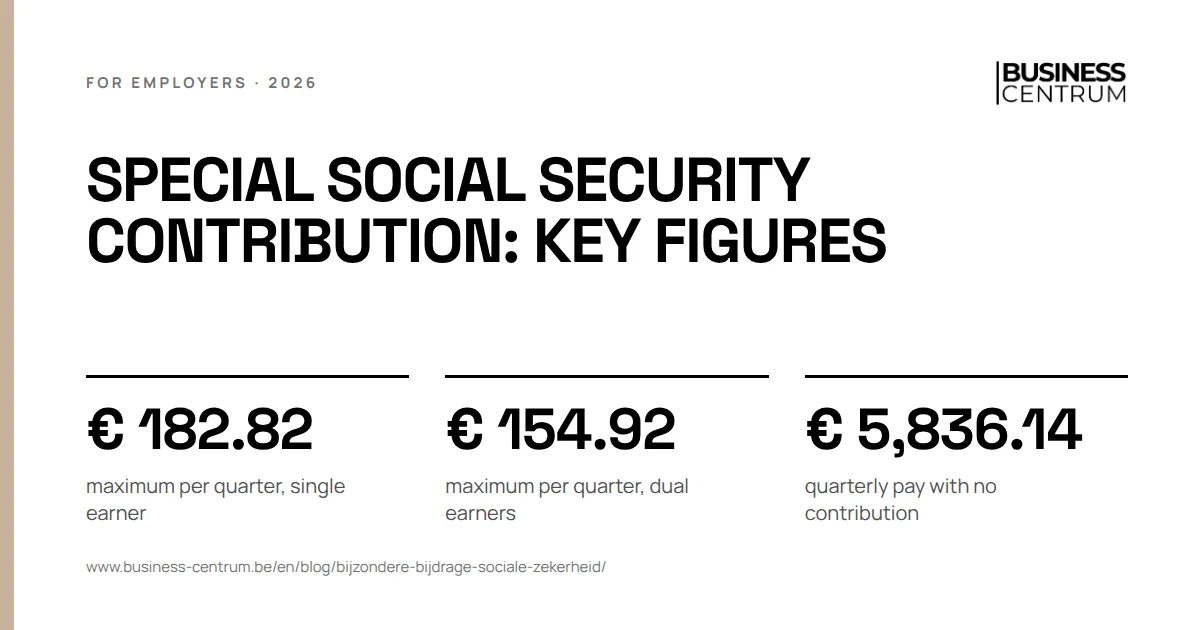
The special social security contribution, BBSZ in Dutch, is an extra deduction from the employee's pay in Belgium, on top of the ordinary RSZ of 13.07%. It depends on quarterly pay and family situation, and amounts to at most € 182.82 per quarter. You withhold it every month. The tax authority settles it for good in the tax assessment.
What is the special social security contribution in Belgium?
The BBSZ is a solidarity contribution the employee pays alongside their personal RSZ. It rises with pay but is capped. You, the employer, calculate it, deduct it from net pay and pay it with the other RSZ contributions. In the DmfA you report it per employee, with worker code 856.
What you withhold is an advance. The final contribution depends on the household's taxable income for the whole year. The FPS Finance settles it in the personal income tax assessment. That is why the total you withheld also appears on the employee's form 281.10.
The BBSZ is not the special contribution on double holiday pay, nor the special employer contribution on a flexi-job. They have similar names, but their own base and their own rate.
Who pays the BBSZ?
Every employee fully or partly covered by employee social security. The calculation starts from the gross pay you report to the NSSO each quarter, at 108% for manual workers. The part of pay paid by a subsistence security fund also counts. Arrears you did not yet know about when you filed the return do not count.
Since 1 April 2022, the amount also depends on how the employee is taxed:
- individual assessment, for a single person;
- joint assessment with a partner who has a professional income, for dual earners;
- joint assessment with a partner without professional income, for single-income households.
Legal cohabitants are treated as married. You ask for the family situation when someone starts, because you also need it for the withholding tax.
How to calculate the special social security contribution: the scale
The contribution is calculated per quarter on quarterly pay. The main brackets:
| Quarterly pay | Single | Dual earners |
|---|---|---|
| Below € 3,285.29 | none | none |
| From € 3,285.29 to € 5,836.14 | none | € 15.45 |
| Above € 6,570.54 | € 30.99 plus 1.10% on the part above € 6,570.54, with higher brackets above | € 43.32 plus 1.10% on the part above € 6,570.54 |
| Maximum | € 182.82, from € 18,116.46 | € 154.92 |
Between € 5,836.14 and € 6,570.54 there is a transitional bracket, so the contribution starts gradually. A single-income household, with a partner without professional income, pays nothing below € 5,836.14. Above it, they follow the dual-earner scale, but with the maximum of a single person: € 182.82.
Worked example: BBSZ for a white-collar employee and a manual worker
A white-collar employee earns € 3,500 gross a month, so € 10,500 per quarter. A manual worker earns € 3,000 a month. Their quarterly pay for the contribution is € 9,720, because you calculate at 108%.
| White-collar, single | White-collar, dual earner | Manual worker, single | |
|---|---|---|---|
| Quarterly pay | € 10,500.00 | € 10,500.00 | € 9,720.00 |
| Part above € 6,570.54 | € 3,929.46 | € 3,929.46 | € 3,149.46 |
| 1.10% on that part | € 43.22 | € 43.22 | € 34.64 |
| Fixed amount | € 30.99 | € 43.32 | € 30.99 |
| BBSZ per quarter | € 74.21 | € 86.54 | € 65.63 |
| About per month | € 24.74 | € 28.85 | € 21.88 |
At the same pay, a dual earner in this bracket therefore pays more than a single person. To check your own situation, use our gross-to-net calculator.
How do you withhold the BBSZ every month?
Because the contribution is based on quarterly pay, you only know the exact amount at the last pay run of the quarter. You therefore work in two steps:
- First and second month. You withhold a provisional monthly amount, based on that month's pay.
- Third month. You calculate the contribution for the whole quarter. If you withheld too much, you pay the difference back to the employee. If you withheld too little, you withhold the difference in the third month.
Each deduction is made after personal RSZ and after withholding tax. Per month, a single person thus never goes above € 60.94. How RSZ itself works is explained in our article on what RSZ is.
The BBSZ on the payslip and in the tax return
On the payslip, the BBSZ appears as a separate deduction, below the withholding tax. Employees often ask about it, because the amount in the third month of the quarter differs from the first two. That is not a mistake but the settlement of the quarter.
In the tax return, the tax authority recalculates the contribution on the household's income for the whole year. If that income is higher than the quarterly pay suggested, for instance because of the partner's income, an extra payment may follow. If annual income was lower, the employee gets part of it back.
What Business Centrum does for you
With every payroll run, we calculate the BBSZ with the scale that matches the family situation, settle the balance in the third month of the quarter and put the total on form 281.10, together with Acerta. You do not have to calculate anything yourself. More on your payroll administration.