
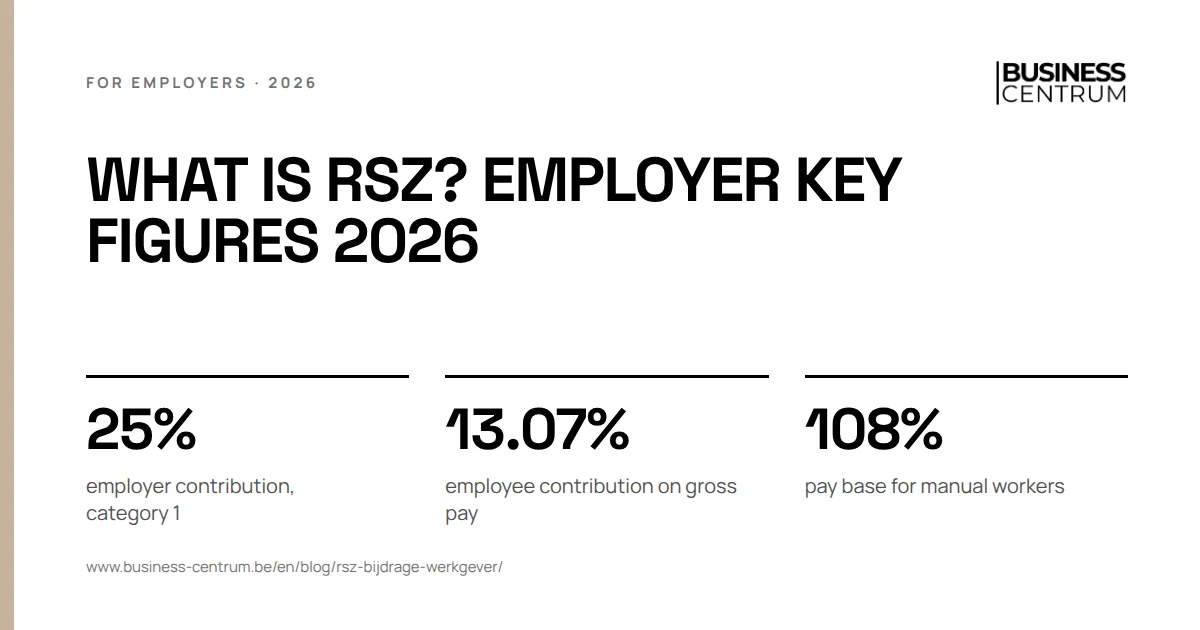
RSZ is the Belgian National Social Security Office, and the word also stands for the contributions it collects. In 2026, the employer contribution for most private sector employees is 25% of gross pay. You also deduct a 13.07% personal contribution from the employee's pay and pay both to the NSSO every quarter. For manual workers, you calculate on 108% of gross pay.
What is RSZ?
RSZ stands for Rijksdienst voor Sociale Zekerheid, the National Social Security Office (NSSO), called ONSS in French. This public body collects the contributions on the pay of every employee in Belgium and distributes them across the branches of social security: pensions, health and disability insurance, unemployment, occupational diseases and accidents at work.
In practice, "RSZ" also means the contribution itself. When people say a bonus is "subject to RSZ", they mean social security contributions are due on it. There are two:
- the employer contribution, which you pay on top of gross pay;
- the employee contribution, which you deduct from gross pay.
As the employer, you are responsible for both. You report every employment through Dimona, you report pay and working time every quarter in the DmfA return and you pay the total to the NSSO.
How much are employer social security contributions in Belgium?
The rate depends on the category of the employer and the employee. For category 1, ordinary employees in the commercial private sector, the breakdown is:
| Contribution | Rate | On which pay |
|---|---|---|
| Base employer contribution | 19.88% | gross pay (manual workers: 108%) |
| Wage moderation contribution (maximum) | 5.12% | gross pay (manual workers: 108%) |
| Together, rounded | 25% | |
| Additional contribution, from an average of 10 employees | 1.60% | gross pay |
| Holiday contribution for manual workers, quarterly and annual together | 15.84% | pay at 108% |
On top of that come small contributions that differ per sector, such as the contribution to the Fund for Company Closures and the contributions to the subsistence security fund of your joint committee. Which committee applies to you is explained in our overview of joint committees.
Category 2 covers the non-profit sector and category 3 sheltered workshops. They have other rates and a different structural reduction.
RSZ contribution employee: what do you deduct from pay?
The employee's personal contribution is 13.07% of gross pay. You deduct it with every salary payment, add your own contribution and pay the total to the NSSO. What is left after RSZ and withholding tax is net pay.
Two things lower or raise that amount for the employee:
- The work bonus. On a low wage, the employee gets a reduction of the personal contribution. The amounts and limits since 1 September 2026 are in our article on the work bonus.
- The special social security contribution. This is a separate monthly deduction that depends on household income. It comes on top of the 13.07% and you deduct it too. More in our explanation of the special contribution.
Why do you calculate on 108% for manual workers?
A manual worker does not receive holiday pay from you but from a holiday fund or the National Annual Holiday Office. To still collect contributions on that single holiday pay, you calculate RSZ on gross pay plus 8%, so on 108%. That applies to both the employer and the employee contribution.
For manual workers, you also pay the holiday contribution of 15.84% on pay at 108%. Part of it is paid every quarter with the ordinary contributions, the rest once a year. It funds the holiday pay the fund pays out in spring. For white-collar employees, you pay holiday pay yourself and there is no holiday contribution.
Worked example: calculate RSZ for the employer
Take a white-collar employee and a manual worker, both category 1, in a company with fewer than 10 employees, without reductions.
| White-collar | Manual worker | |
|---|---|---|
| Gross monthly pay | € 3,500.00 | € 3,000.00 |
| RSZ base | € 3,500.00 | € 3,240.00 (108%) |
| Employer contribution (25%) | € 875.00 | € 810.00 |
| Employee contribution (13.07%) | € 457.45 | € 423.47 |
| Holiday contribution (15.84%) | none | € 513.22 |
For the white-collar employee, RSZ costs you € 875.00 a month on top of gross pay. For the manual worker it is € 810.00 plus € 513.22 holiday contribution, spread over the quarter and the year. You do pay the white-collar employee's holiday pay yourself, on top of the salary. So always work with the full employment cost, not just RSZ.
Which reductions lower employer social security contributions in Belgium?
The rate is a starting point. Several reductions take a fixed amount off per quarter:
- The structural reduction. It applies automatically to every wage below a pay limit and grows as pay gets lower. The social secretariat calculates it per employee and per quarter in the DmfA.
- First hires. For your very first employee you get up to € 2,000 a quarter. For the second to fifth employee it is € 1,000 a quarter. How this works since 1 July 2026 is set out in our guide on the first employee reduction.
- Target groups. Separate reductions exist for certain groups, such as older employees in some regions.
Some employees fall entirely outside the ordinary contributions. For a flexi-job you pay a special contribution of 28%, for a student within the quota a solidarity contribution.
When do you pay RSZ contributions?
Contributions are due per quarter and must be in the NSSO's account by the last day of the month after the quarter. If your contributions for the quarter before last exceeded € 4,000, you pay monthly advances during the quarter. How these are calculated is explained in our article on NSSO advance payments.
What Business Centrum does for you
With every payroll run, we check that the right employer category, the 108% base for manual workers and every reduction you are entitled to are applied correctly, together with Acerta. Every quarter you get an overview of the contributions and due dates, so you know what you owe before the money leaves your account. More on your payroll administration.