
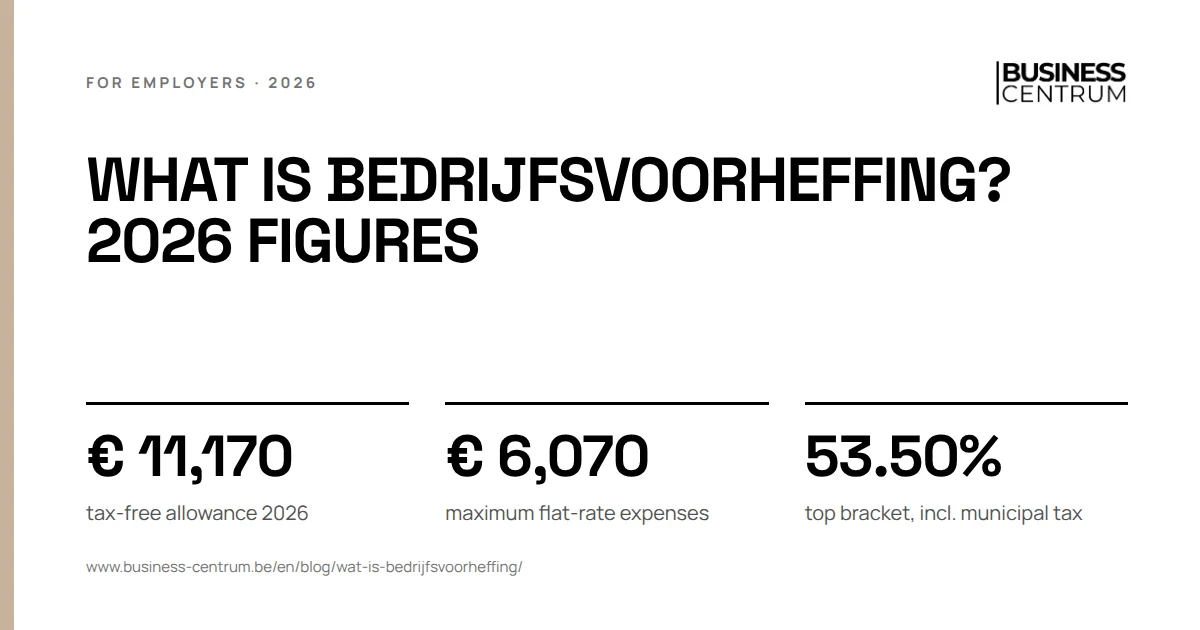
Bedrijfsvoorheffing is the Belgian payroll withholding tax: the advance on personal income tax that you, as the employer, withhold from your employees' pay and pass on to the FPS Finance. In 2026 the brackets run from 26.75% to 53.50%, municipal tax included. You declare and pay it every month, or every quarter if your amount is small.
What is bedrijfsvoorheffing?
Bedrijfsvoorheffing is a deduction at source. Anyone who pays a wage in Belgium withholds part of it and pays it to the state on the employee's behalf. The employee then offsets it in their tax assessment: the withholding tax appears on form 281.10 and is deducted from the tax they actually owe.
It does not only apply to wages. Whoever pays company director remuneration, unemployment and sickness benefits or pensions also withholds it. For an employer, three kinds of payments are involved:
- ordinary monthly pay;
- exceptional payments, such as an end-of-year bonus, double holiday pay or back pay;
- benefits in kind, such as a company car or a phone also used privately.
Bedrijfsvoorheffing comes on top of RSZ and is calculated after it. You first deduct the personal RSZ contribution, then you calculate the withholding tax on what remains. How RSZ works is explained in our article on what RSZ is.
How to calculate bedrijfsvoorheffing: the five steps
The FPS Finance publishes a key formula every year. For monthly pay, the calculation takes five steps:
- Gross annual income. Take gross monthly pay, deduct personal RSZ and multiply by twelve.
- Taxable net annual income. Deduct the flat-rate professional expenses: 30% of gross annual income, with a maximum of € 6,070 in 2026.
- Annual tax. Apply the base scale and deduct the tax on the tax-free allowance of € 11,170.
- Monthly amount. Divide the annual tax by twelve.
- Reductions. Deduct reductions, for example for dependent children or the tax work bonus on low wages.
The scale already includes 7% additional municipal tax. That is why it starts at 26.75% and not at the personal income tax rate.
Family situation matters. If the employee's partner has no professional income of their own, the formula allocates part of the income to that partner and the withholding tax goes down. That is why you ask for marital status and dependent children when someone starts, and ask the employee to report any change.
Worked example: calculate bedrijfsvoorheffing for a white-collar employee
A single white-collar employee without dependent children earns € 3,500.00 gross a month. Simplified, without the rounding in the key formula:
| Step | Calculation | Amount |
|---|---|---|
| Personal RSZ (13.07%) | € 3,500.00 x 13.07% | € 457.45 |
| Gross annual income | (€ 3,500.00 - € 457.45) x 12 | € 36,510.60 |
| Flat-rate professional expenses | 30% exceeds the maximum | € 6,070.00 |
| Taxable net annual income | € 36,510.60 - € 6,070.00 | € 30,440.60 |
| Base tax | € 9,944.05 + 48.15% on the part above € 29,500 | € 10,396.95 |
| Minus tax on the tax-free allowance | € 2,987.98 | € 7,408.97 |
| Withholding tax per month | € 7,408.97 / 12 | € 617.41 |
Net pay thus comes to about € 2,425, before the special social security contribution. You withhold that separately, see our explanation of the special contribution. To check your own situation quickly, use our gross-to-net calculator.
Bonuses, holiday pay and overtime
Exceptional payments do not use the monthly scale but a fixed percentage that depends on the employee's normal annual pay. For normal annual pay between € 26,340.01 and € 31,830, it is for example 40.38% on an end-of-year bonus. A bonus therefore seems taxed more heavily than pay, but the employee settles everything in the tax return. A full example is in our guide on the end-of-year bonus.
For some work, you do not have to pass on part of the withholding tax. That is an advantage for you as the employer, the employee notices no difference. For overtime with a 20% premium, for instance, you do not pass on 32.19% of the overtime pay. Similar exemptions exist for shift and night work and for researchers. How this works for overtime is in our guide on paying overtime.
When do you pay bedrijfsvoorheffing?
You file the return online through FinProf and pay into the account of the competent FPS Finance team. Return and payment must arrive on the same day.
- Monthly is the rule. The return and payment for a month must arrive around the fifteenth of the following month. The exact date is in the annual FPS Finance calendar. For September 2026 it is 15 October 2026.
- Quarterly is allowed if the previous year's withholding tax stayed below a threshold. For 2025 that threshold was € 50,240. The return for the third quarter of 2026 is also due by 15 October 2026.
Form 281.10 and Belcotax
After the year, you draw up a form 281.10 for each employee with the taxable pay and the withholding tax deducted. You file the forms through Belcotax on web. For 2026 income, the deadline is 28 February 2027. If an employee leaves during the year, the form is part of the social documents on dismissal.
What Business Centrum does for you
With every payroll run, we calculate the withholding tax with that year's key formula, apply the family situation and the reductions and handle the return, the payment and the 281.10 forms, together with Acerta. You know the due dates in advance, so the payment leaves on time. More on your payroll administration.