
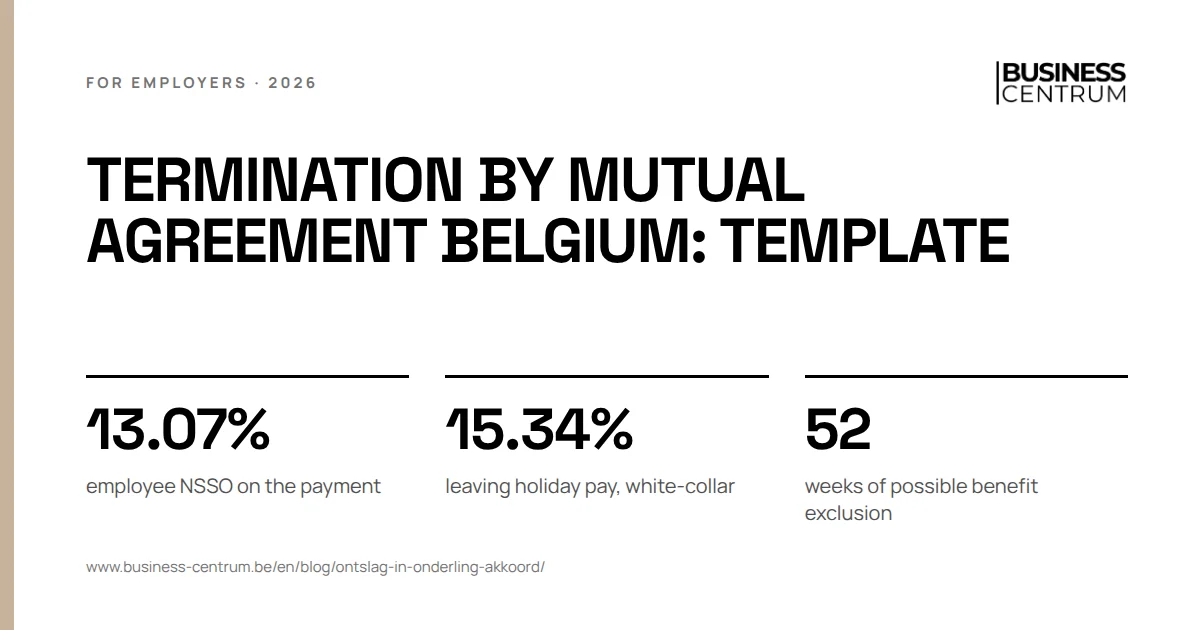
With termination by mutual agreement, employer and employee end the contract together, on a date they choose, without notice. A payment is not compulsory. If you make one, you withhold 13.07% employee NSSO contributions. For the employee, the agreement counts in principle as leaving the job voluntarily: the National Employment Office (RVA/ONEM) can exclude them from benefit for up to 52 weeks.
What is termination by mutual agreement?
Legally, it is not a dismissal. Nobody ends the contract unilaterally: both parties agree that it ends. A lot follows from that:
- there is no notice period and no payment in lieu of notice;
- no registered letter is needed;
- the employee cannot ask for reasons for dismissal under collective agreement 109;
- the form is free, but without anything in writing you cannot prove the agreement.
The agreement is only valid if both parties consent freely. An employee who signs under pressure can later argue that it was really a dismissal. You then risk a payment in lieu of notice after all, based on the employer's notice period.
A template agreement for termination by mutual agreement
You can adapt this template. Each party keeps a signed copy. Draft the final version in the language of your workplace, Dutch or French.
Agreement to terminate the employment contract by mutual agreement
Between [employer name, company number, address], represented by [name, position], hereinafter the employer, and [employee name, national register number, address], hereinafter the employee,
Article 1. End. The parties terminate by mutual agreement the employment contract of [start date]. The contract ends on [end date].
Article 2. Work. [The employee works until the end date. / The employee is released from work from [date] on full pay.]
Article 3. Payment. The employer pays the employee a termination payment of € [amount] gross. Statutory social security contributions and withholding tax are deducted from this amount. [Or: No payment is due.]
Article 4. Final settlement. With the final pay run, the employee receives pay up to the end date, leaving holiday pay and a pro rata end-of-year bonus under the sector rules.
Article 5. Non-compete. [The employer waives the non-compete clause in the employment contract. / The non-compete clause continues to apply and the employer pays the compensation.]
Article 6. Company property. By the end date at the latest, the employee returns [laptop, mobile phone, keys, badge, fuel card, car].
Article 7. Social documents. The employer provides the employee with the social documents, including the C4 form stating the reason "by mutual agreement".
Article 8. Full and final settlement. Once this agreement has been performed, the parties declare that they have no further claims against each other arising from the employment contract or its termination.
Signed at [place] on [date], in two copies.
[Employer signature] [Employee signature]
Download this template in Word and PDF, in Dutch and French.
The clauses SMEs forget
The end date and what happens until then. Without a clear date and arrangements for work, disputes follow. Release from work on full pay is possible, but write it down.
Gross or net. Always state a gross amount. The payment counts as pay for NSSO purposes and is taxed separately as a termination payment. Writing "net" means you pay the contributions and tax on top yourself.
Holiday pay and end-of-year bonus. These are due separately from the payment. A white-collar employee receives 15.34% leaving holiday pay on gross pay for the current year. The pro rata end-of-year bonus depends on your sector. In joint committee (JC) 200, for example, an employee leaving by mutual agreement has, since 2026, been entitled to a pro rata bonus with at least 3 years' seniority.
Non-compete. A non-compete clause takes effect on termination by mutual agreement if the contract lasted more than 6 months. It can only be valid with gross annual pay above € 44,447, and between that amount and € 88,895 only for roles designated in a collective agreement. It lasts at most 12 months. If you do not waive it within 15 days of the end of the contract, you pay at least half the gross pay for the duration of the clause. So settle it in the agreement itself. More in our piece on non-compete clauses.
Full and final settlement. Without this sentence, the employee can later claim overtime, bonuses or compensation. With it, you close the file, provided the settlement is correct.
Worked example
A white-collar employee in JC 200 has worked for you since 1 September 2023 and earns € 3,200 gross a month. On 2 November 2026 you agree that the contract ends on 30 November 2026, with a payment of 8 weeks' pay.
- Weekly pay: € 3,200 × 3 / 13 = € 738.46.
- Payment: 8 x € 738.46 = € 5,907.69 gross. The NSSO deduction of 13.07% is € 772.14. Withholding tax follows.
- Leaving holiday pay: 15.34% on € 35,200 gross pay from January to November, or € 5,399.68, plus any balance for the previous year.
- End-of-year bonus: pro rata, because she has more than 3 years' seniority.
For comparison: on dismissal, her statutory notice would be 13 weeks, or € 9,600 as a payment in lieu on the fixed monthly salary. The 8 weeks are a negotiated amount, not a legal minimum.
Termination by mutual agreement and the C4: what you fill in
You hand over the C4 by the last working day at the latest, also with an agreement. Electronically, this goes through the social risk declaration, scenario 1, plus a paper C4-ASR for the employee. On the form you enter:
- How the contract ended: "by mutual agreement between employer and employee", with the date of the agreement on ending the contract. That is the day you made the agreement, not the end date.
- Payments: the payment made under the agreement, separately from any payment in lieu of notice.
- The exact cause of unemployment. With an agreement you must fill it in. If the initiative came from you, for example because you are cutting the job, state that correctly. The office looks at who really wanted the contract to end.
The other documents you must hand over are covered in social documents on dismissal.
Unemployment: what has changed since 2026?
For the National Employment Office, ending a contract by mutual agreement is in principle leaving the job voluntarily. The employee risks a warning or an exclusion of 4 to 52 weeks. For a repeat case, or if they left with the intention of claiming benefit, the office can exclude them indefinitely. If it turns out the ending really came from the employer, it does not count as leaving voluntarily.
Since 2026 there is a way out: the right to a restart. For a job left from 1 March 2026, an employee with at least 3,120 working days, roughly ten years, can ask once in their career to replace the exclusion with benefit for at most 6 months. They must apply within 30 days of notification of the office's decision.
For you as employer, this means an employee without that work history risks an exclusion with no such way out under an agreement, and will therefore prefer a dismissal with notice. Be open in the negotiation about what each option means for them. An agreement that is challenged later costs more than it saves.
Business Centrum drafts the agreement with the right payment, calculates the leaving holiday pay and pro rata end-of-year bonus for your joint committee, and issues the C4 on time, together with Acerta in your payroll. Torn between an agreement and a dismissal? We set out both scenarios in euros through our employment contracts service.