
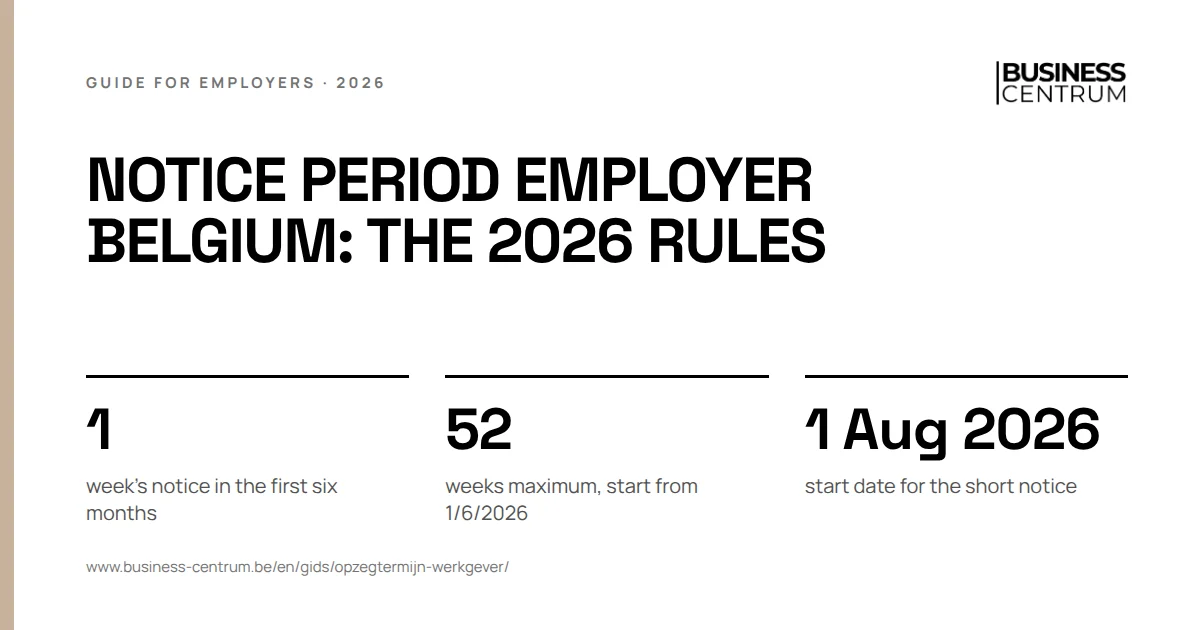
In Belgium, the notice period an employer must give depends on seniority and, since 2026, on the employee's start date. If the contract started on or after 1 August 2026, you give 1 week's notice during the first 6 months. For contracts starting from 1 June 2026, notice is capped at 52 weeks.
Which rules apply since 2026?
Since 1 January 2014, one statutory table has applied to blue-collar and white-collar workers. In 2026 two new laws changed that table, but only for new contracts. The Act of 18 May 2026 on miscellaneous labour provisions (wet houdende diverse arbeidsbepalingen) introduced the cap. The Act of 3 June 2026 amending Article 37/2 of the Employment Contracts Act of 3 July 1978 introduced the short notice. The key is the day the employee actually started work as agreed in the contract, not the day it was signed.
That splits your workforce into three groups:
- Started before 1 June 2026. The familiar table, with no cap. In the first six months, notice rises from 1 to 5 weeks.
- Started on or after 1 June 2026 and before 1 August 2026. The same table, but from 17 years' seniority notice stops growing at 52 weeks.
- Started from 1 August 2026. 1 week's notice while seniority stays under 6 months, then the normal table with the same cap.
A sector collective agreement cannot depart from these periods. In the sectors that used to have different notice periods for blue-collar workers, such as construction, the normal table has also applied since 1 January 2018: that transitional scheme has expired. What the new rules change in practice, with a dismissal worked out for each group, is covered in our piece on the new notice periods for 2026.
Table: notice periods by seniority and start date
Notice is expressed in weeks. Use the column that matches the employee's start date.
| Seniority under 5 years | Start before 1 June 2026 | Start from 1 June 2026, before 1 August 2026 | Start from 1 August 2026 |
|---|---|---|---|
| under 3 months | 1 | 1 | 1 |
| 3 to 4 months | 3 | 3 | 1 |
| 4 to 5 months | 4 | 4 | 1 |
| 5 to 6 months | 5 | 5 | 1 |
| 6 to 9 months | 6 | 6 | 6 |
| 9 to 12 months | 7 | 7 | 7 |
| 12 to 15 months | 8 | 8 | 8 |
| 15 to 18 months | 9 | 9 | 9 |
| 18 to 21 months | 10 | 10 | 10 |
| 21 to 24 months | 11 | 11 | 11 |
| 2 to 3 years | 12 | 12 | 12 |
| 3 to 4 years | 13 | 13 | 13 |
| 4 to 5 years | 15 | 15 | 15 |
| Seniority of 5 years or more | Start before 1 June 2026 | Start from 1 June 2026, before 1 August 2026 | Start from 1 August 2026 |
|---|---|---|---|
| 5 to 6 years | 18 | 18 | 18 |
| 6 to 7 years | 21 | 21 | 21 |
| 7 to 8 years | 24 | 24 | 24 |
| 8 to 9 years | 27 | 27 | 27 |
| 9 to 10 years | 30 | 30 | 30 |
| 10 to 11 years | 33 | 33 | 33 |
| 11 to 12 years | 36 | 36 | 36 |
| 12 to 13 years | 39 | 39 | 39 |
| 13 to 14 years | 42 | 42 | 42 |
| 14 to 15 years | 45 | 45 | 45 |
| 15 to 16 years | 48 | 48 | 48 |
| 16 to 17 years | 51 | 51 | 51 |
| 17 to 18 years | 54 | 52 | 52 |
| 18 to 19 years | 57 | 52 | 52 |
| 19 to 20 years | 60 | 52 | 52 |
| 20 to 21 years | 62 | 52 | 52 |
| 21 to 22 years | 63 | 52 | 52 |
| 22 to 23 years | 64 | 52 | 52 |
| 23 to 24 years | 65 | 52 | 52 |
| 24 to 25 years | 66 | 52 | 52 |
| 25 to 26 years | 67 | 52 | 52 |
| each further year started | +1 | 52 | 52 |
Between 5 and 20 years, notice grows by 3 weeks per year started. After that it slows: 2 more weeks at 20 years, then 1 week per year started from 21 years. In practice the cap only bites for someone who started on or after 1 June 2026 and stays 17 years, so from 2043 onwards. An employer dismissing an employee in 2045 who joined on 1 June 2026 and has 19 years' service gives 52 weeks instead of 60.
Apart from the cap, there is already a limit at pension age. If you give notice so that the contract ends from the month after the one in which the employee reaches the statutory pension age, your notice is capped at 26 weeks.
How to calculate the notice period in four steps
- Find the start date of performance. It decides which column of the table you use. Look at the first working day in the contract, not the signature date.
- Work out when the notice starts. Notice starts on the Monday after the week in which it was served. A registered letter takes effect on the 3rd working day after posting. Saturday counts as a working day; Sundays and public holidays do not.
- Count seniority on that Monday. Count from the first day of employment to the day before the notice starts. Someone who joined on 1 March has exactly six months' seniority on 1 September.
- Read off the weeks and put them in the letter. The letter states the start date and the length of the notice. If either is missing, the notice is void.
Notice period for white-collar and blue-collar staff: the same rules
For contracts that started on or after 1 January 2014, status no longer matters. A white-collar employee and a blue-collar worker with the same seniority receive the same notice. The only difference is the pay used to calculate a payment in lieu: white-collar staff usually have a fixed monthly salary, blue-collar workers often an hourly wage.
For anyone already employed before 1 January 2014, you add two parts. Part I follows the old rules for seniority built up before that date. Part II follows the new table for seniority from 1 January 2014. For blue-collar workers Part I often comes out in days, for white-collar staff in months. This calculation is easy to get wrong, so have it checked before you send the letter.
Worked examples: three start dates, three outcomes
In all three examples the employer posts the registered letter on Monday 5 October 2026. It takes effect on Thursday 8 October, and the notice starts on Monday 12 October 2026.
Example A: white-collar employee since 1 March 2015, gross salary € 3,500 a month. On 12 October 2026 she has 11 years and 7 months' seniority. Notice is 36 weeks and runs until Sunday 20 June 2027, unless holidays or sickness intervene. If you prefer a payment in lieu, this is how to calculate it. Weekly pay is € 3,500 × 3 / 13 = € 807.69. On the fixed monthly salary, the payment in lieu is € 3,500 x 3 / 13 x 36 = € 29,076.92 gross. Benefits under the contract, such as an end-of-year bonus, come on top, and in practice the double holiday pay of a white-collar employee is included as well. On the € 29,076.92 you withhold 13.07% employee NSSO contributions, or € 3,800.35. Because notice is at least 30 weeks, you offer outplacement and deduct 4 weeks from the payment: you pay 32 weeks, € 25,846.15, plus outplacement worth at least 1/12 of annual pay. With gross annual pay of € 45,500 in 2025, that is € 3,791.67.
Example B: blue-collar worker since 1 June 2026, hourly wage € 17.50 for 38 hours a week. On 12 October 2026 he has 4 months and 11 days' seniority. His contract started before 1 August 2026, so the old table applies: 4 weeks. Weekly pay is € 17.50 x 38 = € 665. A payment in lieu comes to 4 x € 665 = € 2,660 gross.
Example C: white-collar employee since 3 August 2026, gross salary € 2,800 a month. On 12 October 2026 she has just over 2 months' seniority and her contract falls under the new rule. Notice is 1 week and ends on Sunday 18 October 2026. A payment in lieu is € 2,800 x 3 / 13 = € 646.15 gross.
Two employees with almost the same seniority can therefore receive different notice. Someone who started on 31 July 2026 and leaves after five months gets 5 weeks. Someone who started on 1 August gets 1.
Worked notice or a payment in lieu?
You have two options. With worked notice, the employee keeps working until the end of the period and you keep paying wages. With a payment in lieu of notice, the contract ends at once and you pay the wages for the full notice in one go. You can also combine them: let the employee work first, then end the contract and pay the rest as compensation.
The payment covers current pay plus the benefits the employee is entitled to under the contract, a collective agreement or custom: end-of-year bonus, meal vouchers, company car, group insurance. For variable pay, take the average of the 12 months before the dismissal. Do not forget the leaving holiday pay for white-collar staff, or a pro rata end-of-year bonus for the months worked if your joint committee (JC) grants one on dismissal: these come on top.
Which to choose? Worked notice is cheaper if the employee stays productive, but a dismissed employee is not always motivated and is entitled to job-search leave. A payment in lieu costs more cash up front, but gives immediate clarity. With long notice, suspensions also matter: every spell of sickness pushes the end date back.
Counting seniority for the notice period
Seniority is the period during which the employee worked for your business without interruption. It includes:
- successive contracts with the same employer, even if the first was fixed-term;
- periods of suspension, such as sickness, holidays or temporary unemployment;
- time as an agency worker in the same role, up to 1 year, if you hired the person straight afterwards.
That last rule only applies when the employer gives notice. A gap of a week or less between two agency assignments counts as employment. A real break between two contracts with you can, however, interrupt seniority.
What happens during the notice period
Suspension. When the employer gives notice, sickness, annual leave, maternity leave, temporary unemployment and some types of leave stop the notice. It resumes after the suspension. How to handle sickness is explained in our piece on sickness during the notice period.
Job-search leave. The employee may be absent on full pay to look for work: half a day a week, and one day a week during the last 26 weeks of notice. With short notice, all of it falls in that final stretch. If the employee receives outplacement, they may take one day a week throughout the whole notice period.
Counter-notice. If the employee finds a new job, they may leave with shorter notice: 1 week under six months for contracts starting from 1 August 2026, and 4 weeks from one year's service. The employer cannot give counter-notice. An employee who simply resigns never gives more than 13 weeks' notice.
Outplacement and employability from 30 weeks
If the employee is entitled to at least 30 weeks' notice, you must offer outplacement: 60 hours of support. With worked notice, you make the offer by registered letter no later than 4 weeks after the notice starts. With a payment in lieu, the support is worth 1/12 of annual pay, with a minimum of € 1,800 and a maximum of € 5,500 excluding VAT. Employees aged 45 or over with at least a year's service are also entitled to outplacement with shorter notice, under a separate scheme.
From 30 weeks, the employee is also entitled to a budget of € 1,840 for training or coaching, which they claim from the National Employment Office (RVA/ONEM). You do not pay this separately: the office funds it from the employer contributions on the last part of the notice. During worked notice, however, the employee must be able to take paid time off to follow these measures. More detail is in our piece on compulsory outplacement.
Template notice letter
Send the notice by registered post or have it served by a bailiff. A basic version:
[Employer name, address, company number]
Registered post to [employee name, address]
[Place], [date of posting]
Re: notice of termination of your employment contract
Dear [name],
We are terminating your open-ended employment contract with a notice period of [number] weeks. The notice period starts on Monday [date] and, barring suspension, ends on [date].
[Choose: You will work your notice period. / You are released from work during the notice period.]
Yours sincerely,
[Name and signature of the authorised person]
Full versions for worked notice, release from work and immediate termination are in our template dismissal letter.
Mistakes employers make with the notice period in Belgium
- Handing over the letter. Notice from the employer is void unless sent by registered post or served by a bailiff. The dismissal stands, but you pay compensation.
- Leaving out the start date. Without a start date and duration in the letter, the notice is void. Again, a payment in lieu follows.
- Using the wrong column. An employee who joined at the end of July 2026 does not get the one-week notice. Check the start date in the Dimona declaration and the contract.
- Posting too late in month six. See the box above: posting a week later can cost five extra weeks of notice.
- Missing the outplacement offer. From 30 weeks, the offer must be made by registered letter and on time.
- Forgetting the reasons. After the first 6 months, the employee may ask for the concrete reasons for dismissal (collective agreement 109). You reply by registered letter within 2 months. If you do not, you owe a penalty of 2 weeks' pay. For a manifestly unreasonable dismissal, a court can award up to 17 weeks' pay.
- Social documents. The C4 unemployment certificate must be ready by the last working day at the latest, with the right reason and the period covered by any payment in lieu.
Business Centrum calculates the notice on the right start date and seniority, drafts the registered letter and puts the payment in lieu, leaving holiday pay and end-of-year bonus correctly on the final payslip. The C4 and the Dimona exit declaration follow automatically in your payroll, handled together with Acerta. Unsure about a dismissal? We review the file beforehand through our employment contracts service.