
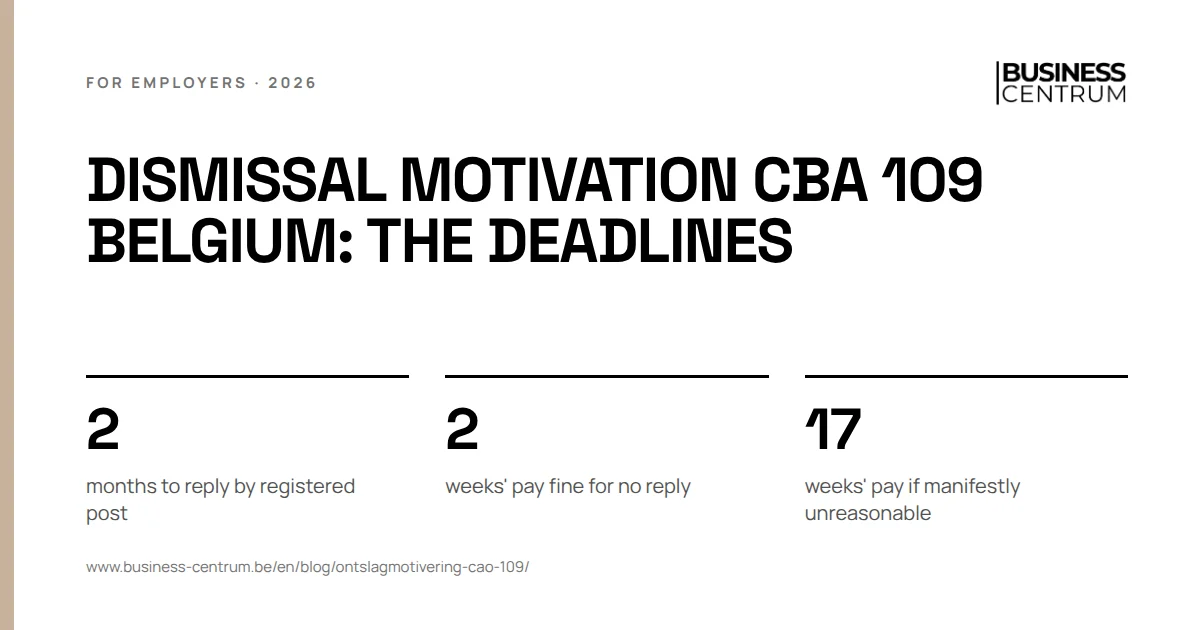
Under CBA 109, a dismissed employee can ask by registered letter for the specific reasons for their dismissal. You answer by registered letter within 2 months of receipt. No answer or a vague one costs a fine of 2 weeks' pay. If the court finds the dismissal manifestly unreasonable, compensation of 3 to 17 weeks' pay follows.
What CBA 109 says about the dismissal motivation
CBA 109 is a national collective bargaining agreement concluded in the National Labour Council. It gives private-sector employees two rights: to know the specific reasons for their dismissal, and protection against manifestly unreasonable dismissal.
The agreement applies to employees with at least 6 months' seniority. Successive fixed-term contracts count, as does agency work in the same role with the same employer. It does not apply:
- to agency workers and students;
- to dismissal with a view to unemployment with company top-up (SWT);
- to dismissal from the month after the statutory pension age;
- to definitive closure, shutdown, collective or multiple dismissal;
- to a special dismissal procedure, such as for protected employees;
- to the request for reasons after a dismissal for serious cause, because the facts are already in the dismissal letter.
Which deadlines apply to the dismissal motivation? The timeline at a glance
The deadlines depend on how you dismiss.
| Step | Termination with compensation (immediate) | Dismissal with notice |
|---|---|---|
| Employee asks for the reasons | Within 2 months of the end of the contract | Within 6 months of notice being served, but no later than 2 months after the end of the contract |
| Form of the request | Registered letter | Registered letter |
| You answer | Within 2 months of receiving the request | Within 2 months of receiving the request |
| Form of the answer | Registered letter | Registered letter |
Example with compensation. You terminate the contract on Thursday 8 October 2026 with compensation in lieu of notice. The employee can ask until Tuesday 8 December 2026. The employee posts the registered request on Tuesday 17 November 2026. According to the commentary to CBA 109, your deadline runs from the 3rd working day after posting, Friday 20 November. Post your registered answer by Tuesday 19 January 2027 at the latest and you are certainly on time.
Example with notice. A blue-collar worker with three years' seniority receives 13 weeks' notice, starting on Monday 12 October 2026 and, without suspension, ending on Sunday 10 January 2027. He can ask until Wednesday 10 March 2027 at the latest. The limit of 2 months after the end falls earlier here than the 6 months after notice was served.
Record the posting date of every registered request in the personnel file. Your deadline runs from the 3rd working day after that date, even if the letter reaches your desk later. For your answer, the posting date of your own registered letter counts.
Dismissal motivation in the first 6 months: does CBA 109 apply?
No. An employee with less than 6 months' seniority cannot ask for reasons or claim compensation for manifestly unreasonable dismissal. For contracts starting from 1 August 2026, notice in those first months is just 1 week.
A dismissal in the first months is still not risk-free. The employee can rely on abuse of rights: they must then prove the fault, the damage and the causal link themselves. They can also rely on anti-discrimination law if the dismissal is linked to pregnancy, health or origin, for example. There, facts that suggest discrimination are enough, and you must prove there was no discrimination.
A template letter for the dismissal motivation
An answer must contain the specific reasons that led to the dismissal. Facts, dates, figures. No summary such as "performance" or "restructuring" without explanation.
Registered post
[Employee name], [address]
[Place], [date]
Re: your request for the reasons for your dismissal
Dear Mr [name],
On [date] we received your registered letter asking for the reasons for your dismissal.
We terminated your employment contract for the following reasons:
- [Reason 1, specific. For example: since January 2026 you missed the agreed order-picking target in six of the nine months. This was discussed with you on 12 March and 4 June 2026, each time with a written record.]
- [Reason 2, specific. For example: after the meeting of 4 June you did not attend the additional training on 18 June, without notice.]
These reasons relate to your suitability for the role.
Yours sincerely,
[Name, role, signature]
Download this template in Word and PDF, in Dutch and French.
Keep the answer consistent with what you said and wrote earlier: in the dismissal letter, on the C4 form, in appraisals. Contradictory reasons are the first thing a lawyer looks for. How to draft the dismissal letter itself is covered in dismissal letter employer template.
Which reasons stand up in court?
A dismissal is manifestly unreasonable if it concerns an employee on an open-ended contract and is based on reasons unrelated to the employee's suitability or conduct or not based on the operational needs of the business, and is one that a normal, reasonable employer would never have decided on. An employee on a fixed-term contract can therefore ask for the reasons, but cannot claim compensation for manifestly unreasonable dismissal. The court's review is marginal: it checks whether your decision was reasonable, not whether it would have chosen differently.
| Reason | Usually stands if | Becomes weak if |
|---|---|---|
| Suitability (performance) | There are appraisals, meetings and chances to improve | Nothing was ever said or written down |
| Conduct | Dated facts, earlier warnings | Only general terms such as "attitude" |
| Operational needs | You show the loss of turnover, the reorganisation or the abolished role | Someone else is hired for the same job shortly afterwards |
| Breach of trust | Specific facts that damaged trust | The term is used without facts |
These patterns come up regularly in case law. Employers who give reasons they can support with documents are in a strong position. Employers who construct reasons after the fact are not.
The burden of proof depends on what you did. If you gave the reasons correctly, the employee must prove the dismissal was manifestly unreasonable. If you did not answer a valid request, or not correctly, you must prove the dismissal was reasonable. If the employee asked nothing, the burden lies with them.
What does a missed answer cost? A worked example
A warehouse worker earns € 3,200 gross a month. You do not answer his registered request and the court later finds the dismissal manifestly unreasonable.
| Item | Calculation | Amount |
|---|---|---|
| Weekly pay | € 3,200 × 3 / 13 | € 738.46 |
| Fine for no answer | 2 weeks x € 738.46 | € 1,476.92 |
| Manifestly unreasonable dismissal, minimum | 3 weeks x € 738.46 | € 2,215.38 |
| Manifestly unreasonable dismissal, maximum | 17 weeks x € 738.46 | € 12,553.82 |
| Total in the worst case | Fine plus maximum | € 14,030.74 |
That comes on top of the compensation in lieu of notice or the pay during notice. A proper answer costs you an hour of writing and a registered letter.
Common employer mistakes
- Leaving the registered request unopened. The letter arrives during the holidays and nobody opens it. The deadline runs anyway.
- Answering by email. Quick, but not a valid answer.
- Giving a general reason. Courts generally do not accept "economic reasons" without figures or explanation as a specific reason.
- Different reasons from the C4. The employee will put both side by side.
- Hiring a replacement too soon. An employer who abolishes a role for economic reasons and hires someone for the same job two months later usually loses that argument in court.
Dismissal motivation by the employer: spontaneous or on request?
It is your choice. Giving reasons spontaneously in the dismissal letter saves a second letter and a deadline to track, but requires a well-prepared file at the time of dismissal. Giving reasons on request gives you time, but the deadline is strict. Either way, write facts you can prove. How the notice period itself is calculated is explained in our guide to the employer's notice period.
What Business Centrum does for you
We track the deadlines in your personnel file, so a registered request does not go unnoticed. We check your answer for specific reasons and for contradictions with the C4 and the dismissal letter, and we process the final pay and social documents together with Acerta. More about our support with employment contracts and dismissal.