
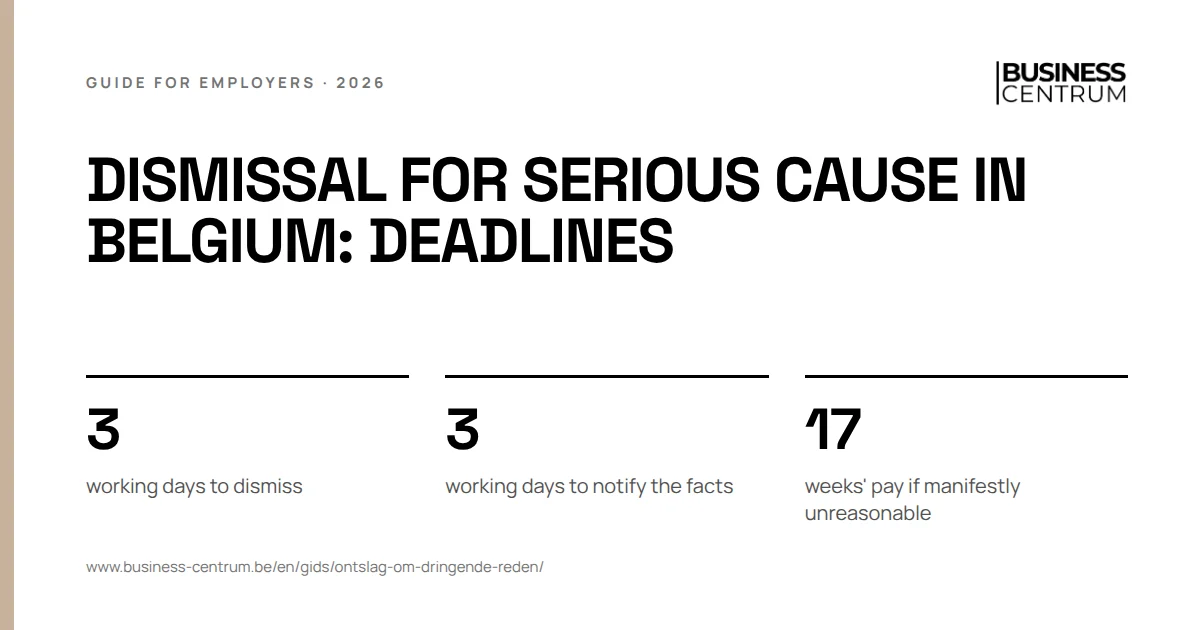
A dismissal for serious cause ends the employment contract immediately, with no notice period and no compensation. You must dismiss within 3 working days of knowing the facts with certainty, and notify those facts by registered letter within 3 working days of the dismissal. The burden of proof is yours. Miss a deadline and the serious cause falls away.
What is a dismissal for serious cause in Belgium?
The law defines serious cause as a serious failing that makes any further professional cooperation between employer and employee immediately and permanently impossible. Three words carry that definition: serious, immediately and permanently. A string of minor mistakes rarely qualifies. A single grave act can, even for an employee with twenty years' service.
The consequences are heavy for both sides. The employee gets no notice period, no compensation in lieu of notice and no outplacement. You pay only what was already owed: pay up to the day of dismissal, leaving holiday pay for white-collar staff and a pro rata end-of-year bonus if your sector does not exclude it for serious cause.
That is why the labour court looks closely. It judges the misconduct in context: the role, the seniority, earlier warnings, the harm to the business. An employer who tolerated the same behaviour for years will struggle to argue it is suddenly unacceptable. If you have warned in writing before, you are in a stronger position. How to do that is covered in our article on a written warning to an employee.
Dismissal for serious cause: the 3-day deadline on a calendar
The law sets two deadlines that run one after the other. Both are 3 working days.
- Deadline to dismiss. It starts the day after you know the facts with sufficient certainty. The dismissal must be given within this period.
- Deadline to notify the facts. It starts the day after the dismissal. Within this period the employee must know in writing which facts you hold against them.
As the FPS Employment and the courts read it, a working day is every day of the week except Sundays and public holidays. Saturday therefore counts, even in a business that is closed on Saturdays. For a registered letter, case law looks at the posting date: the letter must be posted within the deadline, not delivered within it.
An example with a public holiday in it. A warehouse worker is caught taking goods on Monday 9 November 2026. The manager reviews the camera footage that same day and is certain.
| Day | Date | Working day? | Deadline |
|---|---|---|---|
| Monday | 9 November 2026 | Day of knowledge, does not count | Start |
| Tuesday | 10 November 2026 | Yes | Day 1 to dismiss |
| Wednesday | 11 November 2026 | No, Armistice Day | |
| Thursday | 12 November 2026 | Yes | Day 2 |
| Friday | 13 November 2026 | Yes | Day 3: last day to dismiss |
| Saturday | 14 November 2026 | Yes | Day 1 to notify the facts |
| Sunday | 15 November 2026 | No | |
| Monday | 16 November 2026 | Yes | Day 2 |
| Tuesday | 17 November 2026 | Yes | Day 3: last posting day for the reasons |
If the employer dismisses on Friday 13 November, the registered letter setting out the facts must be posted by Tuesday 17 November at the latest. An employer who dismisses on a Friday and thinks he has until Wednesday is too late: Saturday has already used up a day.
In practice you combine both steps in one registered letter: the dismissal and the facts together, sent within the first deadline. The second deadline then no longer exists and there is one date fewer to miss.
The procedure for a dismissal for serious cause, in seven steps
This is how a dismissal for serious cause runs in an SME without formal errors:
- Record the facts on the day. Who, what, where, when, which witnesses. Keep footage, tachograph data, till reports or emails in their original form.
- Note the moment of certainty. Write down when and by whom the facts became known with certainty. That is the start of your deadline and the court will ask about it.
- Hear the employee if you can. Not compulsory, but useful. Record the conversation briefly in writing and have it signed.
- Decide within the first deadline. Only someone with authority to dismiss can give the dismissal. Agree in advance who does this if the managing director is away.
- Send the dismissal and the facts. Ideally together, in one registered letter. If you hand the letter over, have the employee sign a duplicate as proof of receipt. A bailiff is also an option.
- Keep the proof of posting. The dated post office receipt proves you met the deadline.
- Handle the exit. Dimona exit, final pay slip, holiday certificate and C4. What you issue and when is set out in our article on social documents on dismissal.
Hearing the employee before a dismissal for serious cause: is it required?
Private-sector employers have no general statutory duty to hear the employee. The Constitutional Court ruled that this difference with the public sector is not discriminatory. A duty to hear can still arise from a sector collective agreement, your work rules or the employment contract itself. Check all three before you dismiss: if a hearing procedure is set out, follow it.
Even without a duty, we recommend a short interview. You hear the employee's side, you avoid a dismissal based on a misunderstanding and you build evidence. Schedule the interview within the deadline: the interview itself does not extend it.
Examples of dismissal for serious cause that SMEs actually face
The labour courts have accepted, among other things, unjustified absence, breach of trust, theft, insubordination, aggressive behaviour and unfair competition. Whether it is enough in your case depends on the facts. These are situations we see regularly among our clients in transport, construction, hospitality and wholesale:
| Sector | Fact | Evidence you need |
|---|---|---|
| Transport | Tachograph or driver card fraud | Tachograph download, trip list, police report where available |
| Transport | Driving a company vehicle under the influence | Police report, police statement, internal alcohol policy |
| Construction | Deliberately ignoring safety rules after an earlier warning | Written instruction, earlier warning, site manager's statement |
| Hospitality | Recurring till shortages linked to one person | Till reports per user, camera footage, counts with a witness |
| Wholesale | Taking goods without paying | Camera footage, stock discrepancy, statement from the person who noticed |
| All sectors | Absence without notice or justification | Registered formal notice, rotas, attempts to make contact |
Absence calls for care. One day without word is rarely enough. An employer who asks by registered letter for the employee to return or justify the absence, and then hears nothing, is in a much stronger position. How to handle it is explained in employee does not turn up.
A serious cause is stronger if your work rules describe the behaviour as gross misconduct. The court is not bound by that list, but it shows the employee knew what was not allowed.
The evidence file: checklist before you send anything
The party invoking serious cause must prove it, and must also prove that the deadlines were met. Build your file before the letter goes out:
- a chronological account with dates and times;
- the moment the authorised person became certain, and how;
- original evidence: footage, logs, reports, dated photos;
- written witness statements, dated and signed;
- earlier warnings or conversations about the same behaviour;
- the provision of the work rules or sector agreement that was breached;
- the proof of posting of the registered letter.
Describe the facts in the letter so precisely that the employee and the court understand what happened without further explanation. "Gross misconduct" or "breach of trust" without facts is not enough. Whatever is not in the letter cannot be relied on later.
Template letters for a dismissal for serious cause
Below are two templates. Template A combines the dismissal and the facts. Use template B if the dismissal has already been given, for instance orally, and the facts still need to be notified.
Template A: dismissal and facts in one letter
Registered post
[Employee name], [address]
[Place], [date]
Re: dismissal for serious cause
Dear Sir or Madam,
We are terminating your employment contract today with immediate effect for serious cause, without notice and without compensation.
We hold the following facts against you. On [date], at around [time], you [precise description of the facts]. This was established by [name and role] and is shown by [evidence]. We became certain of these facts on [date], when [how certainty arose].
These facts make any further professional cooperation immediately and permanently impossible, because [short reason in your context, for example: your role requires us to be able to trust you fully with the till].
You will receive your final pay and social documents within the statutory time limits.
Yours faithfully,
[Name, role, signature]
Template B: notification of the facts after a dismissal
Registered post
Re: notification of the serious cause
Dear Sir or Madam,
On [date] we terminated your employment contract for serious cause. We hereby notify you of the facts that justify this dismissal: [precise description, with dates, places and witnesses].
Yours faithfully,
[Name, role, signature]
Download both letters in Word and PDF, in Dutch and French.
A template for ordinary notice or termination with compensation is in our article with three dismissal letters for employers.
What does a rejected dismissal for serious cause cost?
If the employee wins, the dismissal stands, but as an ordinary termination. You then pay compensation in lieu of notice based on seniority. On top of that, the court can award compensation for manifestly unreasonable dismissal of 3 to 17 weeks' pay. The fine of 2 weeks' pay for failing to give reasons does not apply here: that part of CBA 109 does not apply to dismissal for serious cause, and the facts were already in your letter.
Worked example. A lorry driver with 6 years' seniority (employed since 2020) earns a gross monthly salary of € 3,000. The court rejects the serious cause.
| Item | Calculation | Amount |
|---|---|---|
| Weekly pay | € 3,000 × 3 / 13 | € 692.31 |
| Compensation in lieu of notice | 21 weeks x € 692.31 | € 14,538.51 |
| Manifestly unreasonable dismissal, minimum | 3 weeks x € 692.31 | € 2,076.93 |
| Manifestly unreasonable dismissal, maximum | 17 weeks x € 692.31 | € 11,769.27 |
| Total in the worst case | € 26,307.78 |
Add to that the employer's NSSO contributions on the compensation, any benefits such as a company car that count towards it, court costs and your own lawyer. A serious cause that fails on a formal error therefore costs more than proper notice. How the notice period works by seniority and start date is explained in our guide to the employer's notice period.
Common mistakes in a dismissal for serious cause
- Waiting too long. A weekend to think, a meeting with the accountant, an overlooked public holiday. The deadline is short and Saturday counts.
- A vague letter. "Theft" without a date, place or item. The court only looks at what is in the letter.
- Ordinary post or email. Without registered post, a bailiff or a signed duplicate, the notification is void. Courts are divided on qualified electronic registered delivery. Use the post.
- Digging up old facts. A mistake from months ago that you tolerated at the time does not become serious cause because a minor mistake is added now. Older facts can, however, colour the seriousness of a new one.
- No proof of the moment of certainty. Without a note or email showing when you knew, the employee can argue you knew earlier.
- Letting the employee keep working. Anyone who lets the employee work normally for days after the facts is often told by the court that cooperation was apparently still possible.
What happens after the dismissal?
The contract ends on the day of dismissal. Pay runs until that day. You file the Dimona exit, prepare the final pay slip, with leaving holiday pay for white-collar staff, and issue the C4 form stating serious cause as the reason. The employee has no right to outplacement. The RVA decides on unemployment benefit itself and may sanction the employee.
If the employee later asks for the reasons for the dismissal, you do not need to answer: the right to ask for the reasons under CBA 109 does not apply to dismissal for serious cause, and the facts are already in your letter. More on that in our article on dismissal reasons under CBA 109.
What Business Centrum does for you
We work out the deadlines with you on that week's calendar, review your letter before it goes out and check whether the employee is protected. After the dismissal we process the Dimona exit, the final pay and the C4, together with Acerta. Call us on the day you discover the facts, not on the day the deadline runs out. More about our support with employment contracts and dismissal.