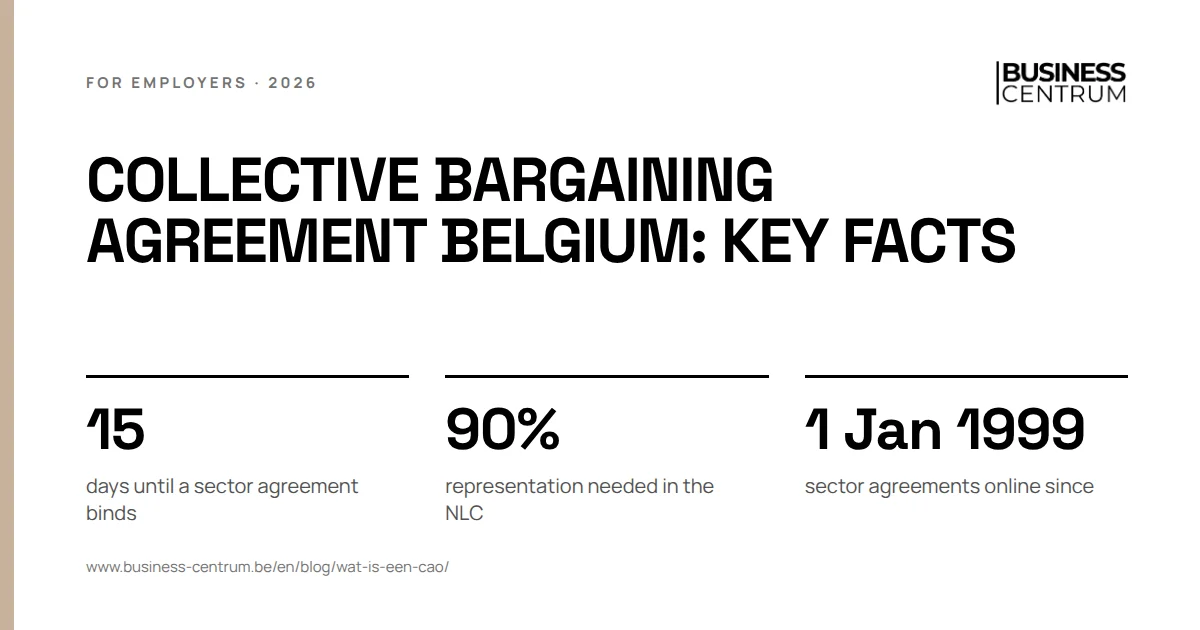
A collective bargaining agreement in Belgium, a CAO in Dutch or CCT in French, is a written agreement between one or more unions and one or more employers or employers' organisations on pay and working conditions. In Belgium these agreements set much of what you pay: pay scales, bonuses and indexation. A sector agreement binds you 15 days after the filing notice appears in the Belgian Official Gazette.
What is a CAO?
The FPS Employment describes a collective agreement as one that sets the individual and collective relations between employers and employees in a company or a sector. The CAO is therefore a full source of employment law, alongside the statute, your work rules and the individual employment contract.
Three things turn a text into a CAO:
- The parties. On the employee side, a representative union always signs. On the employer side, an employers' organisation or one or more employers.
- The form. The agreement is in writing, on pain of nullity, and states among other things its duration or how it can be terminated.
- The filing. The text is filed with the Registry of the FPS Employment and registered. This is free. Only then does the agreement have the legal status of a CAO.
The social partners can regulate almost anything work-related in a CAO: pay, bonuses, meal vouchers, working arrangements, night work, time credit. They must respect the higher sources of law, though. A provision that conflicts with a statute is void.
What types of collective bargaining agreement exist in Belgium?
There are three levels:
| Type | Concluded in | Examples |
|---|---|---|
| Cross-sector agreement | the National Labour Council, by organisations representing at least 90% of the members on each side | the minimum wage of € 2,233.61, the CAO 90 bonus, reasons for dismissal |
| Sector agreement | the joint committee or subcommittee of your sector | pay scales, end-of-year bonus, indexation, sector bonuses |
| Company agreement | your company, with one or more unions | a bonus plan, a specific working arrangement, extra leave |
The National Labour Council's agreements are numbered. That is how you know the CAO 90 bonus and CAO 109 on reasons for dismissal. Sector agreements set what applies in your sector, for instance that pay in JC 200 rose by 2.21% on 1 January 2026. The overview per sector is in our article on pay indexation.
Sector agreement: when are you bound?
A sector agreement binds every employer that falls under the joint committee, even if they signed nothing. After filing, a notice appears in the Belgian Official Gazette. 15 days later, the provisions on individual pay and working conditions bind all employers of that committee within the scope.
You can still deviate from such an agreement individually, with a written agreement between you and the employee. That changes once the agreement is declared generally binding.
Generally binding collective agreement: no more exceptions
The National Labour Council, the joint committee or an organisation sitting on it can ask the King to declare an agreement generally binding. If the minister agrees, the full text is published in the Belgian Official Gazette as an annex to a royal decree.
From then on:
- you can no longer deviate from it, not even with an individual agreement, unless the CAO itself allows it;
- non-compliance can be punished under criminal law;
- the Social Legislation Inspectorate checks that you comply.
How to find a collective agreement that applies to you
Start with your joint committee. It determines which sector agreements apply to you. How to find the right committee is explained in our overview of joint committees.
You then find the texts in two places:
- Sector agreements are in the FPS Employment's CAO search module, for every agreement filed after 1 January 1999. You search by joint committee number and by subject.
- Cross-sector agreements are on the National Labour Council's website, by number.
A company agreement is in your own records. For every registered agreement you can also ask the Registry for a copy.
Concluding, amending or terminating a CAO
If you want to conclude an agreement in your company, for example for a bonus plan or a new working arrangement, you do so with a representative union. You file the signed text with the Registry, on paper or electronically. If the text does not meet the requirements, the Registry provisionally refuses registration and you have 6 months to amend it.
Either party can terminate an open-ended agreement under the procedure and notice set out in the agreement itself. Termination is in writing and is also filed. An agreement can also be amended or replaced by a new one, without first terminating the old one.
What Business Centrum does for you
We determine the right joint committee with you, follow the agreements of your sector and apply new pay scales, bonuses and indexations in payroll on time, together with Acerta. You do not have to read the Official Gazette yourself. More on your payroll administration and on work rules, which must follow the agreements of your sector.