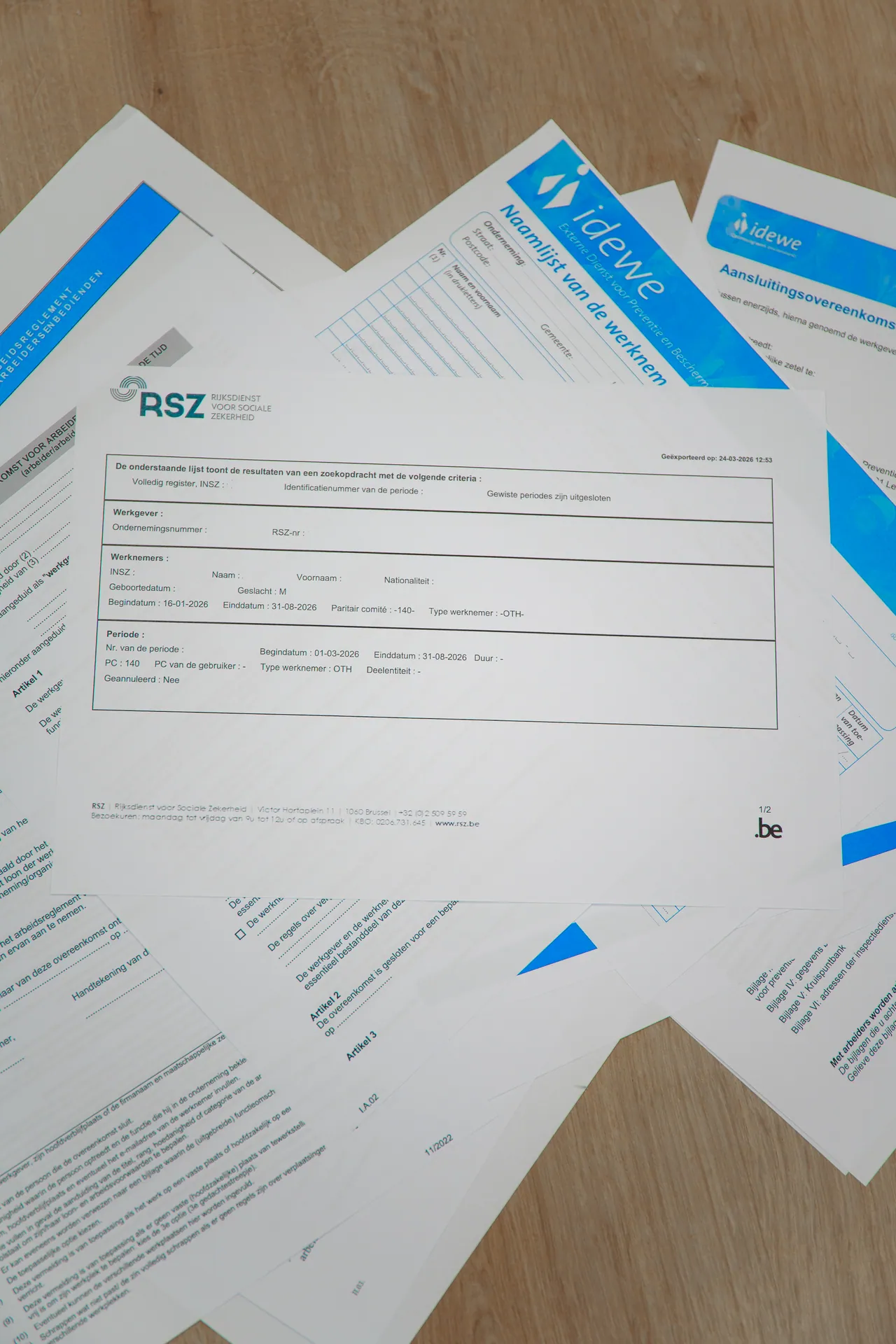
What is a joint committee?
A joint committee (abbreviated JC) is a consultative body in which employers' organisations and employees' organisations jointly determine the employment conditions for a specific sector. The word "joint" refers to the equal representation of both parties. Every sector in Belgium has its own joint committee, and some sectors also have sub-committees for specific sub-activities.
The agreements made within a joint committee are laid down in collective bargaining agreements (CBAs). These CBAs determine, among other things, the minimum wages, pay scales, working hours, bonuses and dismissal procedures. They are binding on all employers and employees who fall under the relevant JC.
How is your joint committee determined?
Assignment to a joint committee is based on your company's main activity. It is not about what is stated in your articles of association or how you describe your business, but about the actual activity that takes up the most working hours or employs the most staff. The employee's job plays no role: a salesperson in a metalworking company falls under the metal committee, not the trade committee. Blue-collar and white-collar workers, however, often fall under a different committee.
The NSSO does not assign the joint committee: when you register as an employer, you state yourself which committee you fall under, and the NSSO assigns an employer category based on your activity. In case of doubt, you can ask the FPS Employment, Labour and Social Dialogue for an opinion; it follows an investigation by the labour inspectorate but is not binding. Only the labour court can make a binding decision.
Some common joint committees in the East Flanders region:
- PC 100: supplementary joint committee for blue-collar workers (often called "the safety net committee")
- PC 124: construction industry (blue-collar workers)
- PC 140.03: road transport and logistics for third parties (blue-collar workers)
- PC 200: supplementary joint committee for white-collar employees, the largest PC in Belgium with around 482,000 employees
- PC 209: white-collar employees of the metalworking industry
- PC 226: international trade, transport, and logistics (white-collar employees)
- PC 302: hospitality
- PC 311: large retail businesses
- PC 322: temporary agency work and service voucher companies
- PC 330: health care institutions and services (healthcare)
- PC 118: food industry (blue-collar workers); white-collar staff fall under PC 220
Why correct classification is so important
The joint committee has direct financial consequences for your business. Incorrect classification leads to structural errors in payroll calculation, bonus payments, and the application of sectoral benefits. These errors accumulate over months and years, and are often only discovered during a social inspection or a dispute with an employee.
Pay scales: each JC has its own pay scales linked to job categories and seniority. In PC 124 (construction), a skilled bricklayer earns more than an unskilled labourer, and that difference is set out in law. If you apply the wrong JC, you also apply the wrong pay scales.
Indexation: automatic wage indexation differs per joint committee. Some committees apply an annual indexation on 1 January, others a quarterly or monthly adjustment based on the health index. PC 200 indexes every year on 1 January, according to the actual change in the smoothed health index. PC 124 indexes every quarter (1 January, April, July and October).
Bonuses: sectoral bonuses are specific to each joint committee. The year-end bonus in PC 302 (hospitality) is calculated differently than in PC 200. In PC 124, there are bonuses for work clothing, tools, and mobility that not every committee has.
CBAs: what do they contain?
Collective bargaining agreements are concluded at three levels:
Intersectoral level: the National Labour Council concludes CBAs that apply to all employers and employees in the private sector. Well-known examples are CBA No. 109 (justification of dismissal) and CBA No. 32bis (transfer of undertakings).
Sectoral level: within each joint committee, CBAs are concluded that are specific to the sector. These contain the pay scales, job classifications, bonuses, and specific leave arrangements. They are usually declared generally binding by Royal Decree, which means they are legally enforceable for all companies in the sector.
Company level: individual companies can conclude their own CBAs with one or more trade unions. These may be more favourable than the sectoral CBAs, but never less favourable.
The consequences for your wage policy
Your joint committee determines the entire framework of your wage policy. This goes beyond the base salary alone. Below is an overview of the elements that can differ per PC:
Minimum wage per job category: each JC defines job categories with corresponding minimum wages. In PC 200 the content of the job determines the class (A to D), and the class determines the minimum wage. The pay scales are adjusted to the index at the pace set by each committee.
Working hours: the statutory working week in Belgium is 38 hours, but a joint committee can set shorter hours or spread them differently. In PC 124 (construction), employees work 40 hours per week, compensated with additional days off (working time reduction days) to an average of 38 hours on an annual basis. In PC 302, specific rules apply for seasonal work.
Meal vouchers and eco-vouchers: the nominal value and the conditions for granting them are set out in a sectoral or company CBA, or, without a union delegation, in a written individual agreement. From 1 January 2026, the maximum total value of a meal voucher rises to 10 euros per day, of which a maximum of 8.91 euros is borne by the employer. Other committees apply different amounts or do not grant meal vouchers at all.
Transport allowance: the employer's contribution to commuting costs is largely regulated at sector level; for public transport a national minimum also applies (NLC CBA No. 19/9). In some committees, the employer pays 100% of public transport costs, in others a percentage or a flat-rate amount.
Change of joint committee
It happens that a company's main activity evolves and no longer corresponds to the applied joint committee. In that case, reclassification is possible, but the process is not straightforward.
A change of joint committee has consequences for all current employment contracts. The pay scales change and the bonuses change. The transition arrangement must be carefully managed to avoid disputes with employees.
You report the change in writing to the NSSO (Identification department), but the NSSO does not decide on your committee. In case of doubt, you can ask the FPS Employment, Labour and Social Dialogue for a non-binding opinion; in case of dispute, only the labour court decides.
How we help you
We check the classification of your joint committee at the start of our collaboration. This forms the basis on which the entire HR administration is built. After all, an error in the classification carries through into every payroll calculation, every bonus, and every declaration.
Our team actively monitors the sectoral CBAs of more than 50 joint committees. With every change in pay scales, bonuses, or employment conditions, we automatically update your payroll administration. You receive clear communication about what is changing and what the financial impact is.
For employers in East Flanders active in sectors such as transport (PC 140.03), construction (PC 124), hospitality (PC 302), or general services (PC 200), we are an experienced partner. We know the specific rules of these committees and translate them into correct and efficient administration.
Are you unsure about your joint committee, or would you like assurance that your wage policy is correct? Get in touch for a thorough review of your HR administration.