
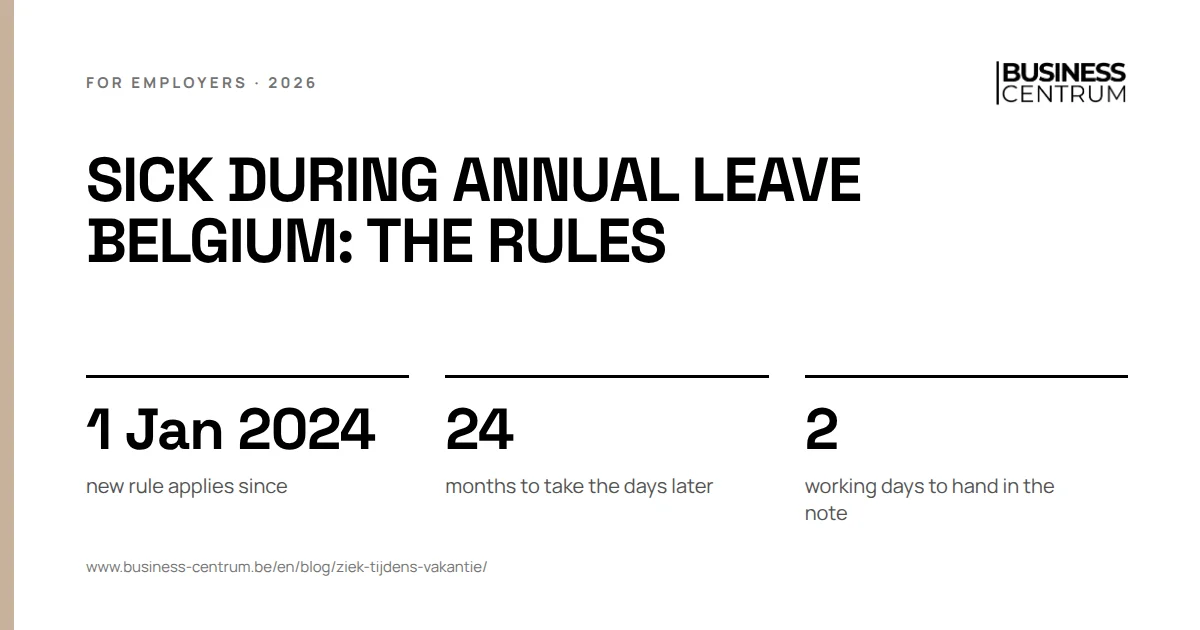
If an employee falls ill during their holiday, those days have no longer counted as holiday since 1 January 2024. You pay guaranteed salary and the employee keeps the holiday days to take later. If illness stops them taking the days in the same year, they have another 24 months after the end of the holiday year.
Sick during annual leave: what has the law said since 2024?
The Act of 17 July 2023 brought Belgian rules in line with the European Working Time Directive: every worker is entitled to at least four weeks of paid rest a year. Being ill is not rest. An illness during the holiday therefore suspends the employment contract, just as on an ordinary working day. The rule also applies during a collective shutdown, such as the construction holiday or a wholesaler's summer closure.
The employee keeps this right only if they follow a few formalities, which are stricter than for an ordinary illness:
| What | Ordinary illness | Sick during annual leave |
|---|---|---|
| Notify the employer | Immediately | Immediately, with the address where they are staying if not at home |
| Medical certificate | Not for the first day, 2 times a year | Always, including the first day |
| Deadline for the certificate | 2 working days, unless a collective agreement or the work rules set another | The same deadline |
| Request to take the days straight after the illness | Not applicable | By the time they hand in the certificate at the latest |
For an ordinary illness, a certificate is only required if a collective agreement or the work rules demand it, or if you ask for one. A company with fewer than 50 employees can exclude the certificate-free days with an explicit clause in a collective agreement or the work rules.
The certificate states the incapacity, its likely duration and whether the employee may travel elsewhere for an inspection. In case of force majeure, they send it within a reasonable time.
Sick during a holiday abroad
An employee who falls ill at their holiday address in Spain or Turkey gives you that address straight away. The certificate must contain the same information as in Belgium: the incapacity, the likely duration and whether they may travel. An inspection at a foreign address is difficult in practice. If the certificate allows travel, the employee must report to a company doctor (controlearts) when you ask; you pay their travel costs.
Step-by-step plan for the employer
- Record the notification. Date, time, the address where they are staying and the likely duration.
- Check the certificate. Did it arrive within 2 working days, or within the deadline in your work rules? Does it state the duration and whether travel is allowed?
- Check for a relapse. If the employee was already off sick on guaranteed salary in the last 8 weeks, the new illness does not open a new period. You only pay what was left of the previous period, unless a certificate confirms a different illness.
- Rebook the days. The sick days move from holiday to guaranteed salary. A white-collar employee gets 30 calendar days of guaranteed salary, a blue-collar worker the first 7 days at 100%, then under the blue-collar scheme. See our guide to guaranteed salary.
- Adjust the holiday balance. The days that overlapped with the illness go back on the balance.
- Answer the request to take the days straight away. The holiday is not extended automatically. You agree new dates, as for any holiday.
- Track the balance until the end of the year. If the employee falls ill long term and can no longer take the days, the carry-over rules below apply.
Sick during a holiday: what happens to leave days and holiday pay?
Ordinary holiday days are taken within the 12 months after the reference year, so before 31 December of the holiday year. For days the employee could not take because of illness, an accident at work, maternity leave, birth leave or adoption leave, the deadline runs to 24 months after the end of the holiday year. For holiday year 2026, that is until 31 December 2028.
For a white-collar employee, you pay the single holiday pay for those carried-over days no later than 31 December of the holiday year, so by 31 December 2026 for 2026. It is the normal pay for those days, based on the December salary. You declare it in the DmfA under pay code 15, with ordinary contributions. When the employee takes the days later, they receive no pay for them. They go into the DmfA under working time code 16 in the first year and 17 in the second.
For a blue-collar worker, the holiday fund pays the holiday pay. You pay guaranteed salary for the sick days. The saved holiday days are already covered by the fund's holiday pay.
Worked example. Sarah is a white-collar employee at a wholesaler, earns € 3,200 gross a month and works five days a week. She has 20 holiday days for 2026.
- She takes ten holiday days from 6 to 17 July inclusive. On 13 July she falls ill until 17 July inclusive and hands in a certificate.
- July: five holiday days and five days of guaranteed salary. Her monthly salary stays € 3,200. On the payslip the five days appear as sickness, not holiday.
- Balance after July: 15 days instead of 10.
- In September she takes ten. From 1 October she is ill until March 2027 and can no longer take the last five days.
- In December 2026 you pay the single holiday pay for those five days: € 3,200 x 5/20 = € 800, under pay code 15.
- If Sarah has not yet received her full double holiday pay, a supplement of 92% of the December salary is added, divided by 20 and multiplied by the five days: € 736. Usually the double holiday pay has already been paid in May or June.
- In April 2027 she takes the five days, unpaid, under working time code 16.
If the employee leaves, you state the carried-over days explicitly on the holiday certificate.
What goes in the work rules?
The formalities for illness during the holiday must be in your work rules (arbeidsreglement). You do not have to follow the usual amendment procedure for this. Include at least:
- the duty to notify you immediately, with the address where they are staying;
- that a certificate is always required, including for the first day;
- the deadline to hand in the certificate;
- that the employee makes the request to take the days straight away no later than with the certificate;
- how the inspection works.
How to build and file the work rules is explained in our guide on drawing up work rules.
Mistakes we often see
- Leaving sick days booked as holiday. The employee loses days they are entitled to, and you risk a pay claim.
- Extending the holiday automatically. You do not have to; new dates are agreed. When you may refuse a holiday request is covered in can an employer refuse holiday.
- Forgetting the relapse rule. An illness within 8 weeks of a previous one does not open a new period of guaranteed salary.
- Also carrying over days left untaken because of workload. Only days that illness or another suspension on the statutory list made impossible to take are carried over, such as an accident at work, maternity leave or birth leave. Days the employee left untaken while working do not count, and neither do parental leave or time credit.
- Forgetting the 31 December holiday pay for a white-collar employee on long-term sick leave.
What Business Centrum does for you
We rebook sick days during holidays, calculate guaranteed salary with the relapse rule and keep each employee's holiday balance. At the end of December we calculate the holiday pay for carried-over days and enter the right codes in the DmfA, together with Acerta. You follow everything through our leave and absence service.