
Guaranteed salary is the pay you, as the employer, keep paying yourself when an employee is ill. A white-collar employee (bediende) receives 100% of their pay for 30 calendar days. A blue-collar worker (arbeider) receives 100% in the first week, after which you pay a falling percentage and the health insurance fund covers part.
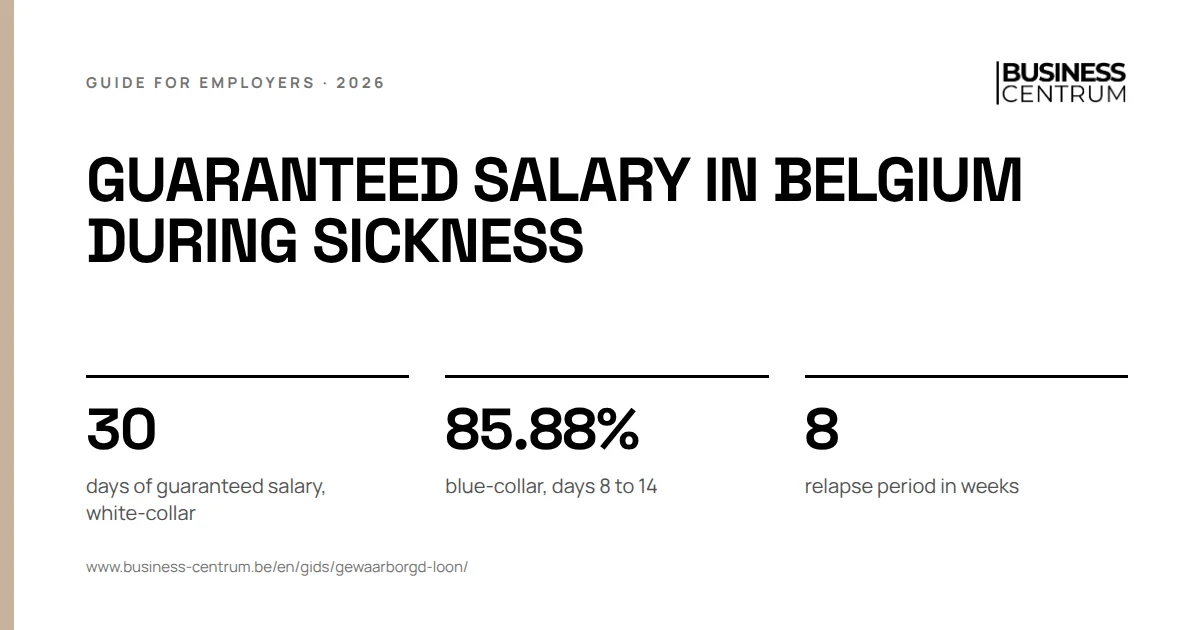
How long do you pay guaranteed salary in Belgium during sickness?
The guaranteed salary period runs for 30 calendar days and starts on the first day of incapacity for work. The waiting day, the unpaid first sick day that blue-collar workers used to have, no longer exists. Blue-collar and white-collar staff therefore start on the same day.
Calendar days are not the same as paid days. You only pay for the days the employee would normally have worked. A Saturday and Sunday in a five-day week, a day of temporary unemployment or a day of collective closure count towards the 30 days but cost you nothing.
If the employee falls ill during a working day and goes home, you pay that day in full. This is the guaranteed daily wage. The guaranteed salary period only starts the following day.
After the guaranteed salary period, the health insurance fund (ziekenfonds or mutualité) takes over. For a white-collar employee that happens from day 31. For a blue-collar worker, the fund already pays part from day 15, while you pay a top-up until day 30.
Guaranteed salary for blue-collar workers comes in three blocks
For a blue-collar worker, the first 30 days are split into three blocks. From day 15, you no longer pay salary in the strict sense, but a top-up on the health insurance benefit.
| Period | You pay as employer | The health insurance fund pays |
|---|---|---|
| Days 1 to 7 | 100% of normal pay | nothing |
| Days 8 to 14 | 85.88% of normal pay | nothing |
| Days 15 to 30 | 25.88% of pay up to the health insurance ceiling, plus 85.88% of the part above it | 60% of pay up to the ceiling |
The health insurance ceiling is the wage cap of the Belgian sickness and invalidity insurance. Since 1 September 2026 it has been € 189.36 gross per day, expressed in a six-day week. Most blue-collar workers stay below it. For them, from day 15 you only pay the 25.88% and the fund tops up.
Each block has its own code in the declaration to the NSSO: the second week separately, the days after it as a top-up under collective agreement no. 12bis. Your payroll must keep the blocks apart, or the payslip for the sick month will be wrong.
White-collar employees get thirty full days of guaranteed salary
A white-collar employee on an open-ended contract, or on a fixed-term contract of at least 3 months, receives 100% of their pay for 30 calendar days. There is no length-of-service condition: even an employee who started last week is entitled. From day 31 the health insurance fund pays 60% of capped gross pay.
A white-collar employee on a contract of less than 3 months, or hired for a job that normally takes less time, falls under the blue-collar scheme. They then need one month of service and receive:
| Period | You pay as employer |
|---|---|
| Days 1 to 7 | 100% |
| Days 8 to 14 | 86.93% |
| Days 15 to 30 | 26.93% of pay up to the ceiling, plus 86.93% above it |
This distinction is often missed. A two-month replacement contract for a white-collar employee at a wholesaler does not give 30 days of full pay.
Worked example: guaranteed salary for a blue-collar and a white-collar employee
Two employees earn the same: € 140 gross per working day, in a five-day week from Monday to Friday. Both fall ill on a Monday, for 30 calendar days. That period contains 22 working days: 5 in the first week, 5 in the second and 12 between day 15 and day 30.
Pay of € 140 per day in a five-day week equals roughly € 116.67 in a six-day week, well below the ceiling of € 189.36. For the blue-collar worker, from day 15 you therefore pay 25.88% on the full daily pay.
| Period | Working days | Blue-collar | White-collar |
|---|---|---|---|
| Days 1 to 7 | 5 | 5 x € 140 x 100% = € 700.00 | 5 x € 140 = € 700.00 |
| Days 8 to 14 | 5 | 5 x € 140 x 85.88% = € 601.16 | 5 x € 140 = € 700.00 |
| Days 15 to 30 | 12 | 12 x € 140 x 25.88% = € 434.78 | 12 x € 140 = € 1,680.00 |
| Total gross | 22 | € 1,735.94 | € 3,080.00 |
For the white-collar employee you pay € 1,344.06 more gross pay that month than for the blue-collar worker. That does not mean the blue-collar worker ends up with half as much: from day 15 they receive a benefit of 60% from the health insurance fund on top of your top-up. For the white-collar employee, the fund only steps in from day 31.
Two things change the outcome. If the sickness starts on a Wednesday, the number of working days per block shifts. If a public holiday falls in the period, you pay it under the public holiday rules. Have your payroll calculate it day by day.
Guaranteed salary in the first month of employment
A blue-collar worker is only entitled to guaranteed salary after 1 month of uninterrupted service. The same condition applies to a white-collar employee on a contract of less than 3 months. A white-collar employee on a standard contract has no waiting period.
What if the blue-collar worker falls ill in the first month? You pay nothing until they reach one month of service. From then on, they receive guaranteed salary for the remaining days of the first 30 days of sickness. For the days before, they claim a benefit from their health insurance fund.
An example. A driver starts on 5 August and falls ill on 27 August for three weeks. From 5 September he has one month of service. From 27 August to 4 September you pay nothing. On 5 September he is on day 10 of his sickness: from then on you pay guaranteed salary in the blue-collar blocks, starting at 85.88%.
Note: this service condition does not apply to a workplace accident or an occupational disease. In that case you pay from the first sick day, even in the first month.
Guaranteed salary after a relapse: the 8-week rule
Since 1 January 2026 the relapse period has been 8 weeks. Until the end of 2025 it was 14 days. The rule works like this: if an employee falls ill again within 8 weeks of the end of a sickness for which you paid guaranteed salary, no new guaranteed salary period opens.
There are two exceptions:
- If the previous period was not used up, you still pay the balance.
- If the employee proves with a medical certificate that the new incapacity is a different illness or a different accident, a new guaranteed salary period starts.
An example with a white-collar employee. She is ill from 20 February to 1 March, returns to work on 2 March and falls ill again on 6 April with the same condition. That is within 8 weeks. You only pay the 20 days left over from the first period. Under the old 14-day rule, you would have paid a full new period of 30 days.
The new period applies to incapacities starting from 1 January 2026. You do look back at sickness periods from 2025: an illness starting on 15 January 2026 can be a relapse of an illness from December 2025.
Guaranteed salary after a workplace accident
For a workplace accident, an accident on the way to or from work, or an occupational disease, different rules apply. You pay first, but the workplace accident insurer or Fedris pays you the daily allowances for that period.
- Blue-collar. For the first 7 days you pay 100% of normal pay. For the next 23 calendar days you pay an advance equal to normal pay, and the insurer reimburses you the daily allowances for that period. After day 30 the insurer pays the employee directly.
- White-collar. You pay normal pay for 30 days. The insurer reimburses you the daily allowances for those days. A white-collar employee on a contract of less than 3 months follows the blue-collar scheme.
There is no service condition. Even a blue-collar worker who started yesterday receives pay from the first day. Report the accident to your insurer quickly, or you will be out of pocket for longer.
When does an employee lose guaranteed salary?
The employee can lose their right for the days before the failure. This applies in three cases:
- They do not tell you straight away that they are ill, unless there is force majeure.
- They do not hand in the requested sick note on time. Without another rule in a collective agreement or the work rules, the deadline is 2 working days. More in our blog on the sick note and the employer.
- They avoid a check by a control doctor without a valid reason.
The loss applies to the sick days before the notification, the certificate or the check. If they hand in the certificate late, you can refuse pay up to the day they hand it in or send it. From then on, guaranteed salary runs as normal.
Two other situations rule out guaranteed salary altogether: an accident during a paid sports competition and an incapacity caused by the employee's own serious fault. Since 1 January 2026 you also pay no guaranteed salary if an employee falls ill during a partial return to work approved by the medical adviser of the fund, however long that return has lasted.
Mistakes employers make with guaranteed salary
These five mistakes come up often:
- Still counting relapse at 14 days. Opening a new period for a relapse within 8 weeks means paying up to a month too much.
- The wrong scheme for short contracts. A white-collar employee on a contract of less than 3 months does not get 30 days of full pay.
- Paying for days without work. Days of temporary unemployment or collective closure during the sickness are not paid days.
- Booking sickness during holiday as holiday. Since 1 January 2024 you pay guaranteed salary for those days and the holiday days move to later. See also our blog on falling ill during holiday.
- No sick note requirement in the work rules. Without a rule, you have to ask for the certificate every time, and the deadline only runs from your request.
After day 30: health insurance fund, solidarity contribution and return to work
After the guaranteed salary period, the health insurance fund pays 60% of capped gross pay. For you as employer, the cost does not always end there.
- Solidarity contribution. If you employ an average of 50 or more people, then for sickness starting from 1 January 2026 you pay a contribution of 30% on the benefits for 2 months from day 31. It covers employees under 55. If the fund pays out € 3,500 in that period, you pay € 1,050.
- Notifying the occupational physician. Report every incapacity of 4 weeks or more to the occupational physician of your external prevention service.
- Return to work. With 20 or more employees, you start a return-to-work process within 6 months if the employee has work potential.
All of this year's changes are in our news item on return-to-work rules in 2026.
Checklist: paying guaranteed salary correctly
- Record the first sick day and whether the employee still worked that day (guaranteed daily wage).
- Check the status: blue-collar, white-collar on a standard contract or white-collar on a contract of less than 3 months.
- Check whether a sickness with guaranteed salary ended in the past 8 weeks. If so, it is a relapse and you only pay the balance.
- Check the length of service for blue-collar workers and short contracts.
- Pass the sick days to your payroll on time, with the certificate.
What Business Centrum does for you
Business Centrum processes sickness periods in your payroll, together with Acerta. We apply the right scheme to each employee (blue-collar, white-collar, short contract), track relapses across the turn of the year and tell you when the 8-week or 6-month deadline is coming up. Sickness and leave run through our leave and absence service.