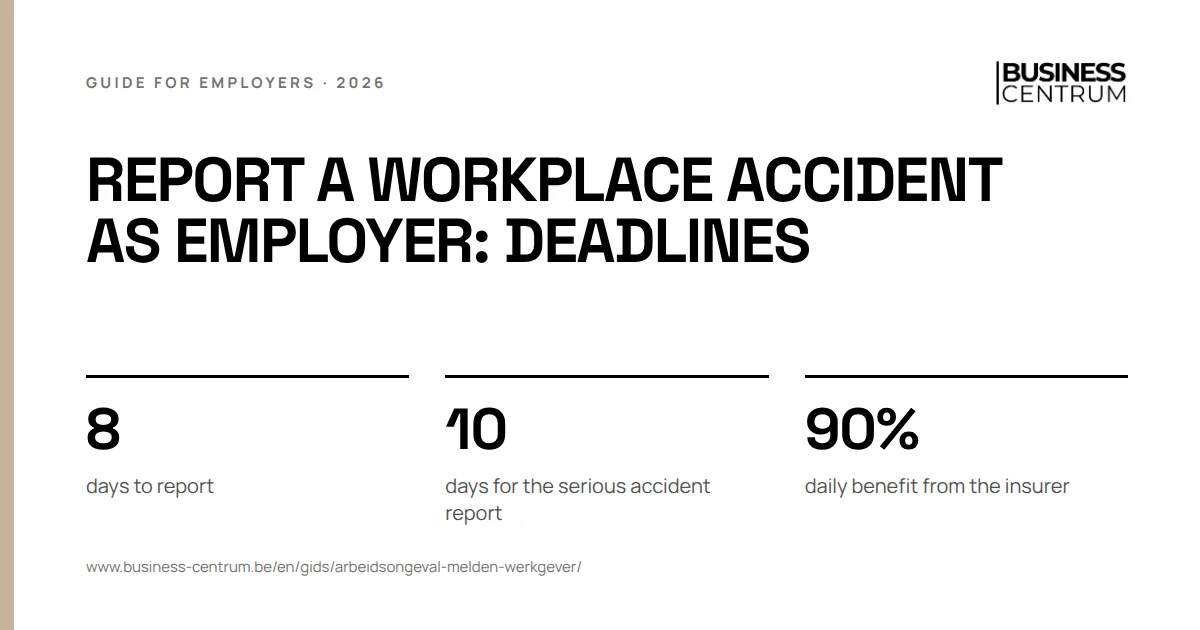
As an employer in Belgium, you report a workplace accident to your workplace accident insurer within 8 days, counting from the day after the accident. After a serious accident, your prevention service investigates it immediately and you send the inspectorate a detailed report within 10 days. A minor accident only goes in the first aid register.
Reporting a workplace accident in Belgium: the employer's timeline
An accident on a building site or in a warehouse starts a clock straight away. This table shows what you do and when. Day 0 is the day of the accident.
| When | What you do |
|---|---|
| Day 0, straight away | First aid, make the area safe, note the witnesses. If the accident is fatal or causes permanent injury, you notify the inspectorate immediately. |
| Day 0, same day | Assess whether it is a minor, an ordinary or a serious accident. The employee receives full pay for that working day. |
| Day 1 | The reporting deadline starts to run. Ask for the medical certificate of first findings. |
| Day 8 at the latest | Report to your workplace accident insurer. |
| Day 10 at the latest | For a serious accident: detailed report to the Welfare at Work Inspectorate (Toezicht op het Welzijn op het Werk). |
| Afterwards | For 4 days of incapacity or more: an accident record card, or a fully completed report form, which you keep for at least 10 years. |
The law speaks of days, not working days. Count calendar days and do not wait until Monday if the accident happened on a Friday.
Minor accident, report or serious accident?
As soon as you learn of the accident, you make a first assessment. It decides which procedure you follow. Whether the accident is recognised as a workplace accident is decided later by the insurer.
| Type | When | What you do |
|---|---|---|
| Minor accident | First aid on site was enough, no doctor was needed and there is no incapacity or loss of pay | Record it in the first aid register, no report |
| Ordinary workplace accident | A doctor was needed, or the employee is off work or loses pay | Report to the insurer within 8 days |
| Serious workplace accident | Fatal, or an event or object from the legal list with a permanent or severe temporary injury | Report to the insurer, immediate investigation, detailed report within 10 days |
The first aid register is not a formality. The exemption from reporting only applies if the minor accident is actually recorded: the name of the victim and of the person who gave first aid, the place, date and time, a description of the accident, the type of care and any witnesses. Without that entry, you must report a minor accident too.
An accident on the way to or from work is also reported to the insurer. For the extra rules on serious accidents, only the workplace itself counts. A lorry driver on his round or a technician on his way to a customer is at his workplace.
How to report a workplace accident in Belgium, and to whom
You report the accident to your own workplace accident insurer. Every private-sector employer must have one. You can choose between three channels:
- The social security portal, using the ASR Workplace Accidents application. You receive a copy by email and a unique number.
- The paper report form from Fedris (the federal agency for occupational risks), which you send to the insurer.
- Your insurer's software or web portal.
The portal channel closes on 1 January 2027. Fedris announced this at the end of September. From that date, every report goes directly to the insurer, on paper or through the insurer's own application, possibly via your broker or your social secretariat. If you report through the portal today, set up access with your insurer before the end of this year. Otherwise you will be looking for it on the day you need it.
Have these details ready for the report:
- the employee's identity, job and status (blue-collar, white-collar, student, flexi-jobber);
- the date, time and exact place of the accident;
- what the employee was doing, what went wrong and which object or machine was involved;
- the injuries and whether a doctor was involved;
- the witnesses;
- the work schedule and pay, so the insurer can calculate the benefit.
Send the medical certificate of first findings as soon as you have it. Do not wait for it to file the report. If the employee is back at work after an incapacity of less than 4 days, counting from the day after the accident, a simplified report can be enough in some cases.
If you do not file the report, the employee can report the accident to your insurer himself. Fedris helps him to do so. His rights are protected, and the risk stays with you.
What is the deadline for reporting a workplace accident, and what if you miss it?
The deadline is 8 days from the day after the accident. If an accident happens on Tuesday 6 October 2026, Wednesday 7 October is day 1 and you report it by Wednesday 14 October at the latest.
If you have missed the deadline, report the accident anyway, as soon as possible. The report remains mandatory until the end of the limitation period of 3 years after the accident. Do not wait for the employee or his union to ask for it.
For a minor accident, no deadline runs as long as it is in the register. If the injury gets worse later, for example a cut that becomes infected and needs a doctor after all, you report the accident within 8 days of the day you heard about it.
The other changes to the fines this year are explained in our news item on the Social Criminal Code in 2026.
Reporting a serious workplace accident to the inspectorate
A workplace accident is serious if it is fatal, or if two conditions are met together:
- The accident is directly linked to an event or an object on the lists of the Code on wellbeing at work. Think of a fall from height, loss of control of a machine, forklift or vehicle, a collapse, a fire or an electrical fault, or scaffolding, a trench, a machine or a means of transport involved in the accident.
- The injury is permanent, or it is on the list of severe temporary injuries: among others fractures, amputations, wounds with loss of tissue, severe burns, internal injuries, acute poisoning and suffocation.
If in doubt, use the online check on the social security portal. It remains available after 1 January 2027.
A serious accident adds three duties:
- Immediate investigation. Your competent prevention service investigates the accident straight away. In most SMEs, that is the external service. Our guide to the external prevention and protection service explains how affiliation works.
- Protective measures. You immediately take the measures that prevent a repeat, without waiting for the report: guard the opening, stop the machine, repair the safety device.
- A detailed report within 10 calendar days. The prevention service's report describes the place, the circumstances and the causes, material, organisational and those lying with third parties, with recommendations. You add the measures you will take, an action plan with deadlines and the opinion of the prevention and protection committee or, if there is none, of the union delegation or the employees. You sign it yourself and send it to the inspectorate.
If the accident is fatal or leaves the employee with a permanent injury, you also notify the Welfare at Work Inspectorate immediately. Give your name and company number, the name of the victim, the date and place, the likely consequences and a short description. Outside office hours there is an on-call service: 02 235 53 00 in Dutch, 02 235 55 44 in French.
If the detailed report cannot be ready in time, for example because a laboratory analysis is still running, the inspectorate can accept a provisional report. If it receives nothing or an incomplete document, it can appoint an external expert from calendar day 11 after the accident. Your insurer pays the expert's fee first and can recover it from you in full.
On a building site with several contractors, for an agency worker or when an outside firm works on your premises, all employers involved work together on the investigation and the report. Agree on this in advance in the contract with the contractor or the temping agency.
Who pays wages after a workplace accident?
On the day of the accident, you pay full wages for that working day. After that, it depends on the employee's status. There is no length of service condition: a blue-collar worker who started yesterday also receives this pay.
| Period | Blue-collar worker (arbeider) | White-collar employee (bediende) |
|---|---|---|
| First 7 days | You pay 100% of normal pay | You pay normal pay |
| The following 23 calendar days | You pay an advance equal to normal pay | You pay normal pay |
| After day 30 | The insurer pays the employee directly | The insurer pays the employee directly |
| Refund to you | The daily benefits for the period in which you paid | The daily benefits for the period in which you paid |
For a blue-collar worker, the working day interrupted by the accident counts as the first day of that week. The insurer pays the medical costs at the official RIZIV/INAMI rate.
The daily benefit is 90% of the basic pay, divided by 365, for every calendar day from the day after the accident, weekends included. The basic pay is the employee's pay over the year before the accident. In 2026 the insurer takes into account at most € 58,096.10 a year. The highest daily benefit is therefore € 143.25.
Illness outside work follows other rules, with a length of service condition and decreasing percentages for blue-collar workers. You will find them in our guide to guaranteed pay during illness. If you process a workplace accident as ordinary illness, you pay the wrong amount and miss the refund.
Guaranteed pay after a blue-collar worker's workplace accident: worked example
A bricklayer, employed as a blue-collar worker, earns € 160 gross per working day in a five-day week. On Tuesday 6 October 2026 at 10 a.m. he falls from a ladder and breaks his wrist. His doctor signs him off until Friday 23 October inclusive. He returns on Monday 26 October. The insurer sets his basic pay at € 43,800 a year.
What you pay as the employer:
| Period | Working days | Amount |
|---|---|---|
| 6 to 12 October: first 7 days, accident day included | 5 | 5 x € 160 = € 800 |
| 13 to 23 October: advance | 9 | 9 x € 160 = € 1,440 |
| Total | 14 | € 2,240 |
What the insurer refunds: € 43,800 x 90% / 365 = € 108.00 per calendar day. From 7 to 23 October inclusive, that is 17 calendar days: 17 x € 108.00 = € 1,836.00. You are left with € 404 in wages.
The deadlines in this example:
- Report to the insurer by Wednesday 14 October at the latest.
- A fall from height with a fracture is a serious workplace accident. The external service investigates it immediately and the detailed report must reach the inspectorate by Friday 16 October at the latest.
- The incapacity lasts more than 4 days, so an accident record card or a complete report form is required.
Had the bricklayer stayed at home beyond 4 November, the insurer would have paid him directly from 5 November.
Three examples: building site, warehouse and on the road
Building site. A groundworker is trapped in a trench that collapses and breaks his leg. This is a serious accident: trenches are on the list, and so are fractures. You stop work in the trench until it is shored, have the external service investigate the accident, report it within 8 days and send the report within 10. If other contractors work on the site, you draw up the report together. Staff management on building sites is covered on our page for the construction sector.
Warehouse. A warehouse worker runs a pallet truck over his foot. The GP finds a bruise and keeps him at home for two days. You report the accident within 8 days, because a doctor was involved. He returns after less than 4 days, so a simplified report can be enough. A bruise is not on the list of severe injuries: no report to the inspectorate.
On the road. A driver twists his ankle getting out of his cab at a customer's loading bay. A colleague cools the ankle, he finishes his round and loses no pay. That is a minor accident: you record it in the first aid register. If he goes to the doctor two days later after all, you report it within 8 days of hearing about it.
Mistakes employers make after a workplace accident
- Not recording a minor accident. Without an entry in the register, the exemption from reporting falls away and the employee will struggle to prove later what happened.
- Waiting for the medical certificate. The deadline runs regardless of the certificate. Report with what you know and send the certificate afterwards.
- Processing the accident as illness. You then apply the wrong pay rules and claim nothing back from the insurer.
- No record card at 4 days or more. Keep the record card or a copy of the complete report for at least 10 years, at the site where the accident happened.
- Treating a serious accident as an ordinary one. Without an investigation and report, the inspectorate can appoint an expert, and that fee ends up with you.
- Not informing the temping agency. For an agency worker, the agency files the report, but it has to hear about the accident from you.
What Business Centrum does for you
Business Centrum processes the workplace accident in your payroll, together with Acerta: pay for the accident day, the first week and the advance for a blue-collar worker, the 30 days for a white-collar employee and the refunds from the insurer. We provide the pay data the insurer needs for the basic pay and track the absence until the employee returns. Illness, accidents and leave are handled by our leave and absence service.