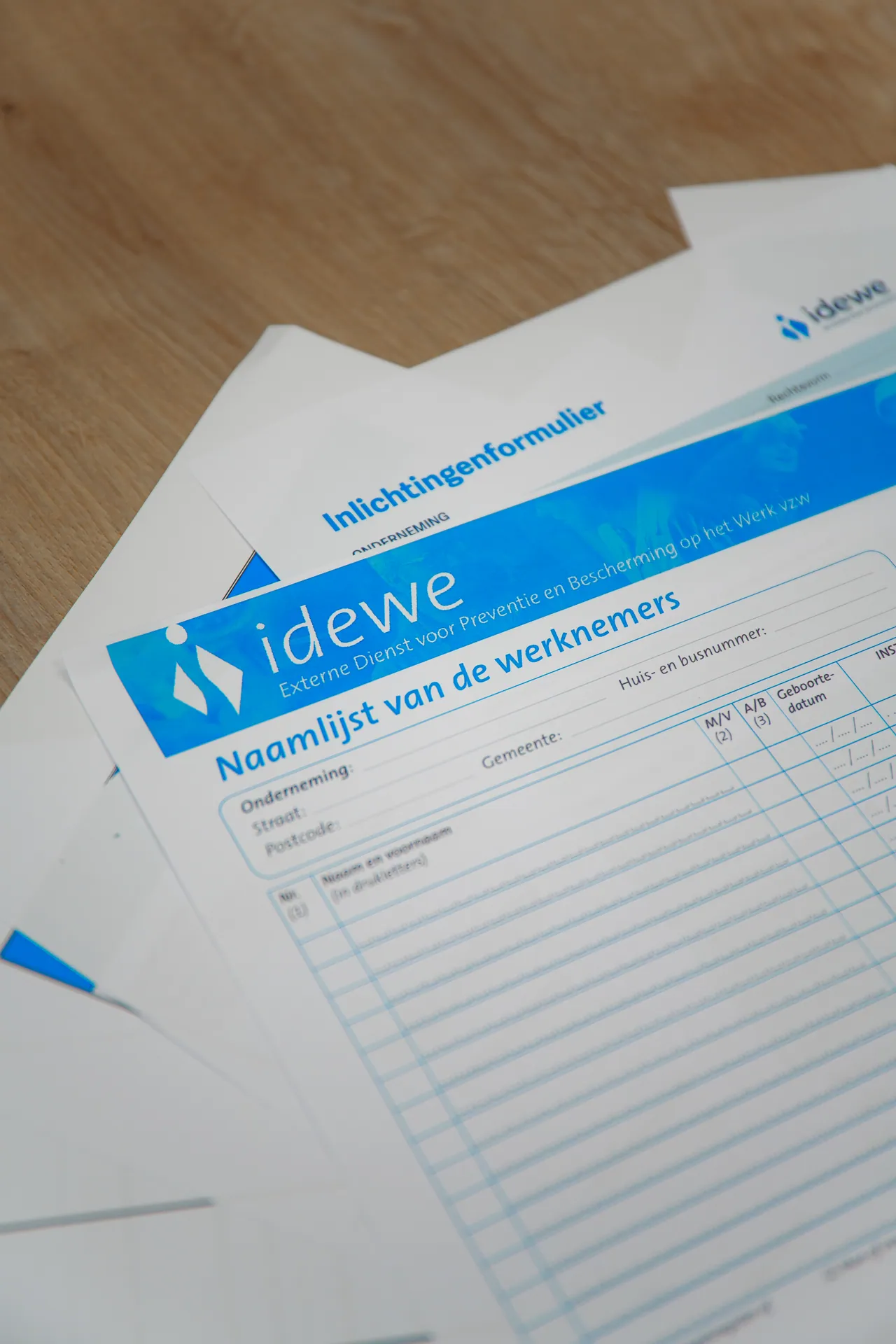
Every employer in Belgium without its own medical department must join an external prevention and protection service at work, from the first employee. In 2026 you pay at least € 47.78 to € 150.74 per employee per year, depending on your main activity and your headcount. A construction company sits in the most expensive rate group, an accountancy firm in the cheapest.
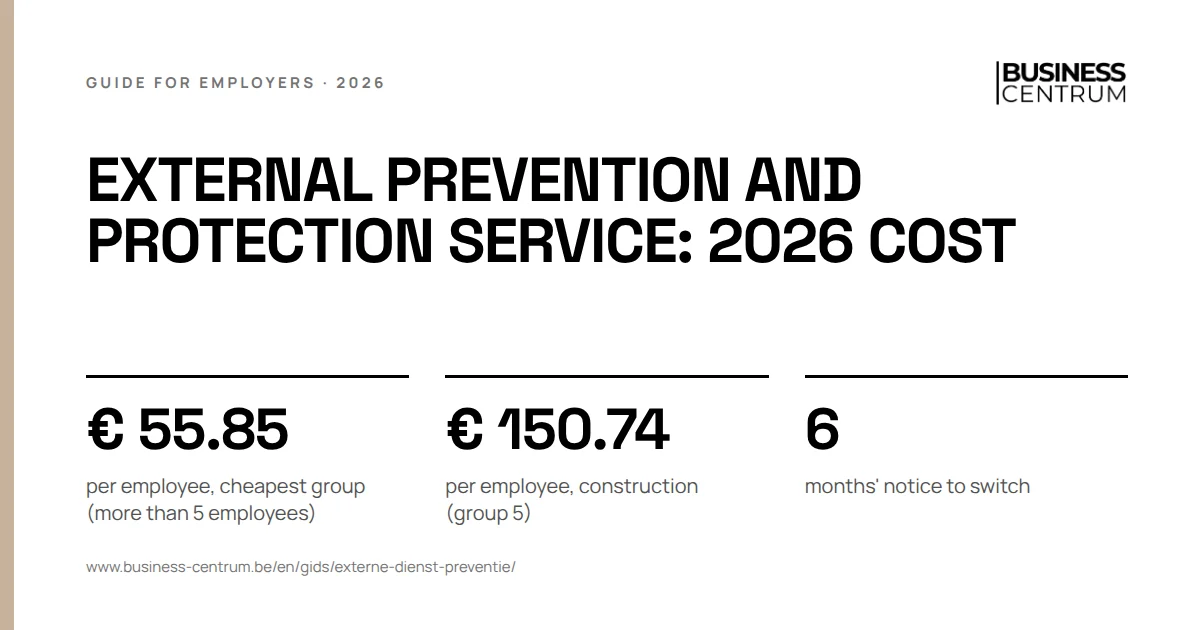
Is an external prevention and protection service mandatory in Belgium?
Yes, for almost every employer. In principle the law lets you choose: your internal prevention service carries out the tasks itself, or you call on an external service. But the internal service may only handle health surveillance of your employees itself if it has its own medical department with an occupational physician. An SME does not. Every employer without such a department must therefore join an external service, even with a single employee.
So you always work with two services:
| Service | Who | What |
|---|---|---|
| Internal service | You or an employee as prevention adviser. With fewer than 20 employees, you may take this role yourself. | Point of contact, cooperation with the external service, first aid, registers |
| External service | A recognised non-profit with occupational physicians, prevention advisers and nurses | Health surveillance, risk analysis, accident investigation, psychosocial issues |
For a small employer, two tasks always lie with the external service. With fewer than 50 employees, the psychosocial prevention adviser, whom your staff can turn to about stress, bullying or violence, always comes from the external service. And without an internal prevention adviser with level I or II training, the external service investigates every workplace accident causing 4 days of incapacity or more. How to report such an accident is explained in our guide to reporting a workplace accident as an employer.
Not being affiliated breaches the Wellbeing at Work Act. The Social Criminal Code punishes it with a level 3 sanction: an administrative fine of € 1,000 to € 10,000. If a workplace accident or damage to health results, it becomes level 4. The inspectorate can also set you a deadline to join.
Join before the first working day. A new lorry driver or forklift operator must have his pre-employment health assessment before he starts. The other steps for a first hire are in our guide to the NSSO reduction for your first employee.
What does the external service do for an SME?
If you have fewer than 200 employees and no prevention adviser with at least level II additional training, you belong to group C- or D. In high-risk sectors the threshold is lower: in construction, transport, warehousing and healthcare, among others, you are already in group B from 50 employees. For you, the Code on wellbeing at work sets a base package that the external service delivers in return for the flat-rate contribution, with no extra charge:
- help with the risk analysis and a reasoned policy advice listing the priority risks in your business and concrete measures;
- health surveillance: pre-employment and periodic health assessments, spontaneous consultations, return-to-work examinations and maternity protection;
- the risk analysis of screen work and of work with food;
- attendance at the prevention and protection committee when an item on the agenda concerns the service;
- the investigation of serious workplace accidents, up to 5 hours a year;
- psychosocial requests from employees, up to the moment the employee's name is disclosed to you;
- company visits and an electronic inventory of everything the service has done for you.
Company visits follow a fixed rhythm, depending on your rate group:
| Step | Rate groups 1 and 2 | Rate groups 3, 4 and 5 |
|---|---|---|
| Information on the risks in your sector | Within 2 months of joining | Within 2 months of joining |
| Exploratory company visit | Within 12 months | Within 6 months |
| Periodic company visit | Every 36 months | Every 24 months |
Outside the package are, among other things, measurements, the examination of a screen worker when the questionnaire calls for it, the further investigation of a formal psychosocial request and accident investigation beyond 5 hours. The service charges these separately at a statutory rate: € 104.35 per health surveillance service or € 154.78 per hour.
Larger employers in group A, B or C+ have no fixed package. Their contribution is converted into prevention units of € 201.89, which they use as they choose.
What does an external prevention and protection service charge in 2026?
The contribution is an annual flat rate per employee. The amount depends on two things: the rate group of your main activity and the number of employees. If you had at most 5 employees on 30 November 2025, the lower rate applies in 2026.
| Rate group | Examples of main activity | Up to 5 employees | More than 5 employees |
|---|---|---|---|
| 1 | Accountancy, IT, travel agencies, building cleaning | € 47.78 | € 55.85 |
| 2 | Temporary agency work, architects, real estate, associations | € 69.31 | € 81.43 |
| 3 | Wholesale, retail, hospitality, warehousing | € 86.14 | € 101.62 |
| 4 | Road haulage, passenger transport, food industry, garages | € 109.02 | € 128.53 |
| 5 | Construction, cargo handling (loading and unloading), waste management, healthcare | € 127.86 | € 150.74 |
The amounts apply per employee per year and are indexed every year. Your main activity is the one carried out by most of your employees, as recorded in the Crossroads Bank for Enterprises. A haulage company with its own warehouse therefore stays in rate group 4 as long as drivers are the majority. The list of NACE codes is being updated to the new NACE-BEL 2025, but your rate group in principle stays the same as long as your main activity does.
These are minimum rates. A service may charge more, but may not give any discount, rebate or refund on the minimum. Compare on service, not on a price below the minimum.
For an employee who does not work for you all year, you pay one twelfth of the flat rate for each calendar month in which he was registered with you via Dimona for at least one day. If that employee receives an individual service, such as a medical examination, you pay the full annual amount.
Cost of an external prevention and protection service: worked examples
Haulage company. Road haulage falls in rate group 4. Twelve drivers and two office staff are employed all year: 14 x € 128.53 = € 1,799.42 a year. In March a driver joins. Normally you would pay ten twelfths for him, but as a safety-sensitive job he has a pre-employment health assessment. You then pay the full amount of € 128.53. An office employee who leaves at the end of June without an examination that year costs six twelfths: € 64.27.
Construction company. Four workers on 30 November 2025, so the lower rate of rate group 5: 4 x € 127.86 = € 511.44 a year. The director does not count: he is self-employed and not in the Dimona.
Ten employees, four sectors. What you pay at least in 2026 for ten employees working all year:
| Sector | Rate group | Minimum per year |
|---|---|---|
| Accountancy firm | 1 | 10 x € 55.85 = € 558.50 |
| Wholesale or hospitality | 3 | 10 x € 101.62 = € 1,016.20 |
| Road haulage | 4 | 10 x € 128.53 = € 1,285.30 |
| Construction | 5 | 10 x € 150.74 = € 1,507.40 |
Extra services may come on top. If the questionnaire for your screen workers shows that someone needs an examination, that examination costs you € 104.35. Laboratory analyses, travel costs and file costs may be listed and charged separately.
Health surveillance for drivers, construction workers and hospitality
Not every employee sees the occupational physician periodically. Health surveillance is mandatory for people in a safety-sensitive job, a job requiring heightened vigilance or an activity with a defined risk. Your risk analysis, carried out with the external service, decides who is covered, and you keep that list up to date.
- Safety-sensitive job: driving motor vehicles, cranes, forklifts, lifting equipment or dangerous machines, where this can endanger the wellbeing of others. Think of lorry drivers, forklift operators and crane operators.
- Activity with a defined risk: exposure to noise, vibration, dust or chemicals, manual handling of loads, or night work with particular risks.
| Risk | Typical job | Periodic health assessment |
|---|---|---|
| Safety-sensitive job | Lorry driver, forklift operator, crane operator | Every 24 months, with a questionnaire or test 12 months after each assessment |
| Manual handling of loads | Warehouse worker, construction worker, removal worker | Every 36 months, from age 45 every 24 months |
| Contact with food | Cook, kitchen assistant, waiting staff | No systematic examination, but a risk analysis every 5 years and training in food hygiene |
Three moments fall outside that rhythm:
- Before starting. Anyone starting in a safety-sensitive or risk job, or moving into one internally, first has a pre-employment health assessment. The occupational physician decides on fitness before the employee actually starts. The first periodic assessment follows 12 months later.
- After a long absence. After 4 weeks of absence through illness, accident or childbirth, a return-to-work examination follows, at the earliest on the day of return and at the latest on working day 10 after that.
- At the employee's request. Every employee, including those not under surveillance, may ask for a spontaneous consultation. You remind everyone of this every year.
You pay the time spent on the examination as working time. In construction, an audiogram is often added for those working in noise. Staff rules per sector are on our pages for transport and construction.
Which external prevention and protection services are there, and how do you choose?
The FPS Employment publishes the list of recognised external services. Today it includes Attentia, CESI, CLB, Cohezio, IDEWE, Liantis, Mensura, Premed and Securex. All are recognised for the whole of Belgium. You are affiliated with one external service at a time.
Because the minimum price is the same for everyone, you choose on what you get:
- Accessibility. Where are the medical centres, and can your drivers or site crews get there easily?
- Sector knowledge. Does the service know the risks of building sites, warehouses or kitchens?
- Fixed contacts. The rules require the same prevention adviser or team to follow up your business. Ask who that will be.
- Charging for extras. Per service or per hour: agree this in the contract in advance.
- Inventory. Ask how you consult the electronic inventory of services.
Switching external service: notice and timing
The contract with an external service runs for an indefinite period. You terminate it with at least 6 months' notice, starting on the first day of the month after your notice. The contract always ends at the end of a calendar year.
In practice: anyone who wanted to switch on 1 January 2027 had to give notice by the end of June 2026 at the latest. If you give notice now, in October 2026, the notice period runs from 1 November and the contract only ends at the end of 2027. Plan a switch more than a year ahead.
How to go about it:
- Ask for quotes stating your rate group and how extra services are charged.
- Submit the new contract for the opinion of the prevention and protection committee or, if there is none, the union delegation or the employees themselves.
- Give written notice to the current service, with proof of receipt.
- Have the new contract start the day after the old one ends, so there is no gap.
- Give the new service your list of safety-sensitive and risk jobs and ask for the examination schedule.
- Update your work rules. The contact details of the external service and of the psychosocial prevention adviser are in them. How to do this is explained in our guide to drawing up work rules.
Mistakes employers make with their external service
- Joining after the first working day. A driver on the road without a pre-employment health assessment is an offence from the first trip.
- No list of risk jobs. Without a list, the service does not know whom to call in, and examinations are left undone.
- Not checking the invoice. The number of employees comes from the Dimona. Compare it with your staff list, especially after departures or seasonal work.
- Giving notice too late. Notice given in July pushes your switch back a full year.
- Not passing on an accident. From 4 days of incapacity, the external service must investigate the accident. It can only do so if you tell it.
- Outdated details in the work rules. After a switch, employees would otherwise contact a service that is no longer responsible.
What Business Centrum does for you
Business Centrum is not an external service and does not sell one. What we do handle is what your external service needs from you: correct Dimona declarations, on which the per-employee contribution is calculated, and staff data that let you check the annual invoice. In the work rules we draw up for you, we include the details of your external service and your psychosocial prevention adviser, and we update them if you switch service.