
Guide for new employers
RSZ reduction
first employee
and the next ones
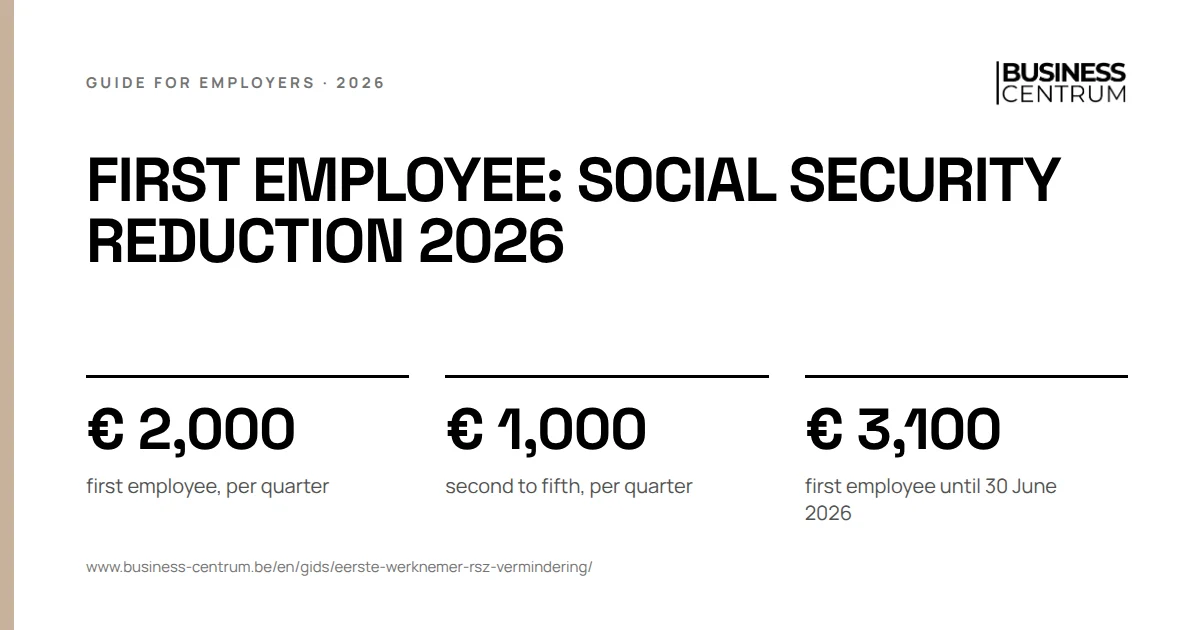
For your first employee you get, since 1 July 2026, a reduction in social security contributions (RSZ) of up to € 2,000 per quarter, with no end date. For the second to fifth employee it is € 1,000 per quarter, for 12 quarters.
You do not have to apply: the reduction goes into your quarterly return. Below you will find the conditions, what must be in place before day one and what your first employee really costs.
By Business Centrum editorial teamPublished
Updated and figures checked on
€ 2,000
per quarter for the first employee, with no time limit
€ 1,000
per quarter for the second to fifth, for 12 quarters
1 July 2026
date of the latest change
The amount
How much RSZ reduction do you get for your first employee?
Its official name is the target group reduction for first hires. For your first employee, the RSZ deducts up to € 2,000 every quarter from the employer contributions you owe. The reduction has no end date: it runs as long as you have an employee.
For the second, third, fourth and fifth employee you receive € 1,000 per quarter each, for 12 quarters. You choose which quarters, within a period of 20 quarters from the hire. A quarter only counts if, during that quarter, at least as many people were employed at the same time as the rank: two for the second employee, three for the third, and so on.
The reduction is not tied to one person. If your first employee leaves and someone else takes the job, the reduction continues on the new employee. You do not need to apply either: your social secretariat enters the right reduction code in the DmfA, the quarterly return to the RSZ, and chooses each quarter the employee on whom the reduction yields the most.
Each box is one quarter. From the second employee on, you choose 12 quarters within a window of 20.
What changed
From full exemption to a fixed amount
Search for the first employee exemption online and you will find three different rules mixed together. All three have applied. This is the order.
- 01Before 1 January 2024
The first employee was almost fully exempt from basic employer contributions, with no end date. For the second to sixth employee there were decreasing amounts over a limited number of quarters.
- 021 January 2024
The benefit for the first employee is capped at € 3,100 per quarter. The reduction for the fourth, fifth and sixth employee is abolished for new hires.
- 031 July 2026
The Programme Act of 30 May 2026 lowers the cap for the first employee to € 2,000, also for existing rights. The second to fifth employee get a fixed amount of € 1,000 per quarter. The fourth and fifth employee count again.
Which amount applies to you?
The hiring date determines the scheme. Amounts per quarter, for full-time work.
| Rank | Hired from 1 January 2024 to 1 July 2026 | Hired from 1 July 2026 |
|---|---|---|
| First employee | € 3,100, lowered to € 2,000 since 1 July 2026 | € 2,000, unlimited |
| Second employee | 5 x € 1,550, then 4 x € 1,050, then 4 x € 450 | 12 x € 1,000 |
| Third employee | 9 x € 1,050, then 4 x € 450 | 12 x € 1,000 |
| Fourth and fifth | No reduction | 12 x € 1,000 |
Has the reduction become smaller?
For the first employee, yes. For the second employee the total drops from € 13,750 to € 12,000. For the third it rises from € 11,250 to € 12,000, and the fourth and fifth pay off again. If you are building a small team, you mainly lose on the first employee.
Conditions
When are you entitled to the reduction?
You are a new employer
You never had staff, or you had nobody employed in the 12 months before the hire, counted day to day. For the second to fifth employee the same logic applies per rank: in the 12 months before, you never had that many people employed at the same time.
It is an extra job, not a replacement
The new employee may not replace anyone who worked in the same technical business unit during the previous 12 months. That unit is wider than your company: a previous business, a sister company with the same directors and a related activity or a business taken over with the same staff all count. In that count the RSZ ignores the 5 days with the highest temporary peak. For the second to fifth employee, the extra job must also last at least 1 month after the hire.
The employee falls under ordinary social security
Only private sector employers qualify. A student worker, a flexi-jobber, an occasional hospitality worker, a dual learning apprentice or a young person up to the end of the year in which they turn 18: for this reduction they do not exist. They open no right and do not count when your rank is determined.
Enough work is performed
If the employee does not have an at least half-time contract, they must work at least 27.5% of a full-time job over the whole quarter. For part-time work the reduction is proportional: a half-time employee yields half the amount. From 80% of a full-time job you get the full amount.
Never more than you owe
The RSZ first deducts the structural reduction, which applies automatically to lower wages. The first hire reduction comes on top, but can never exceed the basic contributions that are still due. You get no money back. Only one target group reduction at a time applies per employee. If your employee also qualifies for a regional reduction, for example for older workers, you choose the most favourable one each quarter.
Example
How the RSZ counts your ranks
Sofie opens an interior design shop in Ghent. Her first years as an employer show how the ranks work, and why the order of hiring matters.
ordinary employeestudent worker
- 01
Sofie hires Lien
Sofie never had staff. Lien is her first employee and opens the right to the first employee reduction: up to € 2,000 per quarter, as long as someone is employed.
- 02
A student helps out in summer
The student works alongside Lien, but for this reduction the RSZ does not see him. He opens no second rank and uses none up.
- 03
Sofie hires Jonas, Lien stays
There are now two ordinary employees at the same time. Jonas opens the second rank: € 1,000 per quarter, for 12 quarters within a window of 20 quarters. Lien keeps the first employee reduction.
- 04
Lien leaves, nobody replaces her
Jonas then takes over the first employee reduction, because it is not tied to Lien. The second rank yields nothing as long as Sofie has only one employee. If she hires again later, she uses the remaining quarters of the second rank, as long as the 20-quarter window is running.
Worked example
What does your first employee really cost?
A full-time white-collar employee, calculated per quarter. As employer you pay 19.88% basic contribution plus 5.12% wage moderation, together 25% of gross pay. For lower wages the RSZ first deducts the structural reduction. Only then does the first hire reduction apply.
| Per quarter | € 3,000 gross per month | € 4,000 gross per month |
|---|---|---|
| Gross pay per quarter | € 9,000.00 | € 12,000.00 |
| Employer contributions (25%) | € 2,250.00 | € 3,000.00 |
| Less structural reduction | − € 494.38 | − € 0.00 |
| Contributions without first hire reduction | € 1,755.62 | € 3,000.00 |
| Reduction as first employee | − € 1,755.62 | − € 2,000.00 |
| Contributions for the first employee | € 0.00 | € 1,000.00 |
| Contributions for the second to fifth employee | € 755.62 | € 2,000.00 |
| Wage cost without reduction | € 10,755.62 | € 15,000.00 |
| Wage cost first employee | € 9,000.00 | € 13,000.00 |
| Wage cost second to fifth employee | € 9,755.62 | € 14,000.00 |
At € 3,000 per month, € 1,755.62 per quarter remains after the structural reduction. That is below the cap of € 2,000, so the reduction wipes out your basic contributions entirely. Over a year that saves € 7,022.48.
At € 4,000 per month, € 3,000.00 in contributions remains per quarter, more than the cap of € 2,000. You still pay € 1,000.00 per quarter. Under the old rule it was less: the wage cost was then € 12,000.00 per quarter.
Not included: end-of-year bonus, double holiday pay, the accident at work insurance premium, the external prevention service, sector contributions and the cost of your social secretariat. For a blue-collar worker the RSZ calculates contributions on 108% of gross pay, plus a holiday contribution. What your employee keeps net, you can see with the gross-to-net calculator.
Checklist
What to arrange before day one
The reduction is the pleasant part. This is the mandatory part, in the order you need it. Skip a step and you usually find out at an accident or an inspection.
First
Registration as an employer with the RSZ
You apply for an RSZ number through WIDE, the online employer identification service on socialsecurity.be. Without that number nobody can file a Dimona or quarterly return for you. Your social secretariat can apply on your behalf.
Before the contract
The right joint committee
Your activity determines the joint committee, and that sets the minimum wage, bonuses and sector contributions. A wrong committee only shows up at an inspection, with back pay as a result. Many white-collar staff in small businesses fall under the supplementary joint committee for white-collar employees.
Weeks before
Joining a social secretariat
By law you can do everything yourself: Dimona, payroll, quarterly return and choosing the reduction. If you are affiliated with an accredited social secretariat, the RSZ refunds € 36.45 per quarter of the affiliation costs, as long as you apply the first employee reduction.
Effective on day one
Accident at work insurance
Every employer must insure staff with an approved insurer from the first working hour. If you do not, you are automatically affiliated with Fedris. The contribution you then pay is not a premium but a fine, based on how long you were uninsured and how many employees you had. After an accident Fedris compensates the victim and recovers all costs from you.
Before the start
External service for prevention and protection at work
The external service handles health surveillance and the risk analysis a small employer may not do alone. You also need an internal prevention adviser: with fewer than 20 employees, that can be you.
Before the start
Work rules
Mandatory from the first employee. They set working hours, pay, notice and sanctions. The draft is available for 15 days for comments. Within 8 days of entry into force you send a copy to the Social Law Inspectorate, which can be done online.
On day one at the latest
Employment contract
Part-time work and a fixed-term contract must be in writing before the start. For a full-time open-ended contract an oral agreement is legally enough, but without paper you can prove nothing. A good employment contract also covers hours, pay and other arrangements.
Before the first working hour
Dimona
The Dimona reports the start of your employee to the RSZ and must be filed before they begin. Without a Dimona your employee is not declared, which weighs heavily after an accident or during an inspection. Read what a late Dimona costs you.
After that: every quarter the DmfA with the right reduction code, and wages paid on time.
What goes wrong
Pitfalls of the first employee reduction
- 01
Using the old amount
Many simulations and business plans still count on € 3,100 per quarter. Since 1 July 2026 it is € 2,000, also for employers who hired their first employee earlier. Recalculate your wage cost.
- 02
Treating a student as your first employee
If you start with student workers or flexi-jobbers, the RSZ does not see a first employee yet. Only the first ordinary employee opens the right. The good news: you use up nothing.
- 03
Taking staff to a new company
Moving from sole proprietorship to a company, or setting up a second company, and the same people move with you? Then you replace employees within the same technical business unit. That opens no new right. Have it checked before you switch, because an existing right can sometimes continue.
- 04
A short peak that blocks a rank
If you hire a second person for a few days on an ordinary contract, it yields nothing: for the second employee the extra job must last at least 1 month. Yet the peak counts. If you hire a real second employee within the next 12 months, that hire opens no reduction, because you already had two people employed at the same time. For short peaks, students or flexi-jobbers work better: they do not count.
- 05
A year without employees
With no employee for 12 consecutive months, the right for the first employee lapses. You must then meet the starting conditions again, which is not always possible. For the second to fifth employee you can still use remaining quarters as long as the 20 quarters have not passed.
- 06
Counting on the full amount with a low wage
The reduction is a cap. With a low or part-time wage, less than € 2,000 in contributions remains after the structural reduction, and you get no more than that. Calculate with the actual contributions.
How Business Centrum helps
Your first hire, from calculation to payslip
Business Centrum works as a partner of Acerta, an accredited social secretariat, and takes over the HR administration of small employers in and around Ghent. For a first hire we do the following:
- 01
The real wage cost upfront
In a staffing analysis we calculate what the employee costs you, with the reduction you will actually get rather than the maximum.
- 02
Rank and business unit checked
We check whether you are a new employer, which rank the hire takes and whether a technical business unit applies.
- 03
Day one arranged
We handle the RSZ registration, the Dimona and the contract, and tell you which insurance and prevention service must be in place before the start.
- 04
The best choice every quarter
We apply the reduction to the employee where it yields the most, and track how many quarters you have left for the second to fifth employee.
Frequently asked questions
Questions about the first employee
Sources
Every amount and deadline on this page was checked against these official sources, last consulted on .
- FOD WASO, Arbeidsreglement
- FOD WASO, Interne dienst voor preventie en bescherming op het werk
- Justel, KB van 16 mei 2003 (harmonisering bijdrageverminderingen), art. 16, § 7
- RSZ, Administratieve instructies 2026/3, De bijdragen
- RSZ, Administratieve instructies 2026/3, Eerste aanwervingen
- RSZ, Administratieve instructies 2026/3, Nieuw dit kwartaal
- RSZ, Administratieve instructies 2026/3, Structurele vermindering
- RSZ, Administratieve instructies 2026/3, Structurele vermindering en doelgroepverminderingen: algemene principes
More at Business Centrum
First employee
Rather have someone check it for you?
Your dedicated contact at Business Centrum looks at it for your situation, together with Acerta.