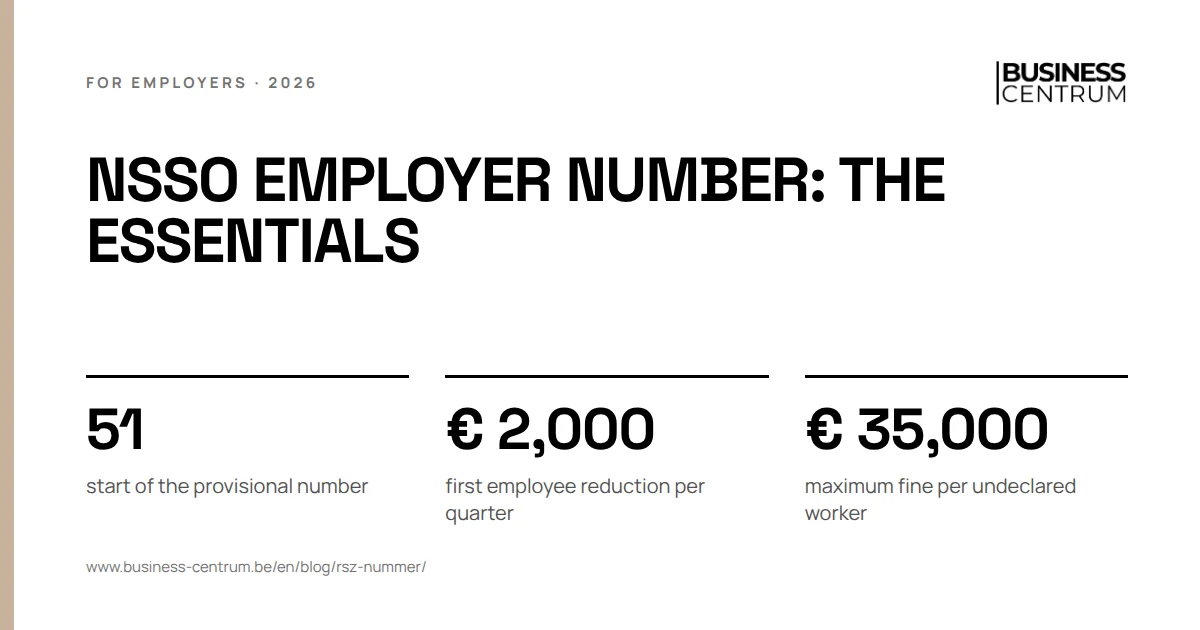
The NSSO employer number, or RSZ number, is the number the Belgian National Social Security Office uses to identify you as an employer. You get it when you hire staff for the first time and register through the WIDE application. Without it, you cannot file a Dimona or a DmfA. Until the final number arrives, you work with a provisional number starting with 51.
What is an NSSO employer number?
The NSSO employer number is your entry in the NSSO's register of employers. Only an employer listed there gets access to the online social security services and can file returns. You use the number for every Dimona, every DmfA return and all correspondence with the NSSO.
When the number is assigned, the NSSO sends a notification with four items:
- the final NSSO number;
- the KBO number, if the NSSO assigns it itself;
- the NACE code, describing your activity;
- the employer category, which determines which contribution rates apply.
That category matters for your employment costs. For most private sector employers it is category 1, with a base contribution of 25%. How that contribution is built up is explained in our article on what RSZ is.
NSSO number, KBO number and VAT number: the difference
A company has several numbers. They often get mixed up:
| Number | Who assigns it | What it is for |
|---|---|---|
| KBO number (enterprise number) | the Crossroads Bank for Enterprises, through a business one-stop shop | your company's identity with every authority |
| VAT number | the FPS Finance | BE followed by your enterprise number, for VAT |
| NSSO number | the NSSO | your status as an employer: Dimona, DmfA, contributions |
| INSZ | the National Register or the Crossroads Bank for Social Security | the identity of each employee |
You first need a KBO number before you can get an NSSO number. In turn, the NSSO tells the KBO that your company is an employer.
Applying for an NSSO employer number
You apply for the number before or when your first employee starts. That is done through WIDE, the employer identification application on the social security portal.
- Make sure you have a KBO number. A company or sole proprietorship already has one. For some employers, the NSSO assigns it itself, for instance for someone who only employs domestic staff, an association without legal personality or a foreign employer without an establishment in Belgium.
- Fill in the WIDE form. In the secure environment, with your eID or itsme, you do not print or send anything. If you choose the unsecured environment, you print the form, sign it and post it. If the signed form does not arrive within the month, 3 reminders follow.
- Use the provisional number. WIDE immediately gives a provisional number starting with 51. You file the Dimona with it, so your employee is reported on time.
- Receive the final number. After processing, the NSSO sends form ID101 with the final number, the category and the NACE code to your e-Box.
- Grant a power of attorney. If you work with a social secretariat or another service provider, it needs a power of attorney to file your DmfA.
How Dimona itself works is explained in our article on Dimona.
How to find your NSSO number
Your own NSSO number is on the ID101 notification in your e-Box, in NSSO notices about your contributions and with your social secretariat. Keep it with your company details, because you need it for every question to the NSSO, the inspectorate or a sector fund.
For most checks on another company you do not need its NSSO number: the authorities work with the KBO number. If you work with a contractor, you use their KBO number on checkinhoudingsplicht.be to see whether they owe money to the NSSO. If they do, you withhold 35% on every payment. More in our article on the withholding obligation.
Does an employee have an NSSO number?
No. An employee does not have an NSSO number. Social security identifies them by their INSZ: the national register number, or a BIS number if they are not in the National Register, for example a cross-border worker. That number is on their identity card and you use it in the Dimona and the DmfA.
After registration: your first employee
Your NSSO number also starts the first-hire reduction. For your very first employee you pay up to € 2,000 less in employer contributions per quarter. The reduction needs no separate application, it goes through the DmfA. What it is worth exactly is set out in our guide on the first employee reduction.
What Business Centrum does for you
We handle your identification as an employer through WIDE, file the first Dimona on time with the provisional number and make sure the reduction for your first employee is in the DmfA from the first quarter, together with Acerta. Hiring for the first time? Also read what we do for small businesses.