
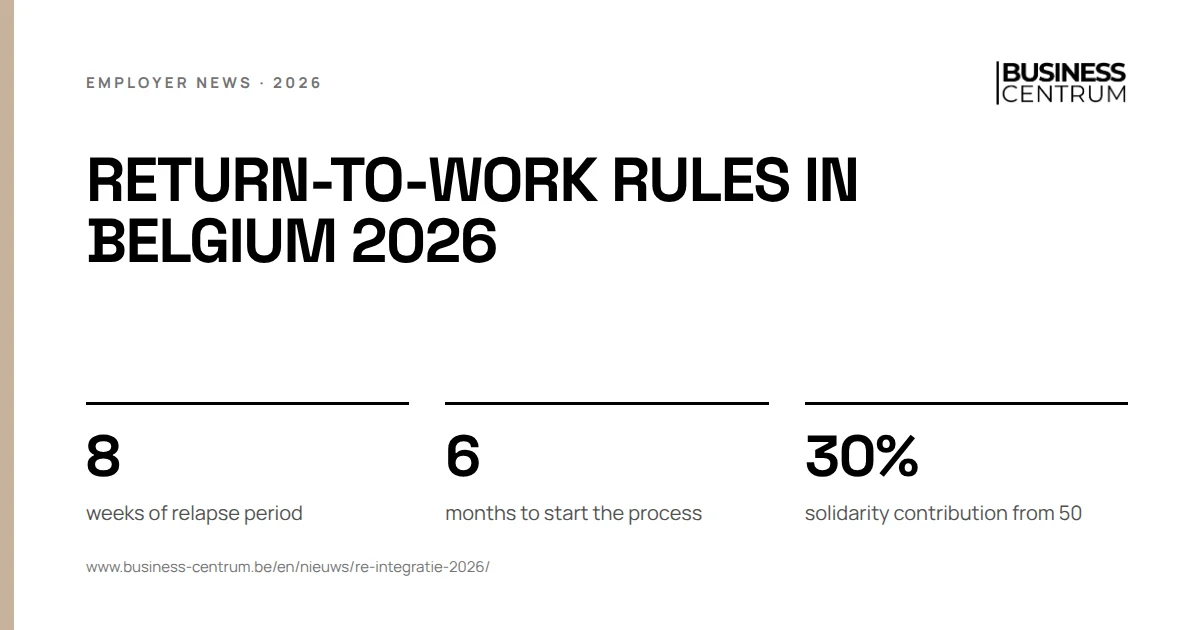
Since 1 January 2026, new sickness rules have applied in Belgium. A relapse within 8 weeks no longer opens a new guaranteed salary period. Employers with 20 or more employees start a return-to-work process within 6 months. From 50 employees, you pay a 30% solidarity contribution on 2 months of sickness benefit.
The 2026 return-to-work rules: the timeline week by week
Most of the rules apply to sickness starting from 1 January 2026. What you have to do depends on the size of your company.
| When | Every employer | From 20 employees | From 50 employees |
|---|---|---|---|
| Day 1 | Sick report, certificate under the work rules, 2 days a year without a certificate | same | same |
| Days 1 to 30 | Guaranteed salary, relapse within 8 weeks | same | same |
| Week 4 | Report the sickness to the occupational physician, who contacts the employee | same | same |
| From day 31 | Health insurance fund pays | same | Solidarity contribution on 2 months of benefit |
| Week 8 | Work potential assessment possible | Request the assessment | same |
| Month 6 | Medical force majeure procedure possible | Process started if there is work potential | same |
The contact procedure runs throughout the sickness, for every employer.
The sick note in 2026 and the 8-week relapse
Days without a certificate. An employee may now stay off on the first sick day without a certificate 2 times per calendar year, down from 3 until the end of 2025. Companies with fewer than 50 employees can exclude this with an explicit clause. More in our blog on the sick note and the employer.
Relapse. If an employee falls ill again within 8 weeks of a sickness with guaranteed salary, you do not pay a new period, only the balance. Until the end of 2025 that period was 14 days. A certificate showing a different illness does open a new period. The worked example is in our guide on guaranteed salary in Belgium.
Part-time return. If an employee falls ill during a partial return to work approved by the fund's medical adviser, you pay no guaranteed salary. This used to apply only to the first 20 weeks; it now covers the whole return.
Contact procedure in the work rules
Since 1 January 2026, every employer must include in its work rules (arbeidsreglement) a procedure for keeping in touch with sick employees. At a minimum it sets out who makes contact and how often. The contact person is one of your own staff, such as an HR officer or the line manager. An external coach or the occupational physician may not take on this role. The contact may never be used to check the sickness. An annex to the work rules is not enough: you follow the normal amendment procedure, see our guide on drawing up work rules.
A model text to adapt:
Contact during incapacity for work. To keep the link with work and prepare a return, the HR manager contacts the employee who is unfit for work on behalf of the employer. A first contact takes place within two weeks of the start of the incapacity, then at least once a month. Contact is by phone, by email or in a meeting, as the employee prefers. Frequency and form may be adjusted by agreement to the employee's state of health. The contact is not used to check the incapacity for work and does not cover medical information.
Download the work rules template with this contact procedure in Word and PDF, in Dutch and French.
If the employee does not respond, record every attempt in the personnel file. The law does not oblige them to reply.
Return to work in companies with 20 or more employees
From 8 weeks of sickness, you can ask your prevention service for a work potential assessment. If your legal entity has 20 or more employees, you must have started a return-to-work process for an employee with work potential no later than 6 months after the start of the sickness. Request the assessment in good time so you can start the process within the deadline. Part-timers working less than 75% of a full-time job count as half.
Who pays the sickness solidarity contribution in 2026?
Only employers with an average of 50 or more employees pay it. The contribution is 30% of the benefits the health insurance fund pays for 2 months, from day 31 of the sickness. It covers employees under 55. Agency workers, flexi-job workers and employees who fall ill in their first 30 days of employment are excluded. The NSSO collects it by debit notice in the 3rd quarter after the quarter in which the sickness began. A small business below the threshold pays nothing.
Medical force majeure in 2026: after 6 months
The procedure to end a contract for medical force majeure can start after 6 months of uninterrupted sickness, compared with 9 months before. No return-to-work process may be running. How the procedure works is explained in our guide on medical force majeure.
What Business Centrum does for you
Business Centrum tracks your employees' sickness periods in your payroll, together with Acerta. We let you know when the 8-week or 6-month mark is reached and check the contact procedure in your work rules. Sickness and leave run through our leave and absence service.