
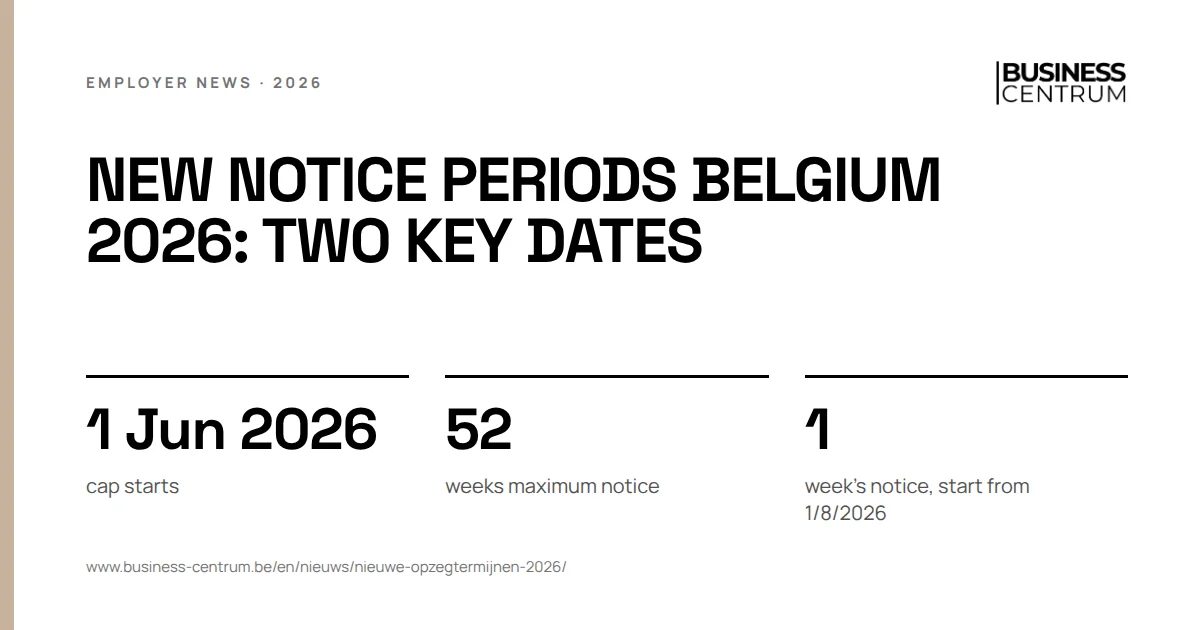
Belgian notice periods changed twice in 2026, each time only for new contracts. For contracts starting from 1 June 2026, notice given by the employer is capped at 52 weeks. For contracts starting from 1 August 2026, notice in the first 6 months is 1 week, for both parties.
The new notice periods of 2026: the start date is the key
Two laws are behind the change: the law of 18 May 2026 for the cap and the law of 3 June 2026 for the short notice. Neither affects existing contracts. What counts is the day performance of the contract starts, as agreed between employer and employee. Not the day it was signed, and not the day of dismissal.
| Contract start date | First six months (employer) | Cap |
|---|---|---|
| before 1 June 2026 | 1, 3, 4 or 5 weeks | none |
| from 1 June 2026 and before 1 August 2026 | 1, 3, 4 or 5 weeks | 52 weeks |
| from 1 August 2026 | 1 week | 52 weeks |
From six months' seniority the table is the same for all three groups. The full table is in our guide to the employer's notice period.
The 52-week notice cap: who does it apply to?
The cap applies from 17 years' seniority. Under the old table, an employee with 17 years' service gets 54 weeks, with 20 years 62. For anyone who started on or after 1 June 2026, the count stops at 52 weeks.
So nothing changes for your current staff. The first employee to actually reach the cap will have 17 years' service in June 2043. The cap is a long-term brake, not a saving for today.
The notice period from 1 August 2026: one week in the first six months
For contracts starting from 1 August 2026, a fixed notice of 1 week applies during the first six months. Under the old table it rose from 1 to 5 weeks. The press talks about the return of the probation period, but a probation clause in the contract remains void, as it has been since 1 January 2014. What exactly returns and how to use it is explained in our piece on the probation period in 2026.
In month seven, notice jumps to 6 weeks. Seniority is counted on the Monday the notice starts, not on the day you decide.
Worked example
Three dismissals worked out
Three white-collar employees on a gross salary of € 3,000 a month. The employer posts a registered letter on Monday 5 October 2026. Notice starts on Monday 12 October 2026. Weekly pay is € 3,000 × 3 / 13 = € 692.31. We calculate on the fixed monthly salary; benefits under the contract, such as an end-of-year bonus, come on top of a payment in lieu.
- Started on 4 May 2026, before the first law. Seniority on 12 October: 5 months and 8 days. Notice: 5 weeks. As a payment in lieu: 5 x € 692.31 = € 3,461.54.
- Started on 1 June 2026, between the two laws. Seniority: 4 months and 11 days. The cap applies, but in the first six months you still follow the old table: 4 weeks. As a payment in lieu: € 2,769.23.
- Started on 3 August 2026, after the second law. Seniority: 2 months and 9 days. Notice: 1 week. As a payment in lieu: € 692.31.
The gap between the first and third employee is € 2,769.23 for the same job and the same pay. Only the start date differs.
What changes for an employee who resigns?
Employees also get shorter notice. For contracts starting from 1 August 2026, they give 1 week in the first six months, where between three and six months it used to be 2 weeks. Counter-notice, when they find a new job after you have dismissed them, drops in that period from 2 to 1 week. The maximum for an employee remains 13 weeks.
What should you do now?
- Record each employee's start date of performance. It decides which rule applies. Check it in the Dimona declaration and in the contract.
- Remove probation clauses from your template contracts. They are void and give employees the wrong expectations.
- Schedule reviews for month six. If in doubt, decide in time: a letter sent a week late costs five extra weeks of notice.
- Update your dismissal letters. The start date and length of notice remain compulsory, and the letter goes by registered post. An example is in our template dismissal letter.
Business Centrum records each employee's start date in your payroll and, on dismissal, calculates the right notice under the rule that applies to that contract, together with Acerta. We update your template contracts through our employment contracts service, so no void probation clause remains.