
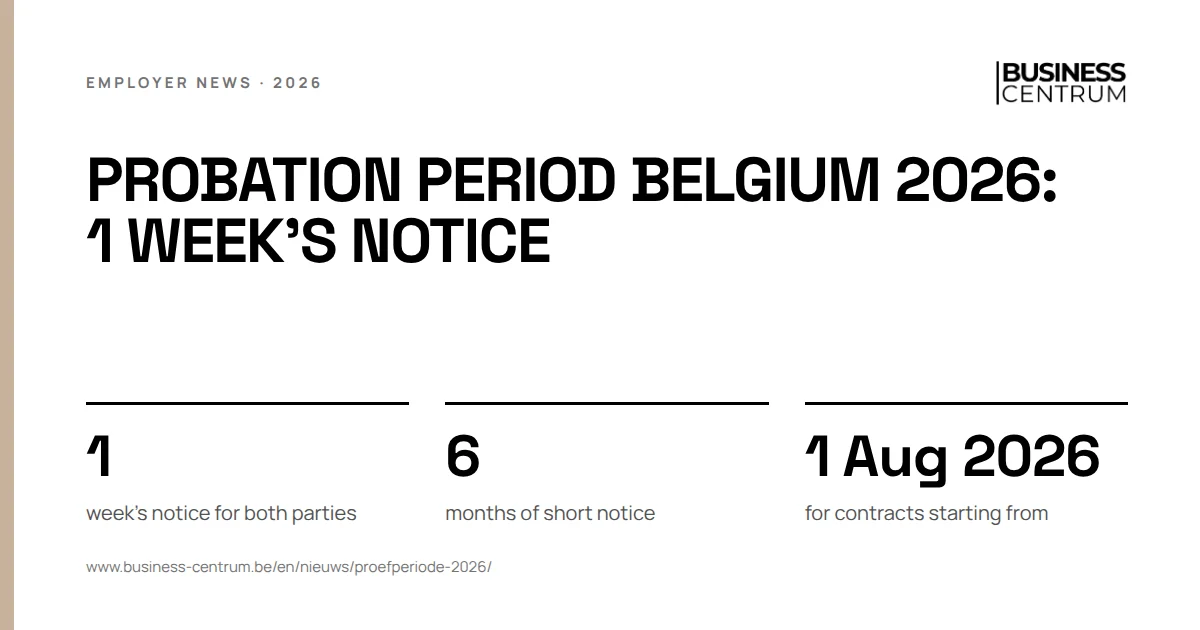
The probation period does not return in 2026 as a clause in the contract. The law of 3 June 2026 does give employer and employee a notice period of 1 week during the first 6 months of seniority. This only applies to contracts whose performance starts from 1 August 2026. After that, the ordinary notice table applies.
Is the probation period back in Belgium in 2026?
Not in the legal sense. Since 1 January 2014, a probation clause in an employment contract has been void, and it stays that way. Writing "six-month probation period" in a new contract means writing a clause with no effect.
What the law does is restore the economic effect of a probation period. For contracts starting from 1 August 2026, notice in the first six months is 1 week, whether the employee has been with you for two weeks or five months. Under the old table, that notice rose to 5 weeks, with 3 weeks already from three months.
For students and agency workers nothing changes: the first 3 days actually worked are still a genuine trial period, during which either party can stop without notice or compensation. For agency work, the parties may agree a different length or no trial period at all.
The notice period in the first six months: how it works
The short notice is not a separate system. It is the first line of the ordinary notice table, and all the formal rules still apply:
- You serve notice by registered letter or through a bailiff. A letter handed over in person is void.
- The letter states the start date and the length: 1 week.
- Notice starts on the Monday after the week in which the letter takes effect, which is the 3rd working day after posting.
- If you do not want the employee to work the week, you pay one week's wages as a payment in lieu of notice.
The rule works both ways. The employee can leave in the first six months with 1 week's notice. If they find a new job after you have dismissed them, their counter-notice is 1 week. If you struggle to recruit, you can also lose staff faster.
The short notice in practice: the month-six calendar
Seniority is counted on the day the notice starts, which makes the last weeks of month six critical. Take a white-collar employee who started on 1 August 2026 on € 2,600 gross a month. Weekly pay is € 2,600 × 3 / 13 = € 600. We calculate on the fixed monthly salary; benefits under the contract, such as an end-of-year bonus, come on top of a payment in lieu.
| Registered letter posted on | Takes effect | Notice starts | Seniority | Notice | As payment in lieu |
|---|---|---|---|---|---|
| Wednesday 20 January 2027 | Saturday 23 January | Monday 25 January | 5 months | 1 week | € 600 |
| Monday 25 January 2027 | Thursday 28 January | Monday 1 February | 6 months | 6 weeks | € 3,600 |
Wednesday 20 January is the last day to post the letter. Post it on Thursday 21 January and the effect slides to Monday 25 January, because Sunday does not count. Notice then starts on 1 February, and the employee has six months' service.
What happens in month seven?
From six months' seniority the ordinary table applies: 6 weeks up to nine months, then more. There is no transition. In the example above, one day late costs € 3,000 more.
So schedule a review meeting around month four or five. If you are still unsure after that meeting, do not leave the decision until the last week. For contracts that were already running before 1 August 2026, this short notice does not apply. The full overview is in our piece on the new notice periods for 2026.
Template letter: notice in the first six months
[Employer name, address, company number]
Registered post to [employee name, address]
[Place], [date of posting]
Re: notice of termination of your employment contract
Dear [name],
We are terminating your employment contract, which started on [date], with a notice period of one week. The notice period starts on Monday [date] and, barring suspension, ends on Sunday [date].
Yours sincerely,
[Name and signature of the authorised person]
Download this template in Word and PDF, in Dutch and French.
State the contract's start date, so it is immediately clear that the short notice applies. More examples, and the calculation after six months, are in our guide to the employer's notice period.
What the short notice does not change
- Reasons for dismissal. In the first 6 months, the employee cannot ask for the reasons for dismissal under collective agreement 109. An earlier fixed-term or agency contract in the same role does count towards those six months.
- Protection against dismissal. Pregnancy, a complaint about harassment or a union mandate remain protected, even in the first months.
- Suspension. If the employee falls ill during the notice you gave, the end date moves back.
- Social documents. The C4, the Dimona exit declaration and the final pay settlement follow as with any dismissal.
Business Centrum records each new employee's start date in your payroll and warns you in good time before the end of month six. On dismissal, we draft the registered letter with the right notice and process the payment in lieu on the final payslip, together with Acerta. To have your contracts checked for a void probation clause, contact our employment contracts service.