
On this page
01
Who falls under joint committee 302?
PC 302 is the Joint Committee for the hotel industry. It covers all hospitality workers, blue-collar and white-collar, and their employers: hotels, motels, guesthouses, restaurants, cafés, bars, snack bars, caterers, canteens, self-service outlets and banqueting halls. Catering on trains falls under it too.
The committee follows your main activity. A tea room attached to a small pastry shop does not fall under it, nor do care homes that belong to the committee for education and housing institutions. A shop with a coffee corner remains a shop, and then you look at retail, such as joint committee 201.
Agency workers fall under the temporary agency work committee. If an agency places someone with you as an extra, those days still count towards your own occasional work quota.
Blue-collar and white-collar together
Hospitality has no separate committee for white-collar staff. A receptionist and a cook both fall under PC 302 and follow the same pay scales, hourly or monthly.
02
Which pay scales apply in joint committee 302?
The minimum wage depends on two things: the job category and the number of years in function with the same employer. The Hospitality Fund describes the sector's reference functions and places each one in one of the categories I to IX. For adults, age plays no role: two kitchen assistants of different ages start on the same wage.
| Category | Example functions | Hourly, 0 years in function | Monthly, 0 years in function | Hourly, 4 years in function |
|---|---|---|---|---|
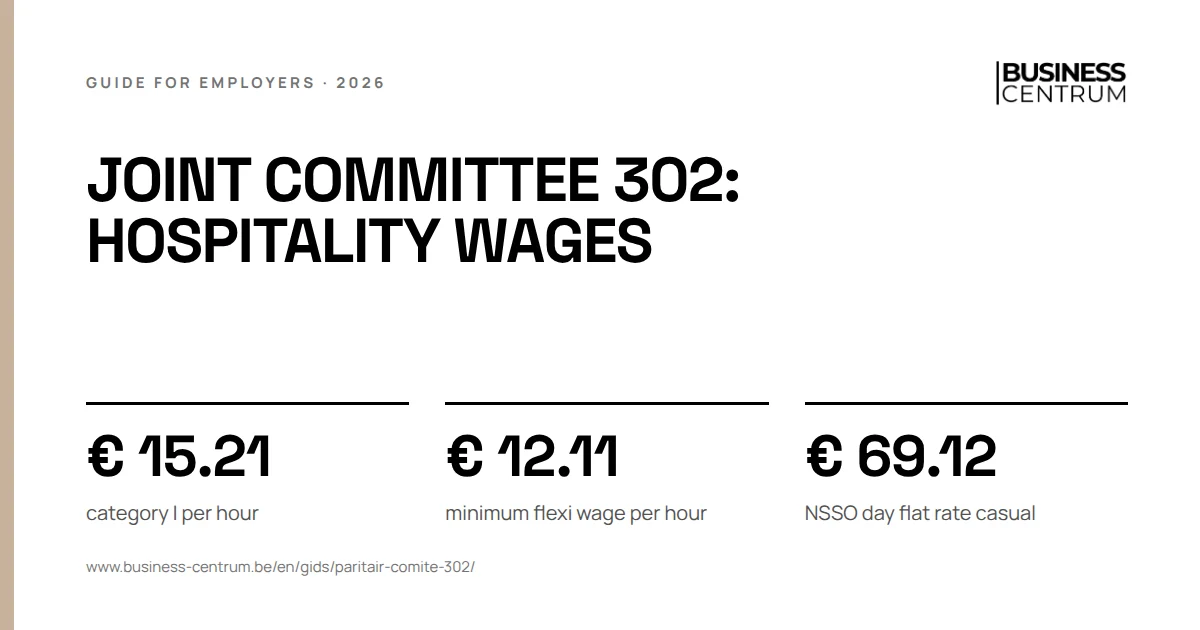
| I | Busser, back-office assistant, toilet attendant | € 15.2097 | € 2,504.53 | € 16.7139 |
| II | Kitchen assistant, commis waiter, bar assistant, chambermaid | € 15.2097 | € 2,504.53 | € 16.7139 |
| III | Dishwasher, pizza maker, host, banquet waiter, doorman | € 15.2977 | € 2,519.02 | € 16.9831 |
| IV | Café waiter, counter server, cashier, head kitchen assistant | € 15.9698 | € 2,629.69 | € 17.5671 |
| V | Restaurant or brasserie waiter, bartender, demi-chef de partie | € 16.8849 | € 2,780.38 | € 18.3359 |
| VI | Chef de partie, pastry chef, sommelier, receptionist | € 17.3317 | € 2,853.95 | € 19.0501 |
| VII | Head of reception, assistant cook working alone, entertainer | € 19.7061 | € 3,244.94 | € 20.6482 |
| VIII | Cook, sous-chef, assistant maître d'hôtel | € 21.2302 | € 3,495.90 | € 22.2062 |
| IX | Head chef, maître d'hôtel, restaurant manager | € 22.5781 | € 3,717.86 | € 23.5855 |
Once an employee has completed all years in function of his category, he receives 1% more every 5 years, calculated on the starting wage of the category. The first increase falls in year 9. Underage students receive a share of the scale: 90% at 17, 80% at 16 and 70% at 15.
The reference function belongs in the employment contract. Someone who combines several functions is paid according to the function he spends most hours on. With a company agreement, you may count other cash pay components towards the scale, but never the year-end bonus.
How indexation works
PC 302 indexes once a year, on the first day of the year. The rate follows the smoothed health index of November compared with the year before. On 1 January 2026 it was 2.189%, for minimum wages and for wages actually paid. The next indexation falls on 1 January 2027. Since 1 June 2026, however, the cent index applies: for a full-time gross monthly wage above € 4,000, the first 2% of indexation applies only to that € 4,000, after that to the full wage again.
Flexi wages follow a different rhythm. They rise by 2% each time the pivot index is exceeded, as on 1 March 2026 and 1 September 2026.
Wages above the scale rise too
Indexation in PC 302 applies to all fixed hourly and monthly wages, including those already above the minimum. Adjusting only the scale wages at the turn of the year means underpaying the rest of the team.
03
Service charge, tips and flat-rate pay
Part of the sector still pays floor staff through a service percentage on the bill. Only certain functions may share in that service money, such as waiters, bussers, maîtres d'hôtel, doormen and chambermaids. Each function gets a share: a restaurant waiter counts for 100%, a starting runner for 55% and a maître d'hôtel for 125%.
For blue-collar workers paid fully or partly through tips or service money, the NSSO calculates contributions on a flat daily wage per function, increased by 8%. If you also pay a wage yourself, the higher amount applies: the flat rate or 108% of what you pay. This scheme only exists for PC 302 and for the functions in the NSSO table.
| Function | Fixed six days a week | Other schedule |
|---|---|---|
| Restaurant waiter | € 139.03 | € 166.90 |
| Café waiter | € 129.74 | € 155.75 |
| Bartender | € 139.03 | € 166.90 |
Wages, service money included, may no longer be paid in cash. On the year-end bonus, the NSSO always charges ordinary contributions, even for staff otherwise declared at the flat rate.
04
Extras: flat rate and daily Dimona
An extra is an occasional worker employed by you for at most 2 consecutive days, on a fixed-term contract or a contract for a clearly defined job. The NSSO calculates contributions on an advantageous flat rate, within two ceilings per calendar year: 50 days per worker and 200 days per employer.
For each day you file a separate Dimona declaration of type EXT, and you choose the form day by day. With a Dimona in hours you report start and end time, at least 2 hours, at € 11.52 per hour started. With a Dimona day you report only the start time and the rate is always € 69.12, the flat rate for 6 hours. For blue-collar workers, 8% is added.
That choice is fixed once the shift starts. If the shift runs longer than reported, you have 8 hours to correct the end time. If it ends earlier, you can correct it until midnight. If the extra does not show up, cancel the declaration before midnight. An extra declared with a Dimona day also goes into the working time register for extras.
After 2 days the status ends
If an extra works one more day in a row, he becomes a regular employee for the whole period. You cancel the EXT declarations and file a new Dimona OTH from the first day, with ordinary contributions.
Worked example
Friday evening, waiter as an extra, 4 hours
- Dimona in hours: 4 × € 11.52
- € 46.08
- Blue-collar base, plus 8%
- € 49.77
- Dimona day: fixed rate
- € 69.12
- Blue-collar base, plus 8%
- € 74.65
05
Flexi-jobs and students in hospitality
Flexi-jobs
Since 1 July 2026, flexi-jobs are allowed in almost every sector, but hospitality keeps its own wage limits. The flexi wage has been at least € 12.11 per hour since 1 September 2026, plus 7.67% flexi holiday pay, € 13.04 in total. The maximum is € 21.00 per hour, or € 22.61 with holiday pay. Outside hospitality, the flexi wage must at least match the pay scale of the function.
The flexi-jobber worked at least 80% of a full-time job for another employer 3 quarters earlier, or is retired. He may not already be employed by you in another way in the same quarter. You first sign a written framework agreement and file a Dimona FLX for each assignment. On the full amount you pay a special contribution of 28%. If a condition is not met, a surcharge of 125% of the flexi wage follows. The full cost is set out in what a flexi-job costs the employer.
Worked example
Saturday, 5 hours of flexi at the minimum
- Flexi wage: 5 × € 12.11
- € 60.55
- Flexi holiday pay 7.67%
- € 4.64
- Net for the flexi-jobber
- € 65.19
- Special contribution 28%
- € 18.25
- Cost to you
- € 83.44
Students
A student works at the solidarity contribution for up to 650 hours per calendar year: 5.42% for you, 2.71% for the student. You sign a written student contract and file a Dimona STU. Ask for a certificate of enrolment from the school: a student card or a sworn statement is not enough for the NSSO. In hospitality, a student can also work 50 days as an extra, with a Dimona EXT.
The pay scale also applies to students, with the percentages for minors above. Young people over 16 may work in hospitality until 23h, provided you notify the inspectorate in writing. Read more about employing students on our employer page.
06
Registered till and working time registration
If a business makes more than € 25,000 a year from meals, excluding VAT and drinks, it issues receipts from a registered cash system (GKS). Since 1 July 2026, a new business must start directly with GKS 2.0. Existing businesses switch between 1 July 2027 and 1 January 2029, depending on the purchase date of their till.
With a GKS you can also register the start and end time of your staff, using the Work IN and Work OUT keys. Without a till, you can do this through the NSSO's alternative system linked to Dimona. Neither replaces the Dimona itself.
That registration has consequences. You may only use a flexi-jobber if his work is registered: through the GKS, the alternative system, electronic time tracking or a daily Dimona with start and end time. And with a GKS in every establishment, a full-time employee may work up to 450 voluntary overtime hours a year since 1 April 2026, up from 360. For 360 of them you pay no overtime premium, and up to 360 hours are exempt from social security and withholding tax.
NSSO reduction for permanent staff abolished
The target group reduction for up to 5 permanent full-time hospitality employees has not existed since 1 July 2026, with no transitional rule. If your wage cost calculation still counts on it, it is wrong.
07
Year-end bonus and the Hospitality Fund
In PC 302, the Guarantee and Social Fund for the Hospitality Sector pays out the year-end bonus. Every month, before day 15, you pay an advance of 12% of the previous month's gross payroll, calculated on 108% for blue-collar workers. By 10 January at the latest, you declare each employee's gross bonus, and the Fund pays the net bonus before 31 January. Whatever remains of your advances is refunded.
Full-time and part-time employees with at least 2 months of uninterrupted service are entitled, as are extras with at least 44 days worked in the year. The maximum is 4.33 weeks of pay, which in a 38-hour week is 164.67 times the December hourly wage. For every block of 21.666 days of attendance the employee gets one twelfth, or per 26 days in a six-day week. For an extra, you divide the hours worked by 8 to get days. Students on the solidarity contribution are not entitled if their establishment uses a registered cash system or the alternative NSSO registration system.
An employee who resigns loses the bonus, unless the notice period ends at the end of the year or later, or he retires. The Fund applies the same rule to a termination by mutual agreement: no bonus. An employee who is dismissed keeps it, except in case of dismissal for serious cause. For a dismissed employee, you declare the bonus before the end of the month after the dismissal.
Worked example
Restaurant waiter, category V, full-time, starting wage
- December hourly wage
- € 16.8849
- Maximum: 164.67 × hourly wage
- € 2,780.44
- Employed since July: 6/12
- € 1,390.22
The Fund also supplies the working time register for extras and manages the job classification and outplacement.
08
Premiums and benefits
Someone who works on a Sunday or a public holiday receives € 2.00 per hour worked, up to € 12.00 per day. For hours between midnight and 5 am, a night supplement of € 1.6209 per hour applies. It does not come on top of overtime pay, and on a Sunday or public holiday you only pay the part above the Sunday premium. In contract catering at a client's premises lasting more than a week, someone who regularly combines several functions receives a small flexibility supplement per hour on top of his wage.
PC 302 has sector eco-vouchers: € 250 a year for a full-time employee, pro rata for part-timers. With an agreement at company level, concluded before payment, you may replace them with meal vouchers or another equivalent benefit. You grant them in December. There are no sector meal vouchers; if you grant them, that is your own policy. For commuting there is also a sector contribution: for public transport, cycling and other means of transport such as a private car.
09
Dimona types in hospitality
| Type | For whom | What you report |
|---|---|---|
| OTH | Permanent staff, and extras who stay longer than 2 days | Start and end of employment |
| EXT | Extras | Each day separately, with start and end time or only the start time |
| FLX | Flexi-jobbers | Each flexi contract, in advance |
| STU | Students at the solidarity contribution | The period and the planned hours |
A forgotten or late Dimona costs a fine, and for extras also the advantageous flat rate. The exact cost is explained in late Dimona.
10
What notice period applies in PC 302?
PC 302 has no notice periods of its own. The general rules of the single status apply, equally to blue-collar and white-collar staff. For a contract starting on or after 1 August 2026, notice given by the employer is 1 week during the first 6 months. After one year of service it is 8 weeks. For contracts from 1 June 2026, the period is capped at 52 weeks. If the employee resigns, the period is never longer than 13 weeks.
11
Where hospitality gets it wrong
The extra who stays
An extra who works one day more than 2 days in a row becomes a regular employee retroactively. The advantageous contributions disappear for the whole period.
Dimona day out of habit
A Dimona day always counts 6 hours. For a short shift you pay more contributions than needed, and once the shift has started you can no longer switch.
Quotas not checked
Beyond 50 days for an extra or 650 hours for a student, ordinary contributions apply. Check the balance in Horeca@work or student@work before you schedule someone.
Advances to the Fund skipped
Employers who do not pay the monthly advances for the year-end bonus receive late payment interest and legal proceedings from the Fund.
A category that is too low
A restaurant waiter classified as a café waiter, or a cook as an assistant cook, loses pay every month. An inspection brings the arrears plus contributions.
12
What Business Centrum does for hospitality
Business Centrum handles the HR administration of hospitality businesses in and around Ghent, as a partner of Acerta. We file the daily Dimona for extras and flexi-jobbers, track the quotas, place each function in the right category and adjust wages at every indexation. We also take over the advances and the declaration to the Hospitality Fund.
You get one fixed contact who knows hospitality, for payroll administration and everything around it. Read more about our social secretariat for hospitality.