
Bogus self-employment in Belgium is a collaboration that is self-employed on paper but runs under authority in practice. The NSSO judges this with 4 general criteria and, in sectors such as construction and transport, with a list of 8 or 9 sector criteria. After reclassification, the NSSO reclaims contributions going back up to 3 years.
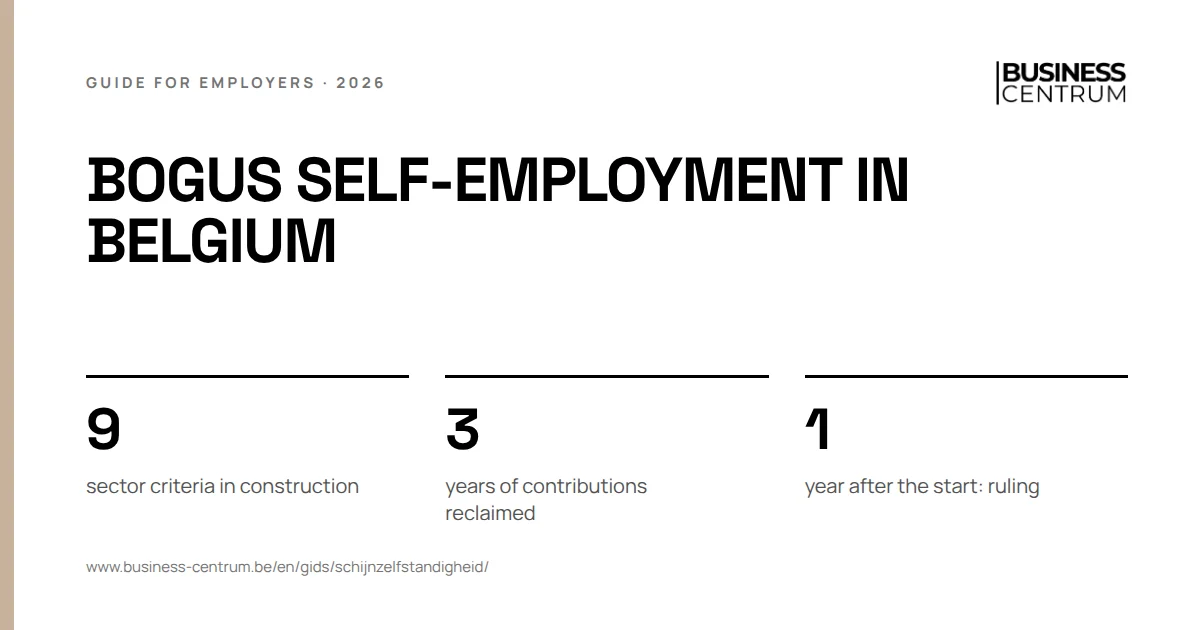
Bogus self-employment in Belgium: what the law says
The Labour Relations Act (title XIII of the programme law of 27 December 2006) starts from freedom. You and your contractor choose whether you work together as employer and employee or as client and self-employed contractor. But the practice must match that choice. If what happens differs from what is on paper, the practice prevails and the relationship is reclassified.
The law states explicitly that some things prove nothing on their own:
- the title of the agreement ("cooperation agreement", "subcontracting contract");
- registration with a social insurance fund for the self-employed;
- registration in the Crossroads Bank for Enterprises;
- the VAT number;
- the way income is declared for tax.
A subcontractor with a company number and tidy invoices can therefore be an employee.
The criteria for bogus self-employment: four general tests
In every sector, the NSSO, the inspectorate or the court looks at 4 general criteria to see whether there is authority:
| Criterion | Points to an employee | Points to self-employment |
|---|---|---|
| What the parties intended | The contract says "self-employed", but practice does not follow | Contract and practice say the same |
| Freedom to organise working time | Fixed hours, clocking in, justifying absences, leave approved by you | They decide when the work is done |
| Freedom to organise the work | Precise tasks, instructions and decisions by a supervisor | Agreements on the result, they choose the method |
| Possibility of hierarchical control | Reporting duty, internal sanctions, negative consequences for deviating | Control of the result only, or of professional ethics |
No single criterion decides. According to the Commission for the Regulation of Labour Relations, practical arrangements about site opening hours or timesheets for invoicing do not in themselves point to authority. The overall picture counts, and the control need not actually be exercised: the possibility is enough.
The sector presumption: construction, transport and other sectors
In several sectors the law goes further than the four criteria. A rebuttable presumption applies there, based on a list of socio-economic criteria. If more than half are met, the relationship is presumed to be an employment contract. If more than half are not met, it is presumed to be self-employment.
The presumption applies to:
- construction and work on real estate (including supply and installation of heating, plumbing, electrics, kitchens, floor and wall coverings);
- security and surveillance for third parties;
- transport of goods and people for third parties, except ambulances and transport of people with disabilities;
- cleaning;
- agriculture and horticulture;
- work via a digital platform, with its own list.
The presumption does not apply to family relationships: between relatives by blood or marriage up to the 3rd degree, between legal cohabitants, or for a company in which such relatives together hold more than 50% of the shares.
The presumption can be rebutted by any legal means, above all with the four general criteria. But it shifts the burden of proof, and in practice that is what makes the difference.
Bogus self-employment in construction: a checklist for the client
If the relationship falls under construction (JC 124), upholstery and woodworking (JC 126), metal, machine and electrical engineering (JC 111) or electricians (JSC 149.01), you use these 9 criteria. Tick what applies to your subcontractor. From 5 ticks, they are presumed to be an employee.
- They bear no financial or economic risk: no personal, substantial investment with their own funds, no personal share in profit and loss, or no personal liability for the work.
- They have no responsibility or decision-making power over their business's finances.
- They do not decide on purchasing and prices, do not find their own customers and do not negotiate contracts.
- They receive a fixed fee regardless of results or the volume of work. Advances for materials do not count.
- They cannot hire staff or send a replacement.
- They do not present themselves as a business: no logo, no lettering on their van, no sign of their own.
- They work mainly or usually for one client.
- They work with materials, vehicles or tools they do not own or rent, or that you provide.
- They do not work independently of your own crews.
For construction activities outside those joint committees, a similar list of 9 criteria applies, including the absence of an obligation to deliver a result. More about the sector on our page on staff in construction.
If you work with subcontractors in construction, also always check the withholding obligation for social and tax debts. See checking the contractor's withholding obligation.
Bogus self-employment in road haulage
For road transport and logistics for third parties (JSC 140.03), the list has 8 criteria. From 5, the presumption of an employment contract applies. Typical signs with a driver:
- no financial guarantee or certificate of professional competence as a haulier;
- no say in the price, unless it is set objectively via a freight exchange or tender;
- they cannot hire staff;
- they mainly drive a lorry they do not own and do not lease or rent themselves, or that you provide or finance.
The client's advertising on the trailer does not prove they are not a business. See also our page on staff in transport and logistics.
Consequences of bogus self-employment for the client
If the NSSO reclassifies the collaboration, you become the employer retroactively. That means:
- NSSO contributions on what you paid, employer and employee share, going back up to 3 years. With fraud or false declarations, that becomes 10 years.
- The employee contribution stays with you. You did not withhold it at the time, so you can no longer recover it from the worker.
- Surcharge and interest: a 10% surcharge and 7% late-payment interest a year.
- A Dimona fine, because the worker was never declared: sanction level 4, administrative € 3,000 to € 35,000 per employee, criminal € 6,000 to € 70,000.
- Employment law claims by the worker: your joint committee's pay scale, holiday pay, end-of-year bonus and, when the collaboration ends, a notice period.
- No workplace accident insurance for that worker. If an accident happens, Fedris pays and recovers the cost from you.
For blue-collar workers, the NSSO calculates contributions on 108% of gross pay, and a holiday pay contribution of 15.84% is added.
Worked example: what the NSSO reclaims
A construction company in JC 124 works for two years with a self-employed bricklayer. He invoices € 3,500 a month, works only for this company, with its materials and in its crews. Seven of the nine construction criteria are met. After an inspection, the NSSO reclassifies him as a blue-collar worker. In this example, the NSSO takes the invoiced amount as gross pay.
| Item | Calculation | Amount |
|---|---|---|
| Invoiced over 24 months | € 3,500 x 24 | € 84,000.00 |
| Calculation base, blue-collar | € 84,000 x 108% | € 90,720.00 |
| Employer contribution 25% | € 90,720 x 25% | € 22,680.00 |
| Employee contribution 13.07%, not recoverable | € 90,720 x 13.07% | € 11,857.10 |
| Blue-collar holiday contribution 15.84% | € 90,720 x 15.84% | € 14,370.05 |
| Surcharge 10% on the ordinary contributions | € 34,537.10 x 10% | € 3,453.71 |
| Dimona fine at the minimum | 1 x € 3,000 | € 3,000.00 |
| Total | € 55,360.86 |
On top of that come late-payment interest of 7% a year for each late quarter, the construction sector's own contributions and whatever the worker can claim in wages and bonuses.
Avoiding bogus self-employment: a ruling from the Labour Relations Commission
The Administrative Commission for the Regulation of Labour Relations assesses, on request, whether a collaboration is self-employed or salaried. You choose between two procedures:
| Opinion | Decision (ruling) | |
|---|---|---|
| Binding | No, advisory only | Yes, for the NSSO, the national institute for the self-employed, the FPS Social Security, the FPS Employment and the social insurance funds |
| Other party | Not involved; with a diverging opinion you notify them within 30 days | Always involved, the procedure is adversarial |
| Appeal | Not applicable | To the labour court, within 1 month |
How to request a ruling:
- Choose the moment. Before the collaboration starts, within 1 year of the start, or within 1 year of a new element that changes the relationship.
- Check it is still possible. If a social inspection service is already investigating, or proceedings are pending at the labour court, your request is inadmissible.
- Complete the application form, with the annex for your sector (construction, security, transport, cleaning, agriculture and horticulture, or platform work). Attach the contract or draft.
- Submit it by email, at the reception of the FPS Social Security, or by registered post.
- Wait for the decision. The Commission decides within 3 months, extended by the time you need to provide further information.
A decision stays binding as long as the collaboration runs as you described it. If practice changes, or you gave incomplete information, it lapses.
Setting up a genuine self-employed collaboration
- Pay for results, not by the hour or a monthly sum regardless of the work.
- Let them use their own equipment and vehicle, or rent them.
- Let them set their price and work for other customers.
- Give no hierarchical instructions on how they work, only on what must be delivered.
- Do not integrate them into your crews with the same hours and the same supervisor.
- Let them send a replacement or use their own staff.
If you simply need extra hands under your direction, an employee or a temporary agency worker is the right form. Compare costs in the cost of a temp agency. If you work as the director of your own company, other rules apply; see the company director.
What to do if the inspectorate is already asking questions
Once a social inspection service opens an investigation into the nature of the collaboration, you can no longer ask for a ruling. Everything then depends on your file and your evidence.
- Gather what shows independence: quotes and invoices per project, price negotiations, invoices to other customers, own insurance, leasing or purchase of equipment and vehicles.
- Map the practice. Who planned the working days? Who gave instructions? Did they ever receive a sanction or remark the way an employee would?
- Count the sector criteria honestly. If 5 or more are met in construction, the burden of proof is on you.
- Limit the damage for the future. Adjust the collaboration, or hire the person with a Dimona and an employment contract. That stops the clock for the coming quarters.
- Have the NSSO's calculation checked. Are the base, the percentage and the period within the limitation period correct?
Mistakes clients make
- Thinking a VAT number or own company is enough. The law looks at practice.
- Taking a former employee back as self-employed for the same work, with the same hours and the same supervisor.
- Having a fixed monthly amount invoiced, regardless of what is delivered.
- Providing workwear, van and tools without rent or a fee.
- Asking for a ruling too late. More than 1 year after the start, or during an investigation, it is no longer possible.
Business Centrum tests your collaborations with self-employed contractors and subcontractors against your sector's criteria, helps you apply to the Commission, and converts the collaboration into a proper contract if that is the right form. If someone needs to become an employee after all, we handle the Dimona and payroll, together with Acerta.