
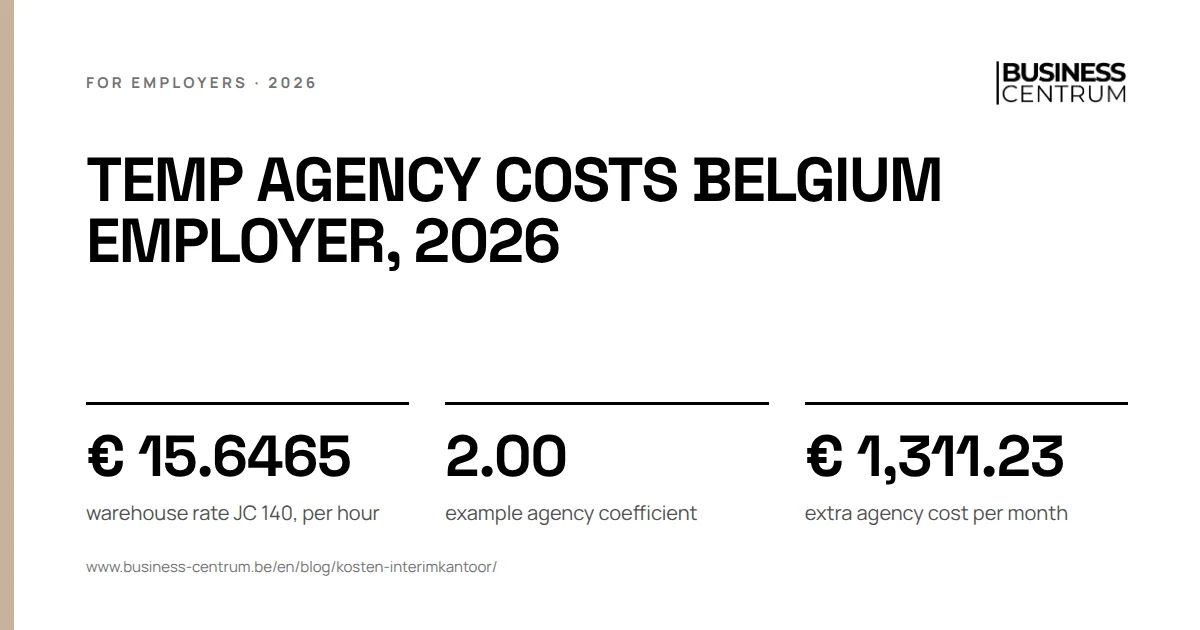
Temp agency costs for a Belgium employer come down to the gross wage times a coefficient, plus VAT. One Belgian agency uses 2 in its own example. For a warehouse worker on the JC 140 pay scale you pay about € 31.29 an hour, against € 23.33 on your own payroll: € 1,311.23 more per month.
How does a temp agency calculate its price?
The agency is the agency worker's employer. It pays the wage, social security (NSSO), holiday pay and the end-of-year bonus, and invoices you an hourly rate. That rate is the gross hourly wage times a coefficient. The coefficient covers employer contributions, holiday pay, the end-of-year bonus, workplace accident insurance, administration and the agency's margin.
The agency does not set the gross wage freely. By law the agency worker may not earn less than he would if you had hired him yourself on the same terms. That includes benefits such as meal vouchers. Your joint committee (JC) pay scale and your own pay policy set the base, and the agency sets the coefficient. Our guide to joint committee 322 explains how this equal pay and the agency worker's year-end bonus are arranged.
Coefficients are commercial rates. They differ by agency, by job and by volume. Always ask what is left out: meal vouchers, travel allowances, shift or night premiums and overtime are often invoiced separately, sometimes with their own coefficient.
Worked example 2026: temp agency costs against hiring directly
A transport company needs a warehouse worker. The JC 140 minimum rate for non-driving staff in class 1 is € 15.65 an hour on a 38-hour week. Both columns start from that wage, because the agency worker is entitled to the same.
| Per hour | Through a temp agency | On your own payroll |
|---|---|---|
| Gross hourly wage | € 15.65 | € 15.65 |
| Coefficient | 2 | not applicable |
| Employer NSSO: 25% on 108% of pay | in the coefficient | € 4.22 |
| Blue-collar holiday contribution: 15.84% on 108% | in the coefficient | € 2.68 |
| End-of-year bonus: 5% of gross pay | in the coefficient | € 0.78 |
| Cost per hour | € 31.29 excl. VAT | € 23.33 before reductions |
The gap is € 7.96 an hour. Over an average month of 164.67 hours (38 hours x 52 weeks / 12), you pay € 5,152.91 through the agency and € 3,841.68 directly: € 1,311.23 more per month for agency staff.
What the example leaves out cuts both ways. On your own payroll you also pay public holidays, guaranteed pay during sickness, workplace accident insurance, an external prevention service and your payroll administration. On the other hand, your NSSO drops through the structural reduction, and if this is your first employee, the first employee NSSO reduction saves up to € 2,000 a quarter. An agency worker does not earn you that reduction, because the agency is the employer.
What else comes on top of the temp agency costs each month?
The agency invoice is not always the whole story. Three items to check before you sign:
- Premiums outside the coefficient. Night, shift, overtime and Sunday work may be billed at a higher coefficient.
- Benefits. If your permanent staff get meal vouchers, so does the agency worker, and the agency passes them on.
- A transfer fee. Some agencies charge an amount if you hire the agency worker yourself within a set period.
Temp or permanent contract: when do you choose which?
Agency work is meant for temporary work. The law only allows it for a limited set of reasons, including replacing a permanent employee, a temporary increase in work, exceptional work and recruitment with a view to a permanent hire.
For a temporary increase in work without a union delegation, the first period is 6 months, with extensions up to 18 months in total. In construction, an agency worker may not exceed 6 months in the same firm for that reason. After that period you can no longer use an agency worker for that work on this ground.
Rules of thumb for an SME:
- Agency staff for a peak of a few weeks, for sickness cover, or when you have no time to search and select.
- Your own hire as soon as the need is structural. Every month of agency work costs € 1,311.23 more in our example.
- Flexi-jobs for recurring peaks with people who already work elsewhere. Since 1 July 2026 this is possible in almost every sector, with a special contribution of 28%. The hourly cost is in our guide on flexi-job costs for the employer.
When temp should become permanent: finding the break-even point
Per hour, hiring yourself is cheaper. The real question is what it costs you to find someone: a job ad, interviews, onboarding and the risk that it does not work out. The agency takes that on, and it sits in the coefficient.
Your break-even point: divide your own recruitment cost by the hourly gap. Say your search costs you € 2,000. With a gap of € 7.96 an hour, you have earned that back after 251 hours worked, or roughly six weeks full-time. If you need the warehouse worker for longer than that, hiring directly wins. For three weeks of cover, the agency wins.
Do not forget the exit. An agency worker stops at the end of his contract. Your own employee on a permanent contract leaves with a notice period from the employer. That cost only shows up later, and it is a reason to consider a fixed-term contract first when the period is uncertain.
From temp to permanent: taking on an agency worker
If you want to test someone through an agency for a permanent post, that is the recruitment reason (instroom). The rules:
- The agency contract runs at least 1 week and at most 6 months per agency worker. Daily contracts are ruled out.
- Per vacancy you get at most 3 attempts, together no longer than 9 months.
- If you have a union delegation, you inform and consult it in advance on the reason, the jobs and the job descriptions.
- If the evaluation is positive, you hire the agency worker on a permanent employment contract.
- Time as an agency worker counts towards his seniority with you. Keep that in mind for any later notice period.
We prepare the employment contract for the transfer during the last agency week, so there is not a single day without a contract or without a Dimona.
Mistakes employers make with agency staff
- Comparing coefficients without asking what they cover. A low coefficient with expensive add-ons is no bargain.
- Keeping an agency worker on a temporary increase for years. After the maximum period the ground is used up. Keep the agency worker on anyway and he counts as your own employee on a permanent contract.
- Only reading the transfer clause when you want to hire someone.
- Forgetting that pay must be equal to that of your permanent staff, benefits included.
What Business Centrum does for you
We calculate for your job and your JC what your own employee costs per hour and per month, with the reductions you are entitled to, so you can set it next to an agency quote. If you take on an agency worker, we draft the contract, file the Dimona and add him to your payroll, together with Acerta.