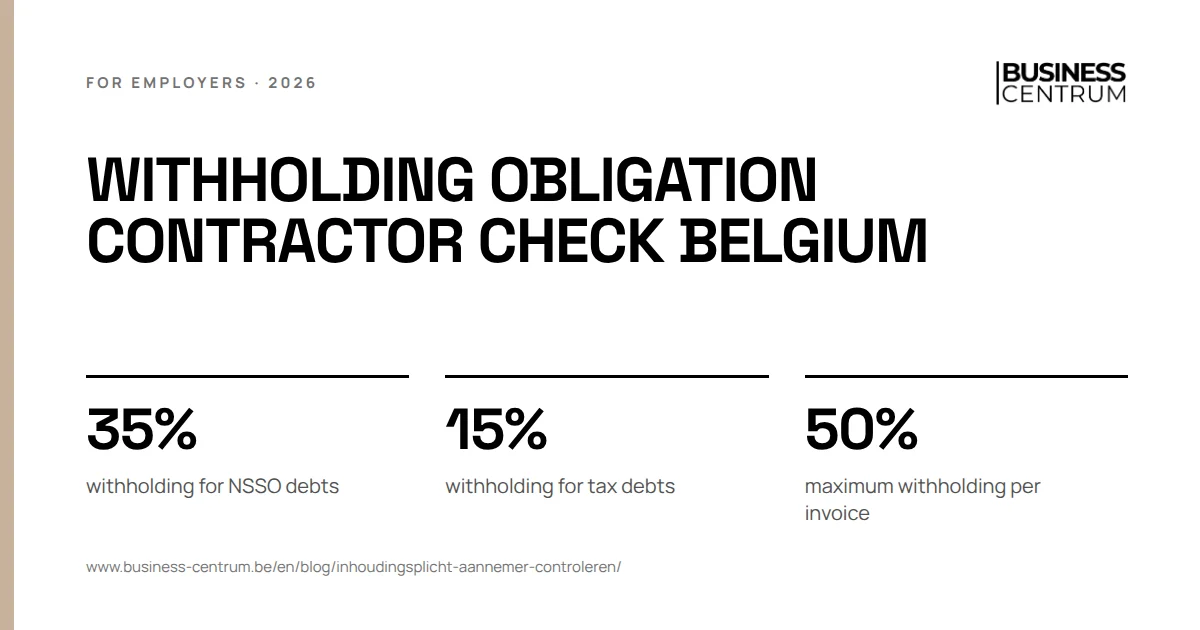
You check a contractor's withholding obligation in Belgium on checkinhoudingsplicht.be, when you sign the contract and again before every payment. If the contractor shows red, you withhold 35% for NSSO debts, 15% for tax debts and, from 30 October 2026, 15% for debts with the NISSE, the self-employed social security institute. Never more than 50% of the invoice excluding VAT in total.
NSSO withholding obligation in construction: who does it apply to?
The rule covers clients, contractors and subcontractors who have these activities carried out:
- work on immovable property, so building, converting, fitting out, repairing, maintaining and cleaning, including installing heating, plumbing and electrics;
- the supply of ready-mixed concrete;
- security services;
- certain activities in the meat sector.
Each link in the chain checks the next one. You, as main contractor, check your subcontractor, and your subcontractor checks theirs. Only a private individual having work done for strictly private purposes is excluded.
A contractor has a social debt as soon as one of these situations applies:
- it owes the NSSO more than € 2,500 in contributions, surcharges, interest or legal costs;
- it has not filed all DmfA returns up to and including the quarter before last;
- it falls under joint committee 124 and has not paid its NSSO advance payments correctly;
- it owes more than € 70 for bad-weather and loyalty stamps;
- it has not paid a joint-liability debt within 30 days of a formal notice by registered letter;
- it falls under the joint committee for security services and owes the security sector's subsistence fund more than € 900;
- from 30 October 2026, for work on immovable property: as a self-employed person or company it has arrears of more than € 2,647 with the NISSE. More on this below.
Checking the contractor's withholding obligation at every payment: step by step
- Check when you sign. Enter the company number on checkinhoudingsplicht.be. For a foreign contractor, use the VAT number or foreign identification number. If it already shows red, you are jointly liable for its debts, unless you withhold correctly at every payment.
- Check again before every invoice. The database is updated monthly, on the Friday after the last Thursday of the month. A green status stays valid until the next update. A red status applies at the moment you look.
- Read the screen. Green: withhold nothing. Red: withhold the percentage shown. Grey: the contractor falls outside the scheme, withhold nothing.
- Prepare the social part. If the social part is red, you prepare the payment in checkinhoudingsplicht.be. You receive a structured reference, unique to that payment.
- Pay the social part. To the NSSO's Retenue Sociale Inhoudingen account, BE76 6790 0001 9295, at the same moment as you pay the invoice. The NISSE part also goes to that account.
- Pay the tax part. If the tax part is red, you request a certificate from the FPS Finance and pay 15% to BE63 6792 0036 4008, with the reference on that certificate.
- Pay the balance to the contractor. For a social withholding, the contractor receives a notice from the NSSO via its e-Box or by post.
A screenshot is not needed: for the social part, the database has evidential value and you keep the consultation reference. If the contractor works with foreign crews, also ask for the Limosa proof. See our article on the Limosa declaration.
Worked example: withholding on a real invoice
A Ghent main contractor receives an invoice from a tiler: € 48,000 excluding VAT. What the contractor withholds depends on what checkinhoudingsplicht.be shows.
| Tiler's status | Withholding | To | To the tiler |
|---|---|---|---|
| NSSO debt only | 35% = € 16,800 | NSSO | € 31,200 |
| Tax debt only | 15% = € 7,200 | FPS Finance | € 40,800 |
| NISSE debt only | 15% = € 7,200 | NSSO account | € 40,800 |
| NSSO and tax debt | € 16,800 + € 7,200 = € 24,000 | NSSO and FPS Finance | € 24,000 |
| NSSO, NISSE and tax | capped at 50%: € 24,000 | NSSO and FPS Finance | € 24,000 |
The rows with a NISSE debt apply from 30 October 2026. In the last case, the system temporarily hides the NISSE withholding to respect the 50% cap. The NISSE debt still exists and reappears as soon as there is room.
We see four mistakes in practice:
- Checking only at the start. A subcontractor that was green in March can be red in June.
- Withholding on the amount including VAT. The percentage applies to the amount excluding VAT.
- Paying without the structured reference. The NSSO then cannot process the payment automatically, and the contractor's status is updated more slowly.
- Sending the tax part to the NSSO. Each institution has its own account. The NISSE part does go to the NSSO account.
A certificate lets the contractor limit the withholding
If the invoice is € 7,143 or more excluding VAT, the contractor can request a certificate that limits the withholding to its actual debt. The contractor requests it, not you.
- Social part: the contractor requests the certificate online from the NSSO and sends it to you. You prepare the withholding as usual and pay the amount on the certificate, with the structured reference.
- Tax part: the contractor requests a tax certificate from the FPS Finance. It is valid for 20 days. If the debt on the certificate is below 15% of your payment, you withhold only that amount.
- NISSE: there is no limitation for debts of self-employed people.
What changes in 2026 for self-employed contractors
A social debt is no longer only a debt with the NSSO. For work on immovable property, arrears under the social status of the self-employed now count too: unpaid social contributions, NISSE surcharges and fines, or a company's annual contribution. From 30 October 2026, these debts can trigger a withholding of 15% on checkinhoudingsplicht.be. Arrears up to € 2,647 (the 2026 amount) do not count, nor does a debt that is not yet due or is covered by a payment plan that is being kept. The NISSE starts with the largest debts.
This mainly affects the sole trader without staff, which rarely had a social debt before. The NISSE first warns the self-employed person by registered letter. Anyone who does not pay within 15 calendar days and does not agree a payment plan with their social insurance fund is listed in the public database.
What do you risk if you do not withhold?
| Social part | Tax part | |
|---|---|---|
| Penalty | the withholding itself plus a surcharge of 100% of that amount | administrative fine of 2 times the amount not withheld |
| Joint liability | up to 100% of the price excluding VAT, 65% if tax liability also applies | up to 35% of the price excluding VAT |
Back to the tiler at € 48,000. If the main contractor forgets the NSSO withholding, it pays € 16,800 withholding plus € 16,800 surcharge, € 33,600 in total. If it forgets the tax withholding, it risks 2 x € 7,200 = € 14,400 in fines. The NSSO can waive the surcharge if the contractor owed no contributions, and 50% of it in exceptional circumstances. For the NISSE part, it risks an administrative fine of 15% of the invoice amount, capped at € 10,578.23 in 2026.
What Business Centrum does for you
For construction companies, we make sure your own status stays green: DmfA on time, advance payments correct, a payment plan with the NSSO if things get tight. Your clients then have nothing to withhold from your invoices. We also show you how to check your subcontractors and what to pay if one shows red. The rules for your sector are in our guide to joint committee 124. Your payroll runs through Business Centrum, together with Acerta.