
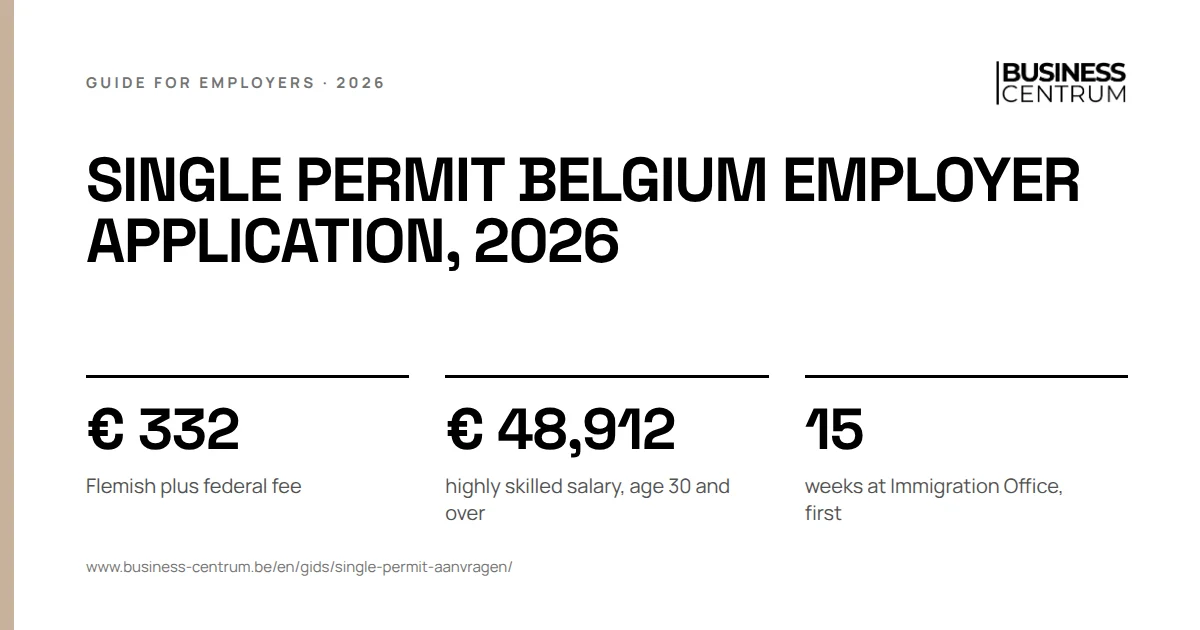
In Belgium, the employer files the single permit application through the Working in Belgium portal. In Flanders, the region decides on the work part and the Immigration Office (DVZ) on residence. You pay a Flemish fee of € 180 and a federal fee of € 152, and the Immigration Office takes roughly 14 to 15 weeks.
What is a single permit in Belgium and when do you need one?
A single permit, officially the combined permit, bundles two authorisations into one document: permission to work and permission to reside. You need one if you employ someone from outside the European Economic Area and Switzerland in Belgium for more than 90 days. Since 3 January 2019 this has run through a single application that the employer files with the region.
The competent region depends on the establishment where the worker is based, not on your registered office. If he works at your depot in East Flanders, Flanders decides on the work part, even if your registered office is in Brussels. This guide follows the Flemish procedure.
Two situations fall outside it:
- Short assignments of up to 90 days. These need a separate work authorisation without a residence part.
- Posted workers employed by a foreign employer. They always need a Limosa declaration, see our article on the Limosa declaration. Sometimes a work authorisation is needed as well, under separate rules. For a medium-skilled role or the 'other' category, posting is ruled out.
EU citizens and foreign nationals who already have unrestricted access to work through their residence status are exempt. If in doubt, check the candidate's residence card first.
Applying for a single permit as an employer: which category fits?
The category sets the conditions, the minimum salary and how long the permit lasts. If you pick the wrong one, the Flemish economic migration service corrects it, but you lose time.
| Category | Main condition | Minimum salary |
|---|---|---|
| Highly skilled | Higher education degree, at least level 5, and a highly qualified role | € 48,912 a year, € 39,129.60 under 30 |
| Managerial | Management role | € 78,259 a year |
| EU Blue Card | Highly qualified job, hired after 1 May 2024 | € 63,586 a year |
| Medium-skilled role | The job is on the Flemish migration list | Pay scale for a trained or skilled worker in your joint committee (JC) |
| Other | The job is on the VDAB shortage list, plus a proven search | Pay scale for a trained or skilled worker |
For most SMEs in construction, transport and wholesale it comes down to the last two. Since 1 January 2026 the former shortage occupation category has been called medium-skilled role. For a job on that migration list you no longer have to prove the shortage yourself. The list is set by a ministerial decree of 1 December 2025. It includes bricklayer, formworker, roofer, electrical technician, refrigeration technician, pipe fitter, earthmoving machine operator and heavy goods vehicle mechanic.
The migration list is not the same as the shortage list of VDAB, the Flemish employment service. If the job is only on that second list, the application falls under 'other', with a heavier procedure.
Single permit in Flanders for a C or CE lorry driver
This is where many transport firms go wrong. Lorry driver, bus driver and coach driver were on the list for years. Not since 1 January 2026, along with baker, butcher, floor and wall tiler, plumber and tower crane operator.
For a new driver only the 'other' category is left, and only if the job is on the VDAB shortage list. The conditions:
- You publish the vacancy yourself on VDAB and EURES for at least 9 consecutive weeks, within the 4 months before the application. You only apply once that period is over.
- You cooperate with VDAB's placement efforts during that period.
- If the local tension indicator for the job is below 12, a shortage is presumed. If it is at or above that level, you prove with extra documents that you found nobody.
- The exact job title from the VDAB list appears word for word in the vacancy, the contract and the application.
- The driver stays outside Belgium during the procedure.
- If it is clear that his foreign driving licence cannot be exchanged for a Belgian one after 185 days of residence, Flanders refuses the application. Check this first against the rules of the FPS Mobility.
Pay follows your JC scale for a trained or skilled worker. For transport, the amounts are in our guide on joint committee 140.
2026 salary thresholds for a single permit in Belgium
Salary is where most files get stuck. Flanders only counts amounts that are certain at the start of employment: fixed gross pay, holiday pay, fixed bonuses, employer contributions to group or hospital insurance, and benefits in kind such as a company car or meal vouchers. Variable pay, uncertain bonuses and expense allowances do not count.
For highly skilled workers the threshold is for now still based on the average gross annual salary of 2025, until Statbel publishes new pay statistics: € 48,912. Under 30, a nurse or a teacher: 80% of that, so € 39,129.60. Flanders converts an annual salary into a monthly one with a divisor of 13.92 when the worker gets double holiday pay and a 13th month. That gives € 3,513.79 a month from age 30 and € 2,811.03 below it.
Worked example. You want to hire a 28-year-old planner with a bachelor's degree at € 2,700 gross a month, with a 13th month and double holiday pay.
- Annual salary as Flanders counts it: € 2,700 x 13.92 = € 37,584.
- Threshold under 30: € 39,129.60.
- Shortfall: € 1,545.60 a year, or € 111.03 a month.
The file misses the threshold. With a monthly salary of € 2,811.03 it passes. If the planner turns 30 during the permit, add a clause to the contract that raises pay automatically to the full threshold. Otherwise the permit only runs until the day before his birthday.
For a medium-skilled role or the 'other' category, the JC pay scale applies. One key point: you may not grade the worker as unskilled, even if he is new to your firm. A bricklayer in construction therefore sits at least in a trained category, see joint committee 124. And pay never drops below the guaranteed minimum monthly income (GGMMI) of € 2,233.61.
After an indexation your permit can suddenly fall below the new threshold. If the automatic increase is not enough, send in an addendum with the new salary.
Documents to prepare for the single permit application
Only submit a complete file. Emailing documents afterwards is not possible. Copies are fine, originals are not required.
About the worker:
- A copy of every page of his valid international passport. If he is already in Belgium, also his Belgian residence permit.
- His national social security number (INSZ), or a BIS number you request through BelgianIDpro if he is not in the national register.
- A criminal record extract if he is over 18, legalised and translated into Dutch, French or English.
- The standard medical certificate.
- Proof of health insurance or a sponsorship undertaking.
The criminal record, medical certificate and insurance proof may be no more than 6 months old when you apply.
About the job:
- An employment contract dated and signed by both parties, in Dutch because you are based in Flanders. It states the term and place of work, the salary, the name and number of your JC, the job and its grading.
- For a highly skilled worker: the degree with a translation. A recent graduate may use a pass certificate.
- For a medium-skilled role or 'other': a CV, a job description signed by both parties listing the daily tasks, a diploma or proof of experience, and a contract with a work schedule showing at least 80% employment.
- Proof that the fee has been paid.
A correct employment contract for a foreign worker is the document that comes back with questions most often. A contract in English only does not meet the Flemish requirement.
The single permit procedure step by step
- Check category and pay. Look at the migration list, the VDAB list and the pay scale before you promise the candidate anything.
- Build the file with the documents above.
- Apply through the single portal. The application is digital only. Since 1 September 2026 the same goes for work cards for short assignments. File a first application at least 1 month and at most 6 months before the start.
- Pay the fee. The Flemish fee has applied since 1 September 2026. You pay it within 15 days by Bancontact, card or transfer in the portal. Miss that deadline and the file is closed.
- Work part in Flanders. You follow the status in the portal and receive a digital letter in your eBox: information requested, admissible, positive or negative work decision. In October 2026 review started after about 2 weeks for highly skilled workers and 6 weeks for medium-skilled and 'other'.
- Residence part at the Immigration Office. After a positive decision the file moves automatically to the Immigration Office. For a first application this takes roughly 14 to 15 weeks. Approval comes as annex 46 or 47, a refusal as annex 48.
- Arrival. If the worker is abroad, he uses the decision to apply for a D visa at the Belgian embassy or consulate. After arrival he reports to the municipality, which issues the electronic card. If he is already in Belgium, everything runs through the municipality.
- Dimona before the first working day. No Dimona, no employment, even with a permit. We include the Dimona declaration in your payroll.
When can the worker start?
Only when both work and residence are approved and the worker has his documents. No permit is ever granted retroactively. If the start date in your application has passed by the time of approval, the start moves to the approval date, and the end date moves with it unless the contract says otherwise.
The law gives the authorities 4 months to decide after they notify you that the file is complete. In complex cases that period can exceptionally be extended. In practice, plan on the waiting times above rather than on that legal period. A driver you need in September is a spring application.
Renewing a single permit: deadlines and changes
File the renewal between 6 and 2 months before the expiry date. The worker can then carry on in the same job with you without a break. Add payslips: the economic migration service accepts those of at least the last 6 months. A renewal also carries the Flemish fee of € 180. At the Immigration Office a renewal takes roughly 14 to 15 weeks.
How often you renew depends on the category. A highly skilled worker gets 3 years straight away. A medium-skilled role at most 1 year, even on a permanent contract. For that group, the renewal comes back every year.
If something changes during the permit:
- Different job: apply for a new authorisation straight away.
- Different workplace: within Flanders you report the change. If the workplace moves to another region, you apply there for a new authorisation.
- Significant change in pay or working conditions: report it, and the service tells you within 15 days whether a new authorisation is needed.
- End of employment: report the dismissal and end date immediately with the stop button in the portal, and file a Dimona out.
- New employer: the new employer applies for a new authorisation. The worker cannot do it himself. In the 'other' category the new employer has to prove the shortage again. For an EU Blue Card, a written notification is enough during the first 12 months.
Single permit for an indefinite term
After some time the worker can apply himself for a combined permit for an indefinite term. He may then do any job for any employer anywhere in Belgium, and you have nothing left to renew.
The condition for most workers: legal residence and at least 4 years of work in the 5 years before the application, under work permits or combined permits. For Turkish nationals 3 years is enough, and 2 years if their registered partner or children live legally with them in Belgium. Sickness, an occupational accident and temporary unemployment due to force majeure count as time worked. Posting, work without an employment contract such as an internship, economic short-time working and authorised absence do not.
A tip from Flanders itself: if your worker meets the highly skilled conditions, choose that category. It is more favourable for his later indefinite application.
Mistakes employers make with a single permit
- Still applying for a driver as medium-skilled. Since 1 January 2026 that application is refused.
- Grading as unskilled. For medium-skilled and 'other' it has to be at least a trained or skilled category.
- Pay that just misses the threshold because variable pay or an expense allowance was counted.
- A contract in English or without the JC and grading.
- Documents older than 6 months or a criminal record without legalisation.
- Missing the yearly renewal for a medium-skilled role. After expiry the worker may no longer work.
- Starting before the decision, or forgetting the Dimona on day one.
What Business Centrum does for you
We check your candidate's salary against the threshold and the pay scale of your JC before you make an offer. We draft the Dutch-language employment contract with every element Flanders requires, and we track the expiry date and the renewal. Once the permit is granted, we file the Dimona and add the worker to your payroll, together with Acerta.