
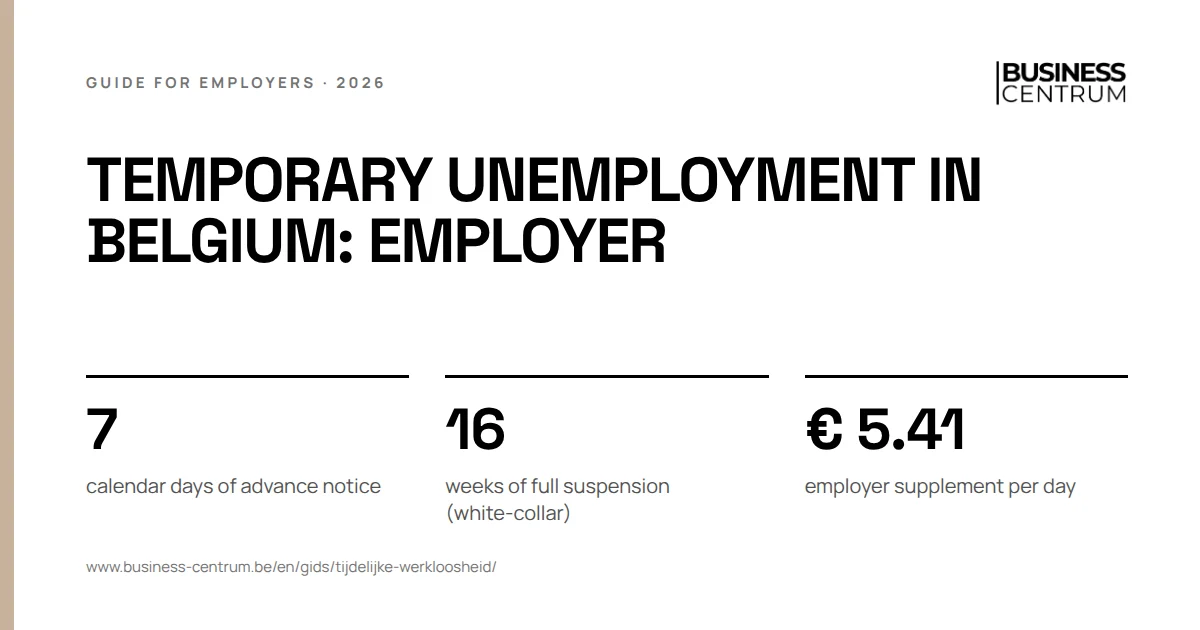
As an employer in Belgium, you can use temporary unemployment for economic reasons when a lack of work temporarily stops you from keeping the normal pace. You notify the workers and the ONEM at least 7 calendar days in advance. The ONEM pays 60% of capped pay, and you pay a supplement of € 5.41 a day.
When can you use temporary unemployment for economic reasons?
Your staff stay employed, but their contract is suspended in full or in part. This lets you avoid dismissals during a low season, a drop in orders or the loss of a client. The ONEM, the federal unemployment office (RVA in Dutch), sets three conditions for the lack of work:
- It has an economic cause. Renovation work, repairing or servicing a machine, poor organisation or mismanagement do not count.
- It is temporary. If you put the same people on unemployment month after month, the ONEM can treat it as structural and refuse it from a certain date.
- It is beyond your control. If the work your own staff normally do is handed to third parties during the suspension, you pay normal wages for those days.
You state the economic cause in the notice to the ONEM and declare that you will not hand the work to third parties. If in doubt, the director of the local ONEM office will look at your figures.
Blue-collar and white-collar staff fall under two different systems. Blue-collar workers follow article 51 of the Employment Contracts Act, with a maximum duration per scheme. White-collar staff follow a system for companies in difficulty, with an allowance per calendar year and preconditions.
Temporary unemployment for economic reasons: blue-collar workers
For blue-collar workers you choose one of three schemes, depending on how many days are still worked.
| Scheme | What it means | Maximum duration |
|---|---|---|
| Full suspension | No working days at all | 4 weeks, then a mandatory working week |
| Large suspension | Fewer than 3 working days a week, or less than 1 working week in 2 | 3 months, then a mandatory working week |
| Small suspension | At least 3 working days a week, or at least 1 working week in 2 | 12 months, with an end date in the notice |
Once the maximum is reached, you first reinstate a full working week: 7 consecutive calendar days in which the worker works normally. Public holidays, annual leave, compensatory rest and sickness count as worked. Bad weather and a collective closure for annual holidays do not: the working week is then extended.
If unemployment runs past the maximum duration or past the end date in your notice, you pay wages for the extra days. Sickness does not extend the scheme. You can expressly exclude a collective holiday closure in the notice, as long as the total suspension stays within the maximum.
Part-time workers follow the scheme of their department. The maximum depends on the full-time colleagues' schedule, not on the worker's own part-time schedule.
Economic unemployment for white-collar staff: the conditions
For white-collar staff the bar is higher. You must meet three conditions at once:
- You fall under the law on collective agreements and joint committees (JC). That covers almost the entire private sector.
- A sector agreement, a company agreement or an approved company plan provides for the measure. Without one, national CLA no. 183 acts as a safety net, from 1 January 2026 to 30 June 2029.
- Your company is in difficulty. You show this through a drop in turnover, production or orders of at least 10% in a quarter compared with the same quarter in one of the two previous years, a temporary unemployment rate among your blue-collar workers of at least 10%, or recognition by the Minister of Employment.
You prove this with form C106A, or its version for companies not liable for VAT. You send it by registered post to the ONEM at least 14 days before your first notice of economic unemployment for white-collar staff. If you rely on a company plan, it goes to the Federal Public Service Employment, where a committee assesses it.
You then work with an allowance per calendar year:
- at most 16 weeks of full suspension;
- or at most 26 weeks of partial work, with at least 2 working days a week;
- if you combine both, two weeks of partial work count as one week of full suspension.
Unlike blue-collar workers, no mandatory working week is needed between two notices. But every calendar week in the notice counts in full against the allowance, even if you call the employee back in between. A notice running from Wednesday to Tuesday therefore costs you two weeks. Start your suspensions on a Monday.
How to apply for temporary unemployment as an employer, step by step
The formalities are largely the same for blue-collar and white-collar staff. Your payroll provider can carry them out for you as your agent.
- Choose the scheme. Full suspension or partial work, with a start and end date. For white-collar staff, form C106A must already be approved.
- Inform the workers at least 7 calendar days before the first day of unemployment. The day of notice and the first day of unemployment do not count. If you give notice on a Monday, unemployment can start on the Tuesday of the following week at the earliest. You post a notice in the workplace or inform each worker individually, also by email or text. State the names or the department, the days of unemployment and the start and end date.
- Send the electronic notice to the ONEM on the same day, for the operating site, not the registered office. You state the economic cause. Only workers with a valid Dimona declaration can be included.
- Inform the works council on the same day, or the union delegation if there is no works council.
- Report the first actual day of unemployment every month for each worker. You can do this on the day itself, the next working day, or at the earliest 5 working days in advance if you are certain. An earlier report counts as no report.
- File a social risk declaration (DRS/ASR) scenario 2 the first time the worker is temporarily unemployed in your company, and give them a copy. They take it to their payment body: their trade union or the public fund CAPAC/HVW.
- File a scenario 5 declaration after each month with the hours of temporary unemployment, and give a copy of that too.
If you later want more days of unemployment, or move from partial work to full suspension, you give a new notice to the workers and the ONEM, again 7 days ahead. You cannot add a worker to a running notice: for that worker you start a new one.
The temporary unemployment control card: eC3.2
Since 1 January 2025, every worker on temporary unemployment fills in the electronic control card eC3.2. You no longer hand out paper cards. Only sheltered workshops (JC 327) may still use the paper C3.2A.
On the eC3.2, the worker records when they work, are sick or take leave. If they work elsewhere during the unemployment, they record it before they start. At the end of the month, they send the card to their payment body, which calculates the benefit from the card and your scenario 5 declaration.
Since 1 March 2026, a new rule applies: after 3 months of temporary unemployment, the worker registers as a jobseeker with VDAB, Actiris, Forem or ADG. If they return to work in full for 2 consecutive weeks, a new period starts. Tell your staff in advance: it is their duty, not yours, but the questions will land on your desk.
What does temporary unemployment cost you as an employer?
You pay no wages for the days of unemployment. The ONEM pays the worker 60% of their average pay, capped at € 3,571.18 a month. Per benefit, that is at most € 82.33 gross. The payment body withholds 26.75% income tax at source on each benefit.
What you pay yourself are the supplements:
| Supplement | Blue-collar | White-collar |
|---|---|---|
| Statutory supplement | At least € 2 per day of unemployment, often through a sector fund | At least € 5 a day, € 6.74 under CLA no. 183 |
| Extra supplement since 2024 | € 5.41 a day | € 5.41 a day |
The extra supplement offsets the cut in the benefit to 60%. If the worker earns at most € 4,284 gross a month, they get it from the first day. If they earn more, only from the 27th day of temporary unemployment with you in the same calendar year. If a collective agreement places payment on a subsistence security fund, the fund pays, not you. If a collective agreement guarantees your staff a percentage of their pay during temporary unemployment that gives them at least as much as the extra supplement, the extra supplement is not due.
Heavy use adds a further cost. If a blue-collar worker has more than 110 days of temporary unemployment for lack of work in the reference period, you pay the NSSO a responsibility contribution.
Worked example: a blue-collar worker fully suspended for four weeks
A worker works 38 hours a week and earns € 3,800 gross a month. That is above the ceiling, so they receive the maximum benefit. You suspend them fully for four weeks: 20 working days or 152 hours.
- Number of benefits. The ONEM calculates hours x 6 / weekly hours: 152 x 6 / 38 = 24 benefits.
- What the ONEM pays. 24 x € 82.33 = € 1,975.92 gross. After 26.75% tax at source (€ 528.56), € 1,447.36 remains.
- Extra supplement paid by you. Their pay is below the threshold, so from day one: 24 x € 5.41 = € 129.84.
- Statutory supplement. Without a sector fund, at least 20 x € 2 = € 40.
In this example you pay around € 170 instead of a full month's wages plus employer NSSO contributions. The worker receives about € 1,617 in total: the net benefit plus your supplements, on which tax is still due. Tell them in advance: the gap with their usual net pay is large, and they would rather hear it from you than from their union.
Public holidays are handled separately. A public holiday can never be reported as a day of unemployment. For blue-collar workers, you pay the public holidays that fall within the unemployment period. For white-collar staff, you pay the public holidays within the first 14 days after the suspension starts.
Sector rules: construction (JC 124) and transport (JC 140)
Construction. Blue-collar workers in construction fall under their own royal decree. The maximum duration is the same, but for a full suspension the notice must be given at least 4 working days in advance. Saturday counts as a working day, Sunday does not, and the day of notice counts: post the notice on Monday and unemployment can start on Friday at the earliest. For partial work it stays at 7 calendar days. Bad weather is a separate scheme, with no advance notice and a monthly report of the first day of bad weather. The supplementary allowance for blue-collar workers in construction runs through the sector's subsistence security fund. The sector rules by category are in our guide to JC 124.
Transport. Drivers and warehouse staff in transport and logistics follow the general scheme for blue-collar workers. Only removal firms (JC 140.05) have their own royal decree, with different rules for partial work. One practical point: for a lorry driver with a fixed parking base, you give the address of that base as the place of work. If your white-collar staff work in logistics or freight forwarding, they often fall under JC 226. Check in our guide to JC 226 whether your sector has its own scheme for economic unemployment of white-collar staff; otherwise CLA no. 183 applies.
Temporary unemployment due to force majeure is something else
Temporary unemployment due to force majeure requires an event that is unforeseeable and unavoidable, beyond your control, and makes work temporarily impossible. A fire, a flood, a power cut across the whole area. A shrinking order book is never force majeure, even if it drops suddenly.
The differences are significant:
- the benefit for force majeure is 65% instead of 60%;
- there is no extra supplement for the employer to pay;
- there is no 7-day notice period and the law sets no reporting procedure, but you should report it electronically as soon as possible and submit a file with evidence, so your staff are paid sooner;
- the ONEM decides case by case, possibly after an investigation.
For a worker who can no longer do their job because of illness, there is medical force majeure. That is a separate procedure through the occupational physician, explained in our guide to medical force majeure.
Which mistakes do employers make most often?
- Reporting the first day too early. More than 5 working days in advance counts as no report. No benefit for that month, and you pay wages.
- Not using up compensatory rest first. Full days of compensatory rest after overtime or Sunday work must be taken before unemployment. Rest days from a reduction in working hours need not be.
- Reporting half days. Temporary unemployment only exists for a full working day. If someone works in the morning, the afternoon is not unemployment.
- Forgetting the end date. For blue-collar workers, the end date in the advance notice still applies, even if you call people back earlier. To avoid the mandatory working week, stop the running notice in advance.
- Misjudging dismissal during the suspension. Notice you give does not run during the suspension. A blue-collar worker may, however, leave without notice during a running suspension.
What Business Centrum does for you
We check whether your lack of work qualifies as economic, prepare form C106A for white-collar staff and send the notices to the ONEM on time. The monthly first-day reports and the scenario 2 and scenario 5 declarations run with your payroll, together with Acerta. Each month you see what the supplements cost you. If you want us to follow this up together with your leave and absences, we set it up before you report the first day of unemployment.