
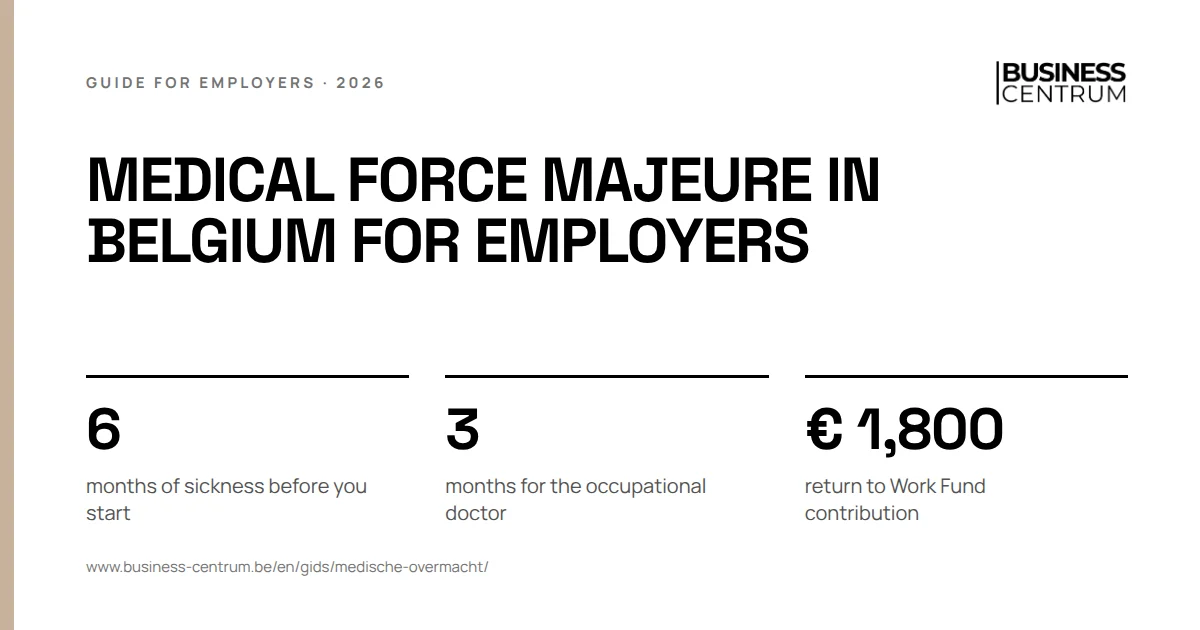
Medical force majeure ends the contract of an employee who can permanently no longer do his agreed work, with no notice or pay in lieu. In Belgium an employer can start the procedure after 6 months of uninterrupted sickness, down from 9. The occupational doctor decides within 3 months. You pay € 1,800 to the Return to Work Fund.
Medical force majeure in Belgium: what it is and when an employer can use it
Medical force majeure is not a dismissal. The contract ends because the employee can permanently no longer perform the agreed work. Only the prevention adviser-occupational doctor can establish that, through a fixed procedure in Article 34 of the Employment Contracts Act and the Code on Well-being at Work. A note from the GP or a specialist is not enough.
The procedure can only start when two conditions are met:
- the employee has been unfit for work without interruption for at least 6 months;
- no return-to-work process is running with the occupational doctor at that moment.
A return to work breaks that period, unless the employee falls ill again within 14 days. An attempt to come back half-time that fails after a week therefore does not count. A return of a month does reset the counter to zero.
The 6-month period has applied since 1 January 2026. Until the end of 2025 you had to wait 9 months. Many employers, and even some advice pages, still use the old period and lose three months. What else changed for sick employees is in our news item on the 2026 return-to-work rules.
The medical force majeure procedure: the timeline in days
An example. A white-collar employee falls ill on Monday 5 January 2026 and never returns. The employer starts the procedure. All the dates below follow from the legal deadlines.
| Moment | Date in the example | What happens |
|---|---|---|
| Day 1 | Mon 5 January 2026 | Sick report, certificate, guaranteed salary starts |
| After 4 weeks | 2 February 2026 | You report the sickness to the occupational doctor |
| After 30 days | 4 February 2026 | The health insurance fund takes over |
| After 8 weeks | 2 March 2026 | You can request an assessment of work potential |
| After 6 months | Mon 6 July 2026 | You send the registered notice |
| 3rd working day after posting | Thu 9 July 2026 | The notice counts as received |
| 10 calendar days later | from 19 July 2026 | Earliest examination by the occupational doctor |
| At the latest 3 months after receipt | by 9 October 2026 | The occupational doctor sends his finding by registered post |
| In the example | received Thu 13 August 2026 | Finding: permanently unfit |
| 7 calendar days | until 20 August 2026 | The employee can still ask for adapted work |
| 21 calendar days | until 3 September 2026 | The employee can appeal |
| No request, no appeal | Fri 4 September 2026 | You end the contract for medical force majeure |
| Last day | Fri 4 September 2026 | C4 to the employee |
| 45 calendar days after the end | by 19 October 2026 | Report and pay € 1,800 to the Return to Work Fund |
Without a request for adapted work and without an appeal, this example therefore takes a little under eight months from the first sick day to the end of the contract. If the employee asks for adapted work, add up to 6 months. If he appeals, everything moves back until the appeal decision is in.
If your company has 20 employees or more and the occupational doctor found work potential, you had to start a return-to-work process within 6 months. While that process runs, the medical force majeure procedure cannot begin.
How an employer runs the medical force majeure procedure, step by step
- Check the conditions. Count the sickness period on the certificates. If there were returns to work, check whether they lasted less than 14 days. Ask your prevention service whether a return-to-work process is running.
- Send the notice by registered post. One copy to the employee, one to the occupational doctor of your external prevention service. An email or a conversation is not enough.
- State the employee's two rights. The letter must say that he can ask the occupational doctor to look into adapted or other work, and that he may be assisted by the trade union delegation. Without them, the procedure is on shaky ground.
- Let the occupational doctor do his job. He invites the employee at least 3 times, with 14 calendar days between invitations. If the employee does not turn up, the procedure ends without a result.
- Wait for the finding. The occupational doctor sends it by registered post to you and the employee, at the latest 3 months after the notice.
- Wait for the employee's deadlines. He has 7 calendar days to still ask for adapted work and 21 calendar days to appeal.
- End the contract in writing. Refer to the occupational doctor's finding and its date. Hand over the C4 and report the exit in Dimona.
- Pay the Return to Work Fund. Within 45 calendar days you report the end to the Fund and pay € 1,800.
Model letter: starting the procedure
Send this letter by registered post to the employee and a copy by registered post to the occupational doctor. In Flanders the letter must be in Dutch; use this text as a guide to its content.
Re: notice of the start of the special medical force majeure procedure (Article 34, Employment Contracts Act)
Dear Sir or Madam,
You have been unfit for work without interruption since [date of first sick day]. With this letter we inform you of our intention to examine whether it is permanently impossible for you to perform the agreed work as [job title], under the special procedure in Book I, Title 4, of the Code on Well-being at Work. A copy of this letter goes to Dr [name], prevention adviser-occupational doctor at [external service].
You have the right to ask the prevention adviser-occupational doctor to examine the options for adapted or other work, if he finds that you can no longer perform the agreed work.
You have the right to be assisted by the company's trade union delegation during this procedure.
The occupational doctor will invite you for an examination. For questions, please contact [name of contact person, telephone].
Yours faithfully, [name, position, signature]
Model letter: ending the contract
Re: end of the employment contract for medical force majeure
Dear Sir or Madam,
The finding of the prevention adviser-occupational doctor of [date], which you received on [date], shows that it is permanently impossible for you to perform the agreed work. [You did not ask for adapted or other work to be examined. / On [date] we sent you and the occupational doctor a reasoned report explaining why adapted work is not possible. / You refused the return-to-work plan of [date].] No further appeal against this finding is possible.
We therefore record that your employment contract ends on [date] because of medical force majeure. You will receive your final settlement, your C4 and your other social documents.
Yours faithfully, [name, position, signature]
Download both letters in Word and PDF, in Dutch and French.
What if the occupational doctor suggests adapted work?
If the employee asks for adapted or other work to be examined, during the examination or within 7 calendar days of the finding, the occupational doctor records the conditions on the form. He does so at the latest 30 calendar days after the request. For example: no lifting above ten kilos, no night work, seated work with breaks.
Then it is your turn. You must seriously examine whether such work exists in your company, within 6 months of the finding. There are two possible outcomes:
- Adapted work exists. You draw up a return-to-work plan with the employee and the occupational doctor. A driver who may no longer drive could, for instance, move to planning or warehouse administration. If the employee accepts the plan, the contract continues with the new work. If he refuses, you send the refused plan to him and to the occupational doctor. Only then can you invoke medical force majeure.
- No adapted work exists. You write a reasoned report on why a plan is technically or objectively impossible, or cannot reasonably be required for well-founded reasons. You send it to the employee and the occupational doctor. After that you can invoke medical force majeure.
A two-sentence report will not hold up. Describe which jobs you looked at, why they do not fit the doctor's restrictions and which adjustments you considered. If the employee is left with a disability, you must also examine reasonable accommodations.
The employee's appeal
If the employee disagrees with the finding, he sends a registered appeal within 21 calendar days to the medical social inspector of the Federal Public Service Employment. He must also inform you. During the appeal, the procedure is on hold.
The medical social inspector consults the occupational doctor and the treating doctor. They decide by majority; without agreement, the medical social inspector decides. He sends the decision by registered post no later than 42 calendar days after the day he received the appeal. If permanent unfitness is confirmed, the procedure continues. If not, it ends with no effect. A new procedure is only possible after another 6 months of uninterrupted sickness, counted from the day after the decision is received.
Medical force majeure: outplacement, end-of-year bonus and other costs
No notice, no pay in lieu of notice. That is the big difference with dismissing a sick employee. For a white-collar employee with ten years' service, the gap quickly runs to tens of thousands of euros.
The Return to Work Fund replaces outplacement. Until 1 April 2024, an employer invoking medical force majeure had to offer outplacement. That rule is gone. You now pay € 1,800 to the Return to Work Fund of the National Institute for Health and Disability Insurance (RIZIV/INAMI), within 45 calendar days of the end. As a recognised incapacitated worker, the employee can ask the Fund for a contribution to buy tailored support from an approved provider. If you do not pay or report, you risk a level 2 sanction. As an administrative fine, that is € 250 to € 2,500. If the employee invokes medical force majeure himself, or you agree the end together, you pay nothing to the Fund. When outplacement is still compulsory on an ordinary dismissal is explained in our blog on outplacement.
Holiday pay. A white-collar employee receives leaving holiday pay: 15.34% of gross pay for the current year, increased by a notional salary for assimilated days such as sickness. If he has not yet taken this year's leave, leaving holiday pay on last year's pay is added, minus what you already paid of it. A blue-collar worker receives his holiday pay from the holiday fund.
End-of-year bonus. There is no general statutory rule. Your sector agreement decides whether an employee gets a pro rata bonus when the contract ends for medical force majeure, and how far sickness counts. Read the collective agreement of your joint committee (JC) before you prepare the final settlement. A bonus the agreement grants and you forget can still be claimed by the employee.
Guaranteed salary. After 6 months of sickness you no longer pay salary. The guaranteed salary only covered the first 30 days, see our guide on guaranteed salary.
Mistakes employers make
- Starting too early. Sending the notice after four or five months starts an invalid procedure. Count the months on the certificates.
- Starting during a return-to-work process. Check first with your prevention service that no process is running.
- Forgetting the two rights. The employer's notice must state the right to adapted work and the right to union assistance.
- Ending too quickly. Wait for the deadlines for adapted work and appeal. Ending the contract on the day the finding arrives is too early.
- An empty report on adapted work. Explain job by job why it does not work.
- Forgetting the Return to Work Fund. The 45-day deadline runs from the end of the contract, even if the employee asks for nothing.
Not sure whether dismissal with notice or an agreement is quicker or cheaper? Read our blog on dismissing an employee on sick leave. The papers to hand over at the end are listed in social documents at the end of employment.
What Business Centrum does for you
Business Centrum tracks sickness periods in your payroll administration, together with Acerta. We flag when the 6-month mark is reached, prepare the notice and the closing letter, and produce the final settlement, the C4 and the Dimona exit. We also schedule the report to the Return to Work Fund. Absences are handled through our leave and absence service.