
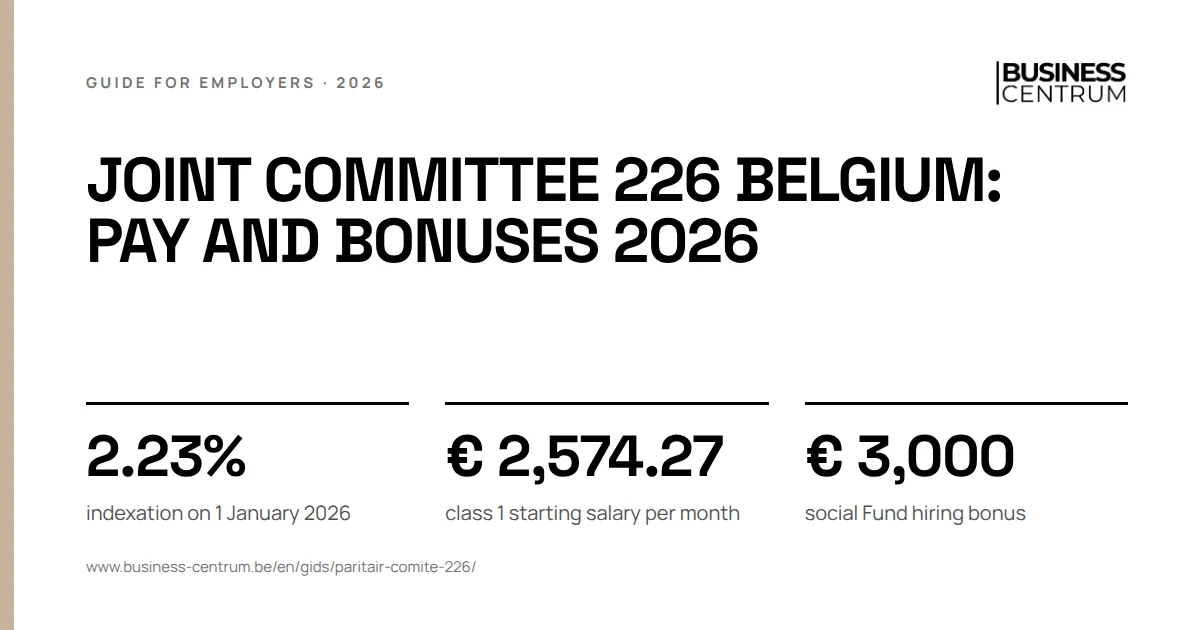
Joint committee 226 in Belgium covers white-collar employees of companies in international trade, transport and logistics. Since 1 January 2026, the pay scales have been indexed by 2.23%: a full-time employee in class 1 with no experience earns at least € 2,574.27 gross per month. Notice periods follow the general law, with no sector rules.
Who falls under joint committee 226?
JC 226 covers workers who mainly do intellectual work in companies whose main activity is international trade, transport for third parties, transport intermediaries, port activities or logistics for third parties. White-collar staff of removal companies working for third parties also fall under it.
In practice this means planners, dispatchers, customs declarants, freight forwarding clerks, customer service and accounts staff in a transport, forwarding or logistics company. The drivers and warehouse staff of the same company do not fall under JC 226 but under joint subcommittee 140.03 for road haulage and logistics. A haulier with ten drivers and three people in the office therefore applies two committees with two pay systems: hourly wages for blue-collar workers, monthly salaries for white-collar staff.
Three situations fall outside JC 226, even if the activity looks similar:
- a manufacturer that imports or exports itself falls under its own sector's committee for its white-collar staff;
- a wholesaler that transports its own goods usually stays in JC 200 for its white-collar staff;
- travel agencies and tour operators are expressly excluded, as are white-collar staff who fall under the committee for the port business or for commercial aviation.
The NSSO lists the joint committee on your identification record, but that entry is not decisive. What counts is your actual main activity. If in doubt, first read our explanation of how a joint committee is determined.
The 2026 pay scale in JC 226: minimum salaries by class
JC 226 scales are monthly salaries for a full-time schedule as it applies in your company. Part-time employees receive a proportional share. The table shows the amounts since 1 January 2026 for four seniority steps.
| Class | 0 years | 6 years | 15 years | 25 years |
|---|---|---|---|---|
| 1 | € 2,574.27 | € 2,715.70 | € 2,841.09 | € 2,933.10 |
| 2 | € 2,810.29 | € 2,952.16 | € 3,365.61 | € 3,769.75 |
| 3 | € 2,966.08 | € 3,141.30 | € 3,571.26 | € 3,953.89 |
| 4 | € 3,121.99 | € 3,297.06 | € 3,726.77 | € 4,109.63 |
| 5 | € 3,278.19 | € 3,452.82 | € 3,892.29 | € 4,260.85 |
| 6 | € 3,433.99 | € 3,656.05 | € 4,128.48 | € 4,497.29 |
| 7 | € 3,589.89 | € 3,850.02 | € 4,492.51 | € 4,861.01 |
| 8 | € 3,755.40 | € 4,322.40 | € 4,903.53 | € 5,343.02 |
The scale runs up to 45 years of seniority. Class 1 ends there at € 3,070.79, class 8 at € 5,960.82. That last amount is the final salary of class 8, which matters for indexation below.
Students receive at least 90% of the class 1 salary with no seniority.
The scale is a minimum. If you pay more, that is the actual salary, and the actual salary also follows the sector indexation.
How does job classification work in JC 226?
The sector groups jobs into eight classes. Class 1 is the simplest job, class 8 the most demanding. The collective agreement on classification contains reference jobs that help you place a role. You look at what the work involves, not at the title on the contract.
Three sector rules that employers often miss:
- The highest job counts. An employee who regularly carries out tasks from different classes receives the salary of the highest class he performs.
- Promotion applies immediately. Someone who moves to a higher class gets the matching salary at once.
- Big jumps are phased. If someone moves up at least two classes with the same employer or within the same group, a transition rule applies. For two classes he reaches the new class after 1 year, in two steps. For five classes or more it takes 4 years, in five steps. His scale seniority keeps running.
A planner you classed as an "assistant" in class 2, but who plans routes on his own and follows up customers, is probably one or two classes higher. With six years' seniority, the gap between class 2 and class 4 is € 2,952.16 against € 3,297.06 per month. In a labour inspection or a dispute, the employee claims that difference back with retroactive effect.
Indexation in joint committee 226
Minimum and actual salaries rise every year on 1 January. The sector divides the smoothed health index of December by that of December a year earlier. A negative result does not reduce pay, it is offset against the next positive indexation.
| Indexation on 1 January | Percentage |
|---|---|
| 2026 | 2.23% |
| 2025 | 3.58% |
| 2024 | 1.13% |
| 2023 | 11.19% |
Worked example. At the end of 2025 a dispatcher earned an actual salary of € 3,500.00, above his scale. On 1 January 2026 it rises by 2.23%: 3,500.00 x 1.0223 = € 3,578.05 gross per month.
The sector limits the indexation of actual salaries to the final salary of class 8, € 5,960.82. An employee earning more only receives the indexation on that amount, unless your company agreed something better.
Since 1 June 2026 the cent index applies on top. For a reference salary above € 4,000 per month, indexation is temporarily capped: 2% on the threshold, and the percentage above that on the full salary. In JC 226 the rule bites for the first time with the January 2027 indexation. Had it applied in January 2026, an employee on € 4,500.00 would have received not € 100.35 but € 80.00 plus 0.23% on € 4,500.00, or € 90.35 in total. You pay half of that saving, plus the contributions on it, to the NSSO as a special wage moderation contribution. More in our piece on the cent index.
Beyond indexation there is no room for pay rises in 2025 and 2026: the wage norm is set at 0%. Only a higher employer share in the meal voucher was legally allowed on top, and the sector agreement applied it in two steps. It also updated the commuting allowances and the hiring premium.
Year-end bonus in joint committee 226
Every employee in JC 226 is entitled to an annual bonus equal to the pay for the month in which you pay it. Unless your company provides otherwise, the reference year is the calendar year and you pay the bonus at the end of the year.
- Full entitlement for anyone employed on the payment date who actually worked the whole year.
- Pro rata: someone who started during the year or did not work all year receives one twelfth per full month worked.
- On leaving, the employee receives his pro rata share on dismissal by you, resignation, force majeure or mutual agreement. The right lapses on dismissal for serious cause and for any termination in the first 6 months. Temporary agency work immediately before, in the same job, counts towards that period.
- Treated as worked are holidays, public holidays, short leave, temporary unemployment, maternity leave, birth leave and the first 30 days of sickness or non-work accident, among others.
For an employee with a fixed and a variable part, the bonus is the fixed part plus the monthly average of the variable part over the previous twelve months.
Since 2026 you may convert up to 60% of the fixed part of the year-end bonus into an equivalent benefit, compared with 50% before. This requires a company collective agreement and an individual agreement with the employee. Both sides take part voluntarily, and you inform the employee in advance about the consequences. The requirement that the benefit relate to wellbeing or mobility was dropped in 2026.
Meal vouchers and eco vouchers in joint committee 226
Meal vouchers. Since 1 January 2016 every company has had to raise its meal vouchers by € 1 employer contribution per day worked, or introduce them at that amount. The 2025-2026 agreement raises the employer share twice by € 1, unless your company agreed otherwise:
| From | Maximum employer share |
|---|---|
| 1 February 2026 | € 7.91 |
| 1 December 2026 | € 8.91 |
The employee pays at least € 1.09 per voucher. If you already granted an increase in 2026, you may deduct it from the sector increase. If a field employee receives a meal allowance instead of vouchers, you may instead raise that allowance by € 1 on each of the same dates. What the new maximum voucher means for your payroll cost is covered in our piece on the new maximum meal voucher.
Eco vouchers. Every employee receives € 250 per calendar year in eco vouchers, handed out early December, with at most € 10 per voucher. You may convert that amount into another benefit through a written company agreement, as long as the total cost per employee per year does not exceed € 250. Without such an agreement, they remain eco vouchers. There is no national abolition of eco vouchers.
JC 226 Social Fund and Logos: what can you claim back?
The JC 226 Social Fund pays grants that many employers miss.
- Hiring bonus. If you hire on a permanent contract an employee who was dismissed by another JC 226 employer, the Fund pays € 3,000 for a full-time hire from 1 January 2026. For an earlier hire it was € 2,808. Dismissal in the first six months or for serious cause does not count. Part-time work, at least half-time, gives a proportional share. There is also a grant for hiring certain young people from at-risk groups.
- Training through Logos. Each year you can claim back up to 0.20% of your payroll in training costs. For an approved Logos course the contribution is € 20 per person per training hour.
- Sector pension. The Fund also manages the supplementary pension. It costs you 1% of the employee's NSSO pay in total.
In return there is a training obligation. Below 10 employees there is no individual training right. Above that and below 20 employees it is 1 day per year for a full-time employee. From 20 employees it is 3 days per year since 2025 and 4 days from 2027, with an annual training plan.
Commuting in JC 226
JC 226 has its own transport scheme, more generous than the national one.
- Train, tram, bus and metro: you pay 100% of the season ticket, or 80% if your company has a third-payer agreement.
- Own car or motorbike: a monthly flat rate based on a distance table. That table rose once in 2026 by 5.80%. For a 10 km single journey this gives € 35.49 x 1.058 = € 37.55 per month.
- Bicycle: € 0.30 per kilometre, against € 0.27 until the end of 2025. For the same distance the employee cannot combine the cycling allowance with another contribution.
Notice and flexi-jobs in joint committee 226
JC 226 has no notice periods of its own. You apply the statutory table, which changed twice in 2026. For contracts starting from 1 August 2026, notice in the first six months is 1 week. After one year of service it is 8 weeks. For contracts starting from 1 June 2026, notice is capped at 52 weeks. The full table and a worked example are in our guide on the employer's notice period.
Flexi-jobs were not allowed in JC 226 until the general extension of 2026. Since 1 July 2026 they are in principle possible across the private sector, and JC 226 is not among the excluded sectors. The flexi base wage is at least the scale for the job, converted to an hourly rate, and at most 150% of it. The employee receives 7.67% flexi holiday pay on top, and you pay a special contribution of 28%. A flexi-jobber in a critical port role or with an airport badge needs a positive security clearance, just like a permanent employee. The conditions on the worker's side are in our piece on flexi-jobs in all sectors.
Worked example: what does a class 4 planner cost?
A full-time planner, class 4, six years' seniority, on the minimum scale of € 3,297.06 per month. Annual cost in 2026, with 220 days worked:
| Item | Calculation | Amount |
|---|---|---|
| Twelve monthly salaries | 12 x 3,297.06 | € 39,564.72 |
| Year-end bonus | one monthly salary | € 3,297.06 |
| Double holiday pay | 92% of a monthly salary | € 3,033.30 |
| Employer NSSO | 25% on 42,861.78 | € 10,715.45 |
| Sector pension | 1% on 42,861.78 | € 428.62 |
| Eco vouchers | per year | € 250.00 |
| Meal vouchers | 220 x 7.91 | € 1,740.20 |
| Total | € 59,029.35 |
That is over € 4,900 per month for a gross salary of € 3,297.06. The structural reduction, sector fund contributions and occupational accident insurance are not included. From December the higher employer share of the meal vouchers also applies.
Mistakes we often see in JC 226
- Employees in the wrong committee. A haulier that declares its office staff in JC 200 misses the sector rules on year-end bonus, transport and meal vouchers.
- Class too low. Job titles stay the same while the work grows. The employee gets the class of the highest job he regularly performs.
- Actual salaries not indexed. The sector indexes not only the scale but also the pay you give above it, up to the final salary of class 8.
- Hiring bonus not claimed. Anyone who hires a dismissed employee from the sector leaves € 3,000 on the table without the form.
- Pro rata bonus forgotten on leaving. Even an employee who resigns after six months is entitled to his twelfths.
What Business Centrum does for you
For haulage companies in East Flanders, Business Centrum processes the pay of drivers in JC 140.03 and employees in JC 226 in a single payroll administration, together with Acerta. We place your employees in the right class, apply the January indexation and the meal voucher increases, and claim the Social Fund grants for you. See also what we do for the transport sector.