
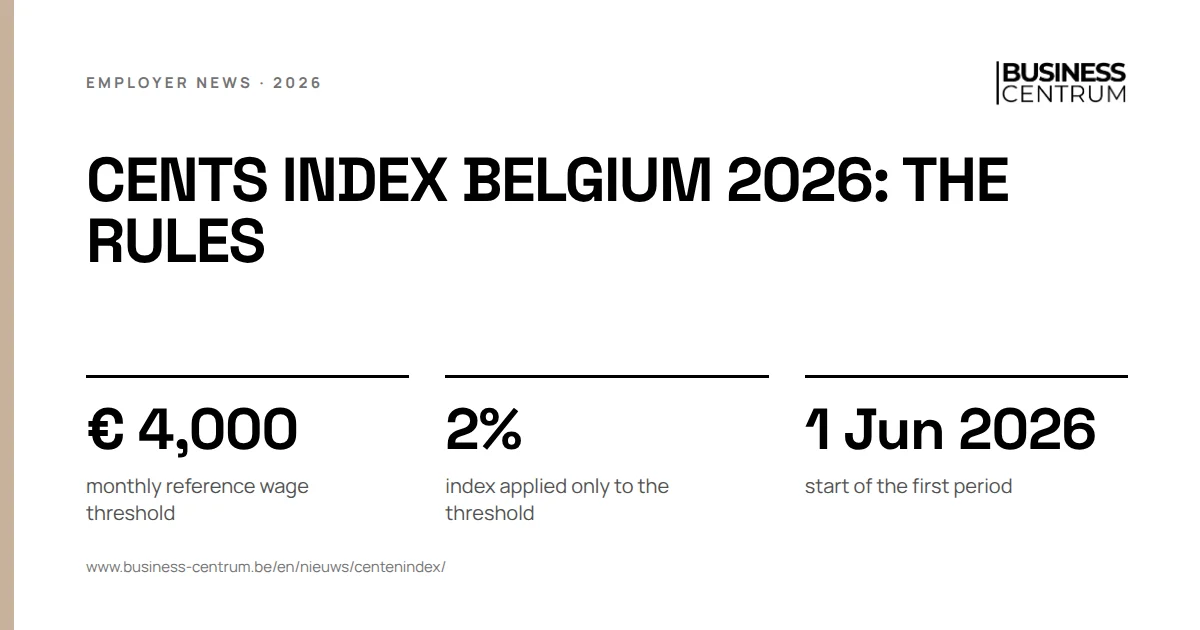
Since 1 June 2026 Belgium's cents index has limited the indexation of higher wages. For a full-time reference wage above € 4,000 gross a month, the first 2% of indexation is only calculated on € 4,000, then on the full wage again. In the meantime you pay a special contribution to the NSSO: half the saving, plus the contributions on it.
How does the cents index work?
The measure comes from the programme law of 30 May 2026. It does not change your sector's indexation system, only the amount the index is applied to.
- Which wage counts: the reference wage, meaning the fixed monthly base wage under the pay scale or contract, converted to full-time. For an hourly wage: hourly wage x full-time weekly hours x 13 / 3.
- What does not count: overtime pay, meal vouchers, bonuses, the year-end bonus, eco vouchers, profit bonuses and premiums for night or weekend work.
- When: moderation starts with your sector's first indexation from 1 June 2026. Only when the sum of indexations since then reaches 2% is the full wage indexed again.
- How often: a first period now, a second from 1 January 2028. That date may still move.
- No way round it: employer and employee cannot depart from the rule. Full indexation remains a pay rise outside indexation.
The reference wage is assessed at the moment the index is applied. Anyone earning € 4,000 or less at that point gets the full index.
Calculating the cents index: an example at 4,500 euros
A white-collar employee in JC 209 has a reference wage of € 4,500 a month. On 1 July 2026 the sector indexes by 2.81%.
| Without cents index | With cents index | |
|---|---|---|
| Index on the first € 4,000 | 4,000 x 2% = € 80.00 | |
| Rest of the index on the full wage | 4,500 x 0.81% = € 36.45 | |
| Total index | 4,500 x 2.81% = € 126.45 | € 116.45 |
| New monthly wage | € 4,626.45 | € 4,616.45 |
The employee loses € 10 gross a month: 2% on the part above € 4,000. Because the July index was above 2%, moderation is complete for them straight away. The next index applies to the whole wage again, until the second period.
If the sector index is below 2%, moderation spreads over several indexations. In JC 202 the same employee received not € 45 but € 40 on 1 July 2026, and the next 1% index will still apply only to € 4,000.
What do you pay the NSSO?
You do not keep the whole saving on pay. While the moderation period runs, you pay a special wage moderation contribution every month for each employee. The NSSO calculates it like this:
- Part A: (moderated reference wage minus € 4,000 x (1 + index)) x work fraction x index, with the index capped at 2%.
- Part B: part A x your overall employer contribution rate.
- Contribution: (part A + part B) / 2.
For the full-time JC 209 employee, with 25% employer contributions:
- Part A: (4,616.45 minus 4,112.40) x 0.02 = € 10.08
- Part B: 10.08 x 0.25 = € 2.52
- Contribution: (10.08 + 2.52) / 2 = € 6.30 a month
You save € 10 in pay and € 2.50 in employer contributions, and pay € 6.30 of that to the NSSO. You calculate the contribution per month and per employment line and declare the total per quarter in the DmfA return.
When does the cents index apply in 2026, per joint committee?
The cents index bites at your sector's first indexation after 1 June 2026. For our clients' committees:
| Joint committee | First indexation with the cents index | Index |
|---|---|---|
| 314 hairdressing and beauty | 1 June 2026 | 2% |
| 124 construction | 1 July 2026 | 1.10% |
| 111 metalworking, blue-collar | 1 July 2026 | 2.81% |
| 209 metalworking, white-collar | 1 July 2026 | 2.81% |
| 121 cleaning | 1 July 2026 | 2.07% |
| 202 food retail | 1 July 2026 | 1% |
| 200 white-collar staff | 1 January 2027 | not yet known |
| 226 transport white-collar staff | 1 January 2027 | not yet known |
| 140.03 road haulage | 1 January 2027 | not yet known |
| 302 hospitality | 1 January 2027 | not yet known |
| 119 food trade, blue-collar | 1 January 2027 | not yet known |
| 112 garages | 1 February 2027 | not yet known |
| 201 independent retail | at the sector's next index step | 2% |
JC 201 last indexed on 1 May 2026, before the start. Its next step only comes when the two-month average of the smoothed health index rises 2% above the sector's pivot. That sector pivot is separate from the pivot index of 102.29 points for benefits and public-sector pay. In construction it is mainly foremen and site supervisors who exceed the threshold, because their hourly wage is converted over a full construction week.
What should you do now?
- List each employee's full-time reference wage and flag those above € 4,000.
- Note the date of the first sector index after 1 June 2026 and track the sum of indexations per employee.
- Include the special contribution in your payroll budget until the moderation period ends.
- Explain to the employees concerned why their index is lower. On the payslip it looks like a mistake.
Your sector's indexation percentages this year are in our overview of wage indexation in 2026. For white-collar staff in the auxiliary committee, see our guide to joint committee 200.
What Business Centrum does for you
Business Centrum applies the cents index automatically in your payroll administration, together with Acerta. We track how much moderation each employee has already reached, calculate the special contribution for the DmfA and give you a quarterly overview of what the measure costs you.