
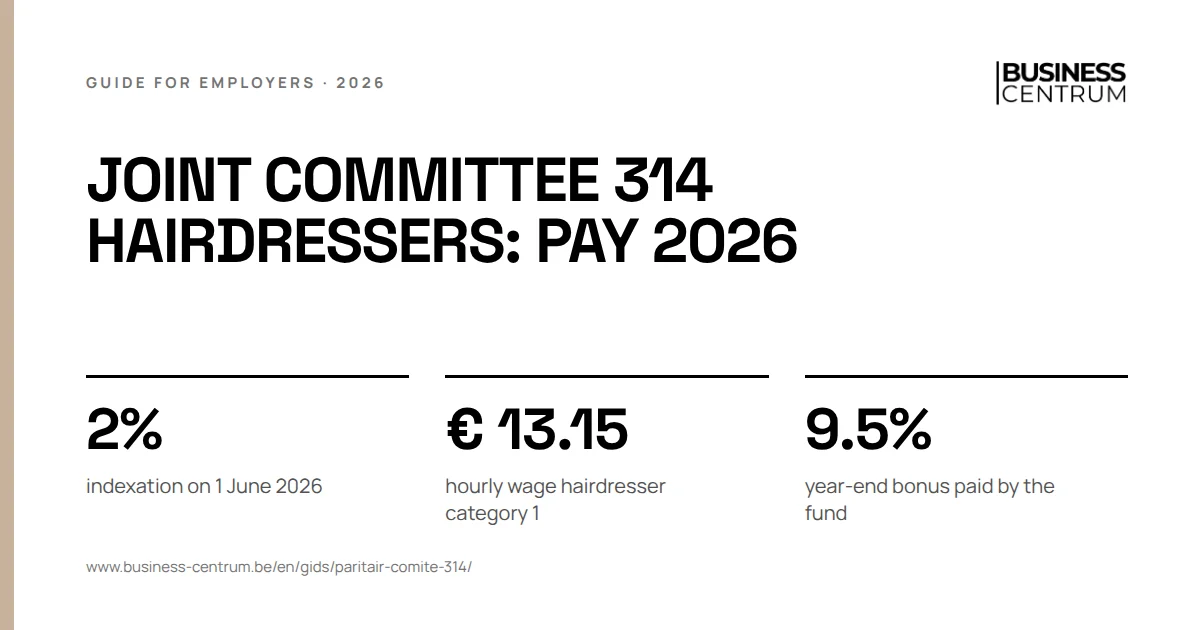
Joint committee (JC) 314 covers hair salons, beauty institutes and fitness centres in Belgium. Since 1 June 2026 all wages have been indexed by 2%: a hairdresser with no diploma or experience earns at least € 13.15 an hour, for a full-time week of 38 hours. The year-end bonus is paid by the sector fund, not the salon.
Who falls under joint committee 314?
JC 314 covers businesses that cut and style hair, provide beauty treatments or run a fitness centre. In practice that means hair salons, barbers, beauty institutes, nail studios, slimming centres and gyms. Administrative staff at those businesses, on reception or in accounts, also fall under JC 314.
What counts is the main activity of your business, not the job title. A hair salon that also sells care products stays in JC 314 as long as cutting and treatments are the core business. A perfume shop with a treatment room at the back is more likely to fall under retail. The NSSO lists a joint committee on your registration, but that entry is not decisive. If in doubt, first read how a joint committee is determined.
JC 314: blue-collar or white-collar?
JC 314 covers blue-collar and white-collar staff together. That keeps things simple, but the status differs by group:
- Hairdressers earn an hourly wage in categories 1 to 4 and are usually blue-collar workers. Category 5, the functional manager, has a monthly wage.
- Beauticians and fitness staff have been white-collar employees since 1 January 2013, on a monthly salary.
- Administrative staff have their own monthly pay scale.
Status determines how you calculate social security and holiday pay. For blue-collar workers you calculate NSSO contributions on 108% of gross pay and the holiday fund pays holiday pay. For white-collar employees you pay single and double holiday pay yourself. Since the single employment status, both groups have the same notice periods.
Which pay scales apply in joint committee 314 after the June index?
The amounts below apply to a full-time employee. Part-timers receive a proportional share.
Hair salons
| Category | Minimum wage |
|---|---|
| 1, entry job | € 13.15 an hour |
| 2, diploma or 6 months' experience | € 16.70 an hour |
| 3, autonomous or 5 years in the sector | € 18.72 an hour |
| 4, operational supervisor | € 20.68 an hour |
| 5, functional manager | € 3,621.64 a month |
| 5, with 10 years in the job | € 3,983.80 a month |
| 5, with 20 years in the job | € 4,340.76 a month |
Beauty institutes
| Category | Minimum monthly wage |
|---|---|
| 1, entry job | € 2,413.45 |
| 2, diploma or 6 months' experience | € 2,562.62 |
| 3, after 2 years in the sector | € 2,682.74 |
| 3, after 5 years | € 2,816.88 |
| 3, after 10 years | € 2,951.01 |
| 3, after 15 years | € 3,085.15 |
| 3, after 20 years | € 3,219.29 |
| 4, operational supervisor | € 3,043.03 |
| 4, after 10 years in the sector | € 3,347.33 |
| 5, functional manager | € 3,283.33 |
| 5, with 10 years in the job | € 3,611.66 |
| 5, with 20 years in the job | € 3,940 |
Fitness centres
| Category | Start | After 20 years |
|---|---|---|
| 1, initiator without diploma | € 2,189.16 | no step |
| 2, initiator with diploma | € 2,322.68 | € 2,787.22 |
| 3, fitness instructor | € 2,681.95 | € 3,218.34 |
| 4, personal trainer | € 2,804.39 | € 3,365.27 |
| 5, specialised personal trainer | € 3,410.53 | € 4,092.39 |
| 6, operational supervisor | € 3,042.23 | € 3,650.68 |
| 7, functional manager | € 3,283.33 | € 3,940 |
Between the start and 20 years there are further steps after 5 and 10 years of sector seniority.
Administrative staff
| Category | Minimum monthly wage |
|---|---|
| 1 | € 2,164.60 |
| 2, under supervision | € 2,298.23 |
| 3, without supervision, after 2 years | € 2,405.90 |
| 3, after 5 years | € 2,513.51 |
| 3, after 10 years | € 2,728.80 |
| 4, operational supervisor | € 2,728.80 |
| 5, functional manager | € 2,944.09 |
| 5, with 10 years in the job | € 3,238.50 |
| 5, with 20 years in the job | € 3,532.91 |
On 3 October 2026 the federal employment ministry's minimum wage database still showed the amounts from 1 December 2025. The June amounts are the December figures multiplied by 1.02. If you pay above the scale, that actual wage also rises with each sector index.
How does the classification of hairdressers work?
The category depends on what the hairdresser can do independently, not on age. Three sector rules salons often miss:
- Category 3 is automatic. A hairdresser moves to category 3 after 5 years of sector seniority at the latest. You can only prevent that if you can show you offered at least 16 hours of training every year and the joint committee's mediation committee grants the exception at your request.
- Evaluation in your salon. Once a hairdresser reaches 3 years' seniority in your salon, you must carry out a written evaluation by the end of the following month at the latest. If you don't, they move to category 3 from the first day of the month after reaching that seniority, unless you both agree in a dated and signed statement that there will be no evaluation. With 3 years in the sector, the hairdresser can also request the evaluation by registered letter.
- Beauticians stay in category 2 for at most 2 years and then move to category 3.
The difference is significant. Category 2 pays € 16.70 an hour, category 3 € 18.72. For a full-time hairdresser that is over € 330 a month. Miss the move and an inspection will make you pay the difference retroactively.
Indexation and the cents index in JC 314
JC 314 does not index on a fixed date. Wages rise by 2% each time the sector's pivot index is exceeded. After 1 January 2025 and 1 December 2025, the next one came on 1 June 2026. Both minimum and actual wages go up.
The June indexation was the first one to which the cents index applies. Since 1 June 2026 that measure covers every wage with a full-time reference wage above € 4,000 a month. The first 2% of indexation then only applies to the threshold of € 4,000. After that the full wage is indexed again.
In JC 314 this currently affects two jobs in particular: the category 5 hairdresser with 20 years in the job and the specialised personal trainer with 20 years' seniority. The hairdresser moved to € 4,340.76 instead of € 4,345.97: the indexation is capped at € 80, or 2% of € 4,000. Because the June index was exactly 2%, the moderation is already complete for these employees. The next index will apply to the whole wage again, until the second moderation period from 1 January 2028.
Commission pay is not part of the calculation base for that contribution. More explanation and an example per sector in our piece on the cents index.
In JC 314, the fund pays the year-end bonus
In JC 314 you do not pay the year-end bonus yourself through payroll. The sector's Subsistence Security Fund (FBZ) pays it, based on the NSSO returns. You finance it through an employer contribution on your NSSO return.
- Amount: 9.50% of the gross pay earned in the reference period.
- Reference period: from 1 July 2025 to 30 June 2026 for the 2026 bonus.
- Condition: more than 32 days worked or treated as worked in that period, and a net bonus above € 25.
- Excluded: dual learning apprentices, trainees, IBO trainees and flexi-job workers.
- Payment: the employee receives a payment slip in early December. They hand it to their union or send it to the fund, which pays from 4 January 2027.
Take a category 3 hairdresser who works a full reference year full-time at the current hourly wage: 1,824 hours x € 18.72 = € 34,147.29. The bonus is then € 34,147.29 x 9.50% = € 3,243.99 gross. The fund withholds social security and payroll tax.
If an employee gets no slip, data is usually missing from the DmfA return. The fund automatically issues a supplementary slip in July of the following year once the NSSO has the data. So check that your quarterly returns are correct and filed on time.
What else does the Subsistence Security Fund pay?
The fund also pays top-ups that employees often don't know about. They apply themselves, but they will ask you.
| Situation | Top-up from the fund |
|---|---|
| Sickness or accident, days 31 to 60 | € 16.50 a day |
| Sickness or accident, days 61 to 150 | € 5.50 a day |
| Temporary unemployment | € 5.50 a day, at most 100 days |
| Childcare, child under 3 | € 11 per childcare day |
| First job after hair or beauty training | € 150 once |
The amounts apply to a full-timer. Part-timers receive a proportional share. For the sickness top-up the fund asks for a copy of the payslip for the first month of incapacity, so you need to be able to supply it quickly.
Training: the annual obligation
Every employer in the sector must offer its staff at least 16 hours of vocational or technical training per calendar year. The training can take place in or outside the business, provided the sector recognises it. The sector training centre Coach and accredited trainers offer such courses.
In practice:
- Choose a recognised course on the fund's website.
- Schedule it in the rota and confirm the invitation in writing.
- Have the employee register attendance with the trainer's QR code.
- Keep the proof. It counts if you later want to postpone category 3.
The employee receives € 75 gross from the fund per full training day, € 37.50 for a half day and € 25 for a recognised trade fair, up to € 750 a year. That allowance comes on top of their wage and costs you nothing extra.
Working hours, overtime and Sunday work
A full-time week is 38 hours. Overtime starts above that limit or above 9 hours a day. Each overtime hour entitles the employee to a 50% premium and time off in lieu. Voluntary overtime is the exception: since 1 April 2026 an employee who has agreed in writing may work up to 360 voluntary overtime hours per calendar year, without time off in lieu. For 240 of those hours no premium is due.
Part-timers often work more than their contract. With a contract under 19 hours a week you may have 3 extra hours a month worked without a premium, from 19 hours 6. From the next extra hour you also pay a 50% premium.
Sunday work is in principle banned in the sector. Hair salons in seaside resorts, health resorts and tourist centres, and fitness centres, may however employ staff on Sundays. In such a salon each employee works at most 39 Sundays a year. For each hour on a Sunday or public holiday you pay a 50% premium, and every employee is entitled to 12 free Sundays a year.
Until 1 June 2026 hairdressers and beauticians could not work after 20:00. Since that date night work is no longer banned in general: if you want staff to work after 20:00, first set those hours in your work rules. Under the sector agreement fitness centres pay a 5% premium for hours between 20:00 and 23:00. Work after 23:00 was banned there until then; have the current conditions checked before you open later.
Work clothes, tools and commission
If you do not provide work clothes and the employee buys and maintains them, you pay € 2.15 per day worked or started. If you provide the clothes but not the cleaning, it is € 1.65 a day. If the work rules or the employment contract expressly leave the choice of clothing free, after a risk assessment, no allowance is due. Protective clothing is always your responsibility: an apron and disposable gloves in a hair salon, a tunic and an apron in a beauty institute.
If you do not provide scissors, clippers and other tools, the hairdresser is entitled to a flat-rate refund of € 560.10 net a year. If they want to use their own tools, they sign a statement every year and the flat rate lapses.
If you pay commission on turnover or product sales, make sure the hourly wage never falls below the category's scale. Commission comes on top of the minimum, it does not replace it.
Flexi-jobs in JC 314
Flexi-jobs are not new in JC 314. The flexi wage has existed in the sector since 1 January 2018. The general extension of 1 July 2026 changed nothing here: JC 314 is not on the list of excluded sectors.
- The basic flexi wage is at least the pay scale for the job and at most 150% of it. Bonuses and premiums do not count towards that ceiling.
- The worker receives 7.67% flexi holiday pay on top.
- You pay a special contribution of 28% on the flexi wage and flexi holiday pay, not ordinary NSSO contributions.
- A flexi-job worker has no right to the year-end bonus or the fund's top-ups.
A flexi hairdresser at category 2 level therefore costs you € 16.70 x 1.0767 x 1.28 = € 23.01 an hour. Who qualifies and how to declare them is on our page about the flexi-job worker.
Notice periods in JC 314
JC 314 has no notice periods of its own. You apply the statutory table, which changed twice in 2026. For contracts starting from 1 August 2026, employer notice in the first six months is 1 week. For contracts starting from 1 June 2026, notice is capped at 52 weeks. The full table is in our guide on employer notice periods.
Worked example: what does a category 3 hairdresser cost?
A full-time category 3 hairdresser on the minimum of € 18.72 an hour. They work 48 paid weeks of 38 hours, or 1,824 hours. Their holidays are paid by the holiday fund.
| Item | Calculation | Amount |
|---|---|---|
| Gross pay | 1,824 x 18.7211 | € 34,147.29 |
| Employer NSSO | 25% on 108% of pay | € 9,219.77 |
| Blue-collar holiday contribution | 15.84% on 108% of pay | € 5,841.65 |
| Total | € 49,208.71 |
That is over € 4,100 a month for a hairdresser earning € 3,082.74 gross a month. The contribution to the fund, which pays the € 3,243.99 year-end bonus, is on your NSSO return and not included in this total. Nor are the structural reduction, workplace accident insurance and the external prevention service.
Mistakes we often see in JC 314
- Category 3 not granted. The hairdresser stays in category 2 despite 5 years in the sector, or 3 years in your salon without an evaluation.
- No training offered. Without proof of 16 hours of training a year you cannot postpone category 3.
- June index missed. JC 314 does not index on a fixed date. Waiting for the database means paying too little for months and topping up later.
- Extra hours paid at the normal rate. Above the credit of 3 or 6 hours a month a premium is due.
- Work clothes allowance forgotten. The daily allowance quickly adds up to hundreds of euros a year per employee.
What Business Centrum does for you
Business Centrum processes payroll for hair salons, beauty institutes and fitness centres in East Flanders in a single payroll administration, together with Acerta. We place your staff in the right category, apply the sector index and the cents index, and make sure the DmfA is correct so the fund calculates the year-end bonus properly. For businesses with a handful of staff, see also what we do for small SMEs.