
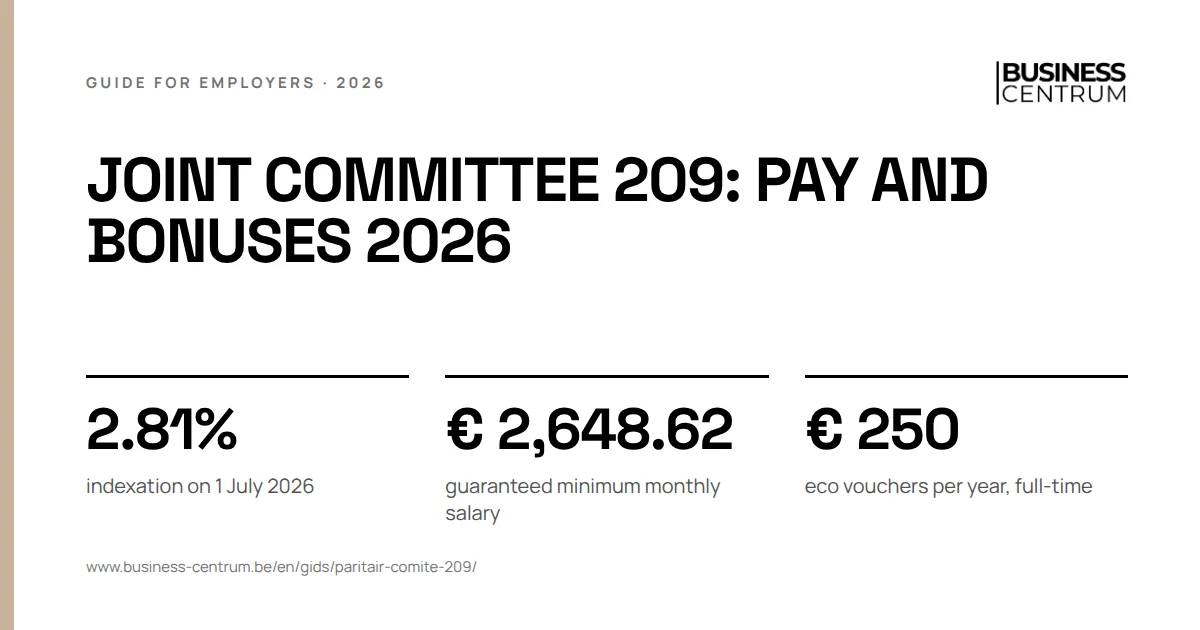
Joint committee 209 covers white-collar employees in metal, machine and electrical engineering. On 1 July 2026, their minimum and actual salaries rose by 2.81%. The guaranteed minimum monthly salary is now € 2,648.62 gross for a full-time employee. The sector sets the year-end bonus by province, and the differences are large.
Who falls under joint committee 209?
JC 209 covers the employees of companies that manufacture, process, machine or assemble parts in metal, plastic or composite materials, where this requires techniques specific to metal, machine and electrical engineering. The design offices of those companies are included. Think of machine builders, fabrication workshops, sheet metal shops, boilermakers, shipyards, makers of farm machinery, electronics and measuring instruments, galvanisers and companies that maintain and repair the sector's machines.
The committee follows the same activities as JC 111, but for staff who mainly do intellectual work. The boundaries:
| Situation | Committee |
|---|---|
| Employees of a machine builder or fabrication workshop | JC 209 |
| Blue-collar workers of the same company | JC 111 |
| Employees of a garage | JC 200 |
| Employees of an electrical installer that does not make its own equipment | JC 200 |
| Employees of a steel producer | JC 210 |
A metal company therefore almost always works with two committees: JC 111 for the workers on the shop floor and JC 209 for the employees in the office, the design department and workshop management. Both index on the same day: JC 111 also rose by 2.81% on 1 July. The pay system differs. Workers have hourly wages per class, employees monthly salaries per step.
Most sector agreements apply to "scaled and scalable" employees: those whose job fits in the pay scales. Managers also fall under JC 209, but the pay scales and part of the bonuses do not apply to them. The sector pension does apply to managers.
Which pay scales apply in joint committee 209?
JC 209 has one national minimum pay scale, per occupational group and per step. The provinces do not have their own minimum wages: the database of the Federal Public Service Employment states that the provincial minimum wages are the national ones. The amounts apply to a full-time employee with an average working week of 38 hours.
| Step | Administrative employees | Technical employees | Draughtsmen | Foremen | Boilermaking markers |
|---|---|---|---|---|---|
| 1 | € 2,648.62 | € 2,648.62 | € 2,648.62 | € 2,650.16 | € 2,948.60 |
| 2 | € 2,648.62 | € 2,648.62 | € 2,648.62 | € 3,119.14 | € 3,097.98 |
| 3 | € 2,756.34 | € 2,648.62 | € 2,948.60 | € 3,375.25 | |
| 4 | € 2,948.60 | € 2,648.62 | € 3,119.14 | ||
| 5 | € 2,756.34 | € 3,502.97 | |||
| 6 | € 2,778.26 | ||||
| 7 | € 2,948.60 |
The step follows the job. The sector's job descriptions link each step to autonomy and professional experience. An administrative employee in step 1 works to fixed rules and needs no experience. Step 2 requires 2 years of professional experience, step 3 4 years and initiative, step 4 6 years and dividing work among colleagues. A technical employee in step 7 has 6 years of experience, a draughtsman in step 5 9 years. Foremen have at least 9.
Guaranteed minimum monthly salary. No full-time employee aged 18 or over earns less than € 2,648.62. That amount is also the floor of the pay scale: in the first steps of most groups, the two coincide.
Students. Since 1 January 2024, a minor on a student contract receives a percentage of the salary you pay in your company for the same job: 80% under 16.5, 85% from 16.5, 90% from 17, 95% from 17.5 and 100% from 18. A 17-year-old student in a job for which you pay € 2,648.62 therefore receives 2,383.76 euros gross per month full-time.
Job classification. Since 31 March 2014, the sector has its own job classification with 9 classes. The minimum pay scale is not yet linked to it. The agreement on minimum wages stays in force until the sector concludes a new scale based on those classes. Many companies already use the classification for their own pay policy, but for the legal minimum, the step still counts.
Indexation in joint committee 209 in 2026
JC 209 indexes once a year, on 1 July. The sector compares the four-month average of the index in June with that of June a year earlier. Both minimum and actual salaries go up. If you pay above the scale, you index that higher salary as well.
| Indexation on 1 July | Percentage |
|---|---|
| 2026 | 2.81% |
| 2025 | 2.72% |
| 2024 | 3.34% |
| 2023 | 6.05% |
| 2022 | 8.14% |
On 1 January 2025, the guaranteed minimum monthly salary also rose by € 85, the last step of the 2023-2024 sector agreement. The wage norm for 2025 and 2026 is 0%, which leaves no room for a collective pay rise on top of indexation. The next indexation falls on 1 July 2027.
Worked example. A technical employee earned 3,000 euros gross in June. From July he receives 3,000 x 1.0281 = 3,084.30 euros.
The cent index. Since 1 June 2026, for a full-time reference salary above € 4,000 a month, the first 2% of indexation is calculated only on € 4,000. An engineer on 4,500 euros a month received 4,000 x 2% plus 4,500 x 0.81% in July, 116.45 euros in total instead of 126.45 euros. While the moderation period runs, you pay a special wage moderation contribution to the NSSO. The full calculation is in our article on the cent index.
Year-end bonus in joint committee 209 by province
JC 209 has no national year-end bonus. Each province or region has its own agreement, and you apply the one of the province where your company is located. The reference period runs everywhere from 1 December to 30 November.
| Province or region | Year-end bonus | Condition |
|---|---|---|
| East and West Flanders (excluding the Waasland) | thirteenth month: the gross monthly salary of July | 60 days actually worked, employed on 30 November |
| Waasland | thirteenth month: the basic salary of 30 November plus any production bonus | 60 working days actually worked |
| Antwerp and Limburg | thirteenth month: the basic salary of 1 December (Antwerp) or 1 November (Limburg) | 6 months of seniority on 30 November and 60 days worked |
| Flemish Brabant, Walloon Brabant and Brussels | 8.33% of the annual gross salary | 1 year of service at the end of the reference period |
| Hainaut, Namur, Liège and Luxembourg | at least 2.36% of gross pay in the reference period | none, but not due if you already grant an equivalent benefit |
East and West Flanders in detail. The bonus is the individual gross monthly salary of July, without supplements. Anyone who joins or leaves during the reference period receives one twelfth per month worked, except in case of dismissal for serious misconduct. Assimilated are workplace accidents, short leave, public holidays, annual leave and sickness: the first two periods with guaranteed monthly pay, together at most 6 months. For each day that is not assimilated, one 261st of the bonus is deducted. You pay by the end of January of the following year at the latest.
Worked example. An administrative employee in Ghent earns 3,100 euros gross in July and works the whole year. She was absent without justification on two days. Her bonus is 3,100 minus 2 x 3,100 / 261, or 3,076.25 euros gross. The same employee in Brussels would get 8.33% of 12 x 3,100, or 3,098.76 euros. In Charleroi, the minimum is 2.36% of 37,200 euros, or 877.92 euros.
Conversion. In the provinces where the bonus is at least one full monthly salary, so all Flemish provinces and Brabant with Brussels, you may convert up to 50% of the bonus into days off or a bike lease. This requires a company agreement, the individual consent of the employee and prior information about the consequences. The conversion must be cost-neutral: you count all employer costs of the bonus, including NSSO contributions, the subsistence security fund and the sector pension. How to calculate the bonus itself and the withholding tax on it is explained in calculating the year-end bonus.
Eco vouchers in joint committee 209
A full-time employee who worked the whole reference period receives € 250 a year in eco vouchers. The reference period runs from 1 October to 30 September and you pay the vouchers every year in October. Part-time employees receive a share based on their working time, those who joined or left during the period a proportional share.
All days worked and assimilated count, including workplace accidents, birth leave and sickness up to 3 months beyond guaranteed pay.
Worked example. An employee works 4/5 and started on 1 April. For the period up to 30 September she receives 250 x 4/5 x 6/12, or 100 euros in eco vouchers.
Eco vouchers have not been abolished in JC 209. The sector agreement runs for an indefinite period. The overview of the Federal Public Service Employment states that an alternative is possible, but the sector does not impose a specific benefit. If you want to convert, arrange it at company level and in writing. The position in other sectors is in eco vouchers abolished in 2026?.
Seniority leave in joint committee 209: career leave
The sector has no seniority leave per year of service, but career leave by age. An employee with at least 6 months of seniority in your company receives each year:
- one day from age 50;
- two days from age 58;
- three days from age 60.
The right starts in the month in which the employee reaches that age. If your company already granted extra leave days or seniority days, career leave comes on top. You may use the same rules for requesting and taking leave as for those existing days.
Commuting costs: bike, car and public transport
The sector agreement on commuting goes further than the national rules:
- Public transport: you pay the contribution of national collective agreement no. 19/9, increased by 12.50%.
- Bike: € 0.27 per kilometre, up to € 10.80 per working day. Up to € 0.37 per kilometre, a cycling allowance is free of NSSO contributions and tax.
- Car or other transport: € 0.08 per kilometre, up to € 9.20 per day. The minimum is € 1.69 per day up to 20 km there and back, and € 2.03 above that.
The bike and car allowances only apply to employees with a gross monthly salary of up to € 6,500. There is no salary ceiling for public transport. You count the shortest route for the means of transport, there and back, rounded to the kilometre.
Worked example. An employee lives 10 km from work. By car she drives 20 km a day: 20 x 0.084 = 1.68 euros. That is below the minimum, so you pay € 1.69 per day. If she cycles, she receives 20 x 0.27 = 5.40 euros a day. The tax limits are covered in the cycling allowance for employers.
Job security, sector pension and other rules in joint committee 209
Multiple dismissal. If within 60 calendar days you dismiss at least 10% of your average number of employees, or at least 3 in a company with fewer than 30 employees, you must first follow the sector's consultation procedure. You inform the works council or the union delegation in advance. If you have neither, you inform the employees concerned and the chair of the regional conciliation office in writing and at the same time. If you skip this step, you pay each dismissed employee, on top of normal notice, compensation of 50% of the pay for a notice period, calculated on seniority built up since 1 January 2014.
Sector pension. If you are not exempted and have no opting-out, you pay a pension premium of 2.29% of the reference salary, plus 0.10% for the solidarity part.
Meal vouchers. JC 209 has no sector meal vouchers. If you give them anyway, the national rules apply: at most € 10 per voucher, of which at most € 8.91 is the employer's share.
Flexi-jobs. Since 1 July 2026, flexi-jobs have in principle been open to almost every sector, and JC 209 is not on the list of exceptions. You pay a special contribution of 28% and 7.67% flexi holiday pay. The flexi wage is at least the scale for the job.
Five mistakes employers make in joint committee 209
- Indexing at the wrong time. JC 209 indexes in July, not in January like JC 200.
- Using the year-end bonus of the wrong province. A company with sites in Ghent and Charleroi has two schemes: a thirteenth month and a minimum of 2.36%.
- Deducting career leave from existing leave days. That is not allowed: it comes on top.
- Forgetting eco vouchers on departure or for part-timers. The reference period runs until 30 September, and leavers are entitled to a share.
- Three dismissals in a small company without consultation. Below 30 employees, that is already a multiple dismissal, with compensation if you skip the procedure.
Business Centrum processes the pay of JC 209 employees and JC 111 workers for metal companies in East Flanders in a single payroll administration, together with Acerta. We place your employees in the right step, apply the July indexation and calculate the year-end bonus under the agreement of your province.